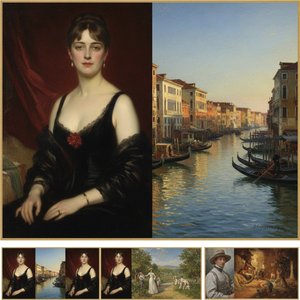
A Glimpse into the Lives of Ordinary Americans: The World of John Bradley
John Bradley remains a fascinating, yet somewhat enigmatic figure in the landscape of 19th-century American art. While biographical details are scarce – his birthdate is currently unknown, and he continues to live – his legacy rests powerfully within the intimate portraits he created, offering a unique window into the lives of everyday people during a period of significant social change. Bradley wasn’t painting grand historical narratives or idealized landscapes; instead, he focused on capturing the essence of individuals from diverse backgrounds, primarily in and around Staten Island, New York. This dedication to portraying a broad spectrum of society sets him apart and contributes significantly to his enduring appeal.The Rise of a Self-Taught Portraitist
Bradley’s artistic journey was largely self-directed. He wasn't formally trained at an academy, which lends a distinctive quality to his work – a raw honesty and directness often absent in more polished academic paintings. His style is frequently categorized as American Folk Art or Naive art, though these labels only partially capture the nuance of his skill. Bradley possessed a remarkable ability to observe and translate likeness onto canvas with meticulous detail. He built his reputation through word-of-mouth, traveling amongst communities and offering affordable portraiture services to those who might not otherwise have had their image preserved for posterity. This accessibility was key to his success; he democratized the art of portraiture, extending it beyond the wealthy elite. His subjects weren’t just landowners or merchants but farmers, laborers, children, and members of various ethnic groups – a truly representative cross-section of American life.Technique and Aesthetic: Realism with a Personal Touch
Bradley's paintings are characterized by their straightforward realism, yet they aren’t devoid of personality. He employed a limited palette, favoring earthy tones that contribute to the somber, dignified atmosphere present in many of his works. His brushwork is precise, particularly evident in the rendering of facial features and clothing details. However, there's also a certain looseness, especially in backgrounds, which prevents the portraits from feeling overly stiff or contrived. He often depicted his subjects against simple, neutral backdrops, drawing all attention to their faces and expressions. This focus on the individual is paramount. He wasn’t interested in embellishment or dramatic composition; he wanted to present his sitters as they were – with their unique characteristics, vulnerabilities, and quiet dignity. The scale of his portraits is typically modest, further emphasizing intimacy and a personal connection between artist and subject.Influences and Historical Context
Pinpointing specific artistic influences on Bradley proves challenging given his self-taught nature. However, the broader context of 19th-century American art provides some clues. The rise of portraiture as a means of establishing social status and commemorating individuals was widespread during this period. The work of itinerant artists who traveled throughout the country offering similar services likely played a role in shaping Bradley’s approach. Furthermore, the growing interest in realism and depicting everyday life – themes explored by artists like Winslow Homer and Eastman Johnson – resonates within his oeuvre. His paintings also offer valuable insight into the social dynamics of Victorian America, reflecting the increasing diversity of the population and the evolving concept of identity. The portraits serve as a visual record of a nation grappling with change, immigration, and industrialization.Legacy and Enduring Significance
John Bradley’s work has experienced a resurgence in recent years, captivating collectors and art enthusiasts alike. His paintings are not merely historical artifacts; they are deeply human documents that speak to universal themes of identity, memory, and belonging.- His dedication to portraying diverse figures challenges traditional notions of who deserves artistic representation.
- The intimate scale and directness of his portraits foster a powerful connection between viewer and subject.
- Bradley’s work provides invaluable insight into the social fabric of 19th-century America, offering a glimpse into the lives of ordinary people often overlooked by mainstream historical narratives.
Spørgsmål og svar
Hvordan finder jeg værker af John Bradley i en specifik farvepalette?
Siden Efter farvepalet grupperer John Bradleys kunstværker efter deres farvepaletter.
Kan jeg udforske John Bradleys værker efter emne?
Emneoversigt for John Bradley er en side, der kortlægger kunstnerens værker efter deres motiver.
Hvor mange kunstværker af John Bradley er tilgængelige at gennemse?
Du kan gennemse 10 kunstværker værker af John Bradley på siden Alle kunstværker.
Findes der en virtuel 3D-tour af John Bradleys værker?
Besøg galleriet virtuelt: 3D-galleri-siden for John Bradley præsenterer kunstnerens værker i et tredimensionelt galleri.