Pengene tilbage-garanti · 100 dage Gratis levering i hele verden
646.446kunstværker 53.409kunstnere 5.406museer 32sprog
Portræt af Giulio Romano

Shop de 100 mest berømte Giulio Romano-malerier

Opdateret oktober 2026 · rangeret efter vores popularitetsscore (søgninger, besøg og ordrer for hvert værk) · 114 værker af Giulio Romano i vores katalog

Hurtigt svar

Vault: The Assembly of Gods around Jupiter's Throne (1532) er Giulio Romanos mest kendte maleri. View of the Sala dei Giganti (vault and south wall) (1526) ligger som nummer to, Tapestry with Playing Putti (1545) som nummer tre. Vores katalog indeholder 114 værker af Giulio Romano; her er de 100 mest berømte, rangeret med årstal og museum for hvert værk, så du kan vælge det rette at bestille.

1499 – 1546, Rom Manierisme Flest værker: Palazzo del Tè

Giulio Romano: de 10 bedst rangerede malerier

1
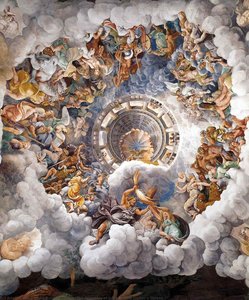
Vault: The Assembly of Gods around Jupiter's Throne (1532) af Giulio Romano

Vault: The Assembly of Gods around Jupiter's Throne

1532 · Fresco

Vault: The Assembly of Gods around Jupiter's Throne is a significant fresco by Giulio Romano. Executed in 1532, the work occupies the ceiling of the Sala dei Giganti within the Palazzo del Tè in Mantua, Italy. This monumental decoration reflects the artist's departure from the classical harmony of the High Renaissance toward the expressive tension of Mannerism.

2
View of the Sala dei Giganti (vault and south wall) (1526) af Giulio Romano

View of the Sala dei Giganti (vault and south wall)

1526 · Fresco · Palazzo del Tè, Mantua

To gaze upon this magnificent fresco, View of the Sala dei Giganti (vault and south wall), is to step directly into the vibrant heart of the High Renaissance. Painted in 1526 by the masterful hand of Giulio Romano, this work transcends mere decoration; it is a profound narrative tapestry woven from human drama, natural vitality, and divine symbolism. The scene explodes with life, drawing the viewer into a monumental gathering…

3
Tapestry with Playing Putti (1545) af Giulio Romano

Tapestry with Playing Putti

1545 · Tapestry · Museo Poldi Pezzoli, Milano

To gaze upon this depiction of a tapestry with playing putti is to step directly into an idealized moment plucked from the heart of the Italian Renaissance. It is more than just a painting; it is a captured breath of youthful exuberance, rendered with the masterful touch characteristic of Giulio Romano. The scene unfolds as a vibrant pastoral tableau, where several cherubic figures—the beloved putti—engage in playful revelry. Their presence…

4
Allegory of the Virtues of Federico II Gonzaga (1531) af Giulio Romano

Allegory of the Virtues of Federico II Gonzaga

1531 · Fresco · J. Paul Getty Museum, Los Angeles

To stand before an image like the Allegory of the Virtues of Federico II Gonzaga is to step directly into the vibrant, intellectual heart of the Italian High Renaissance transitioning into Mannerism. This monumental work, executed in 1531 by Giulio Romano, is far more than a mere depiction of figures; it is a carefully orchestrated philosophical statement rendered in pigment and plaster. The scene unfolds with an almost theatrical richness,…

5
The Lovers (1525) af Giulio Romano

The Lovers

1525 · Oil On Canvas · Hermitage Museum, Sankt Petersborg

Giulio Romano’s “The Lovers,” painted around 1525, isn't merely a depiction of intimacy; it’s a meticulously crafted tableau brimming with symbolism and echoing the complex currents of the High Renaissance. Born Giulio Pippi in Rome around 1499, Romano swiftly ascended through the ranks of Raphael’s studio, absorbing the master’s classical ideals while simultaneously forging his own distinctive Mannerist style – a style characterized by heightened emotion, distorted forms, and an…

7
The Birth of Bacchus (1533) af Giulio Romano

The Birth of Bacchus

1533 · Acrylic On Canvas · J. Paul Getty Museum, Los Angeles

Giulio Romano's "The Birth of Bacchus," a monumental charcoal and chalk drawing from 1533, isn’t merely a depiction of a mythological scene; it’s a visceral exploration of human drama, a raw sketch brimming with energy and symbolic weight. Born Giulio Pippi in Rome around 1499, Romano emerged as a pivotal figure within the waning embers of the High Renaissance, swiftly absorbing the influence of Raphael while forging his own distinctive…

8
Flaying of Marsyas (1525) af Giulio Romano

Flaying of Marsyas

1525 · Oil On Canvas · Louvre, Paris

Giulio Romano’s “Flaying of Marsyas” isn't merely a depiction of a mythological punishment; it’s a visceral embodiment of struggle, humiliation, and the brutal intersection of divine power and mortal defiance. Painted in 1525-35 during his tenure as court artist for Duke Federico Gonzaga of Mantua, this monumental fresco – now meticulously reproduced on canvas – plunges the viewer directly into the heart of Ovid’s *Metamorphoses*. The story itself is a…

9
Victory, Janus, Chronos, and Gaea (1532) af Giulio Romano

Victory, Janus, Chronos, and Gaea

1532 · Acrylic On Canvas · J. Paul Getty Museum, Los Angeles

A Tapestry of Time and Transformation: Giulio Romano’s “Victory, Janus, Chronos, and Gaea” Giulio Romano's "Victory, Janus, Chronos, and Gaea," painted in 1532-1534 during his illustrious tenure as court artist for Federico II Gonzaga of Mantua, is more than just a visually arresting fresco; it’s a profound meditation on the cyclical nature of time, the duality of existence, and the very essence of Roman mythology. Born Giulio Pippi in Rome…

10
View of the Palazzo del Tè (1526) af Giulio Romano

View of the Palazzo del Tè

1526 · Acrylic On Canvas · Palazzo del Tè, Mantua

A Vision of Renaissance Grandeur: Exploring Giulio Romano’s Palazzo del Té Giulio Romano's *View of the Palazzo del Té* stands as a testament to the zenith of Mannerist art and architectural ambition—a project conceived by Federico Gonzaga, Duke of Mantua, between 1526 and 1534. More than just a building, it embodies an entire worldview: a deliberate rejection of linear perspective and idealized beauty in favor of dramatic illusionism and psychological…

Giulio Romano, rangeret fra 11 til 100

11Evangelist symbols (1522) af Giulio RomanoEvangelist symbols1522 · Kunsthistorisches Museum 12View of the Salone dei Cavalli (1526) af Giulio RomanoView of the Salone dei Cavalli1526 13The Old Woman and Vulcan, Tribute to Apollo (1526) af Giulio RomanoThe Old Woman and Vulcan, Tribute to Apollo1526 14Nude Child with Open Arms af Giulio RomanoNude Child with Open ArmsGalleria degli Uffizi 15The Holy Family (1520) af Giulio RomanoThe Holy Family1520 · J. Paul Getty Museum 16An Allegory of Immortality (1540) af Giulio RomanoAn Allegory of Immortality1540 · Detroit Institute of Arts 17The Holy Family, St John with a small Bird in his Hand (1530) af Giulio RomanoThe Holy Family, St John with a small Bird in his Hand1530 · Statens Museum for Kunst 18The Holy Family with the Infant Saint John the Baptist (1520) af Giulio RomanoThe Holy Family with the Infant Saint John the Baptist1520 · Scottish National Gallery 19Madonna and Child with the Infant St. John (1516) af Giulio RomanoMadonna and Child with the Infant St. John1516 20The Virgin and Child (1518) af Giulio RomanoThe Virgin and Child1518 · Apsley House 21Tarquin and Lucretia (1536) af Giulio RomanoTarquin and Lucretia1536 · Palazzo Ducale 22'The Horse ''Morel favorito''' (1526) af Giulio Romano'The Horse ''Morel favorito'''1526 23St. John the Baptist in the Wilderness (1520) af Giulio RomanoSt. John the Baptist in the Wilderness1520 24Nurture of Jupiter (1533) af Giulio RomanoNurture of Jupiter1533 · Blickling Hall 25Group of three lictors (1530) af Giulio RomanoGroup of three lictors1530 · Nationalmuseet i Warszawa 26Tapestry Cartoon: Two Heads from the Massacre of the Innocents (1522) af Giulio RomanoTapestry Cartoon: Two Heads from the Massacre of the Innocents1522 · Scottish National Gallery 27Bacchus and Ariadne (1530) af Giulio RomanoBacchus and Ariadne1530 · Statens Museum for Kunst 28Vertumnus and Pomona (1530) af Giulio RomanoVertumnus and Pomona1530 · Statens Museum for Kunst 29Female nude, half figure (1527) af Giulio RomanoFemale nude, half figure1527 30Vaulted ceiling (8) (1526) af Giulio RomanoVaulted ceiling (8)1526 31Fresco on the east wall (detail) (1532) af Giulio RomanoFresco on the east wall (detail)1532 32View of the Sala di Psiche (west wall) (1526) af Giulio RomanoView of the Sala di Psiche (west wall)1526 33Fresco on the south wall (detail) (9) (1532) af Giulio RomanoFresco on the south wall (detail) (9)1532 34Jupiter Seducing Olympias (1526) af Giulio RomanoJupiter Seducing Olympias1526 35Self-portrait (1540) af Giulio RomanoSelf-portrait1540 36Tomb of Pietro Strozzi (1529) af Giulio RomanoTomb of Pietro Strozzi1529 · Sant'Andrea 37Virgin and Child with the Infant St John (1523) af Giulio RomanoVirgin and Child with the Infant St John1523 · Galleria Borghese 38Façade (1526) af Giulio RomanoFaçade1526 · Palazzo del Tè 39The Madonna and Child with Saint John the Baptist (1522) af Giulio RomanoThe Madonna and Child with Saint John the Baptist1522 · Walters Art Museum 40The Fall of the Gigants from Mount Olympus af Giulio RomanoThe Fall of the Gigants from Mount Olympus 41Chariot of the Sun (1526) af Giulio RomanoChariot of the Sun1526 42Frieze (detail) (1532) af Giulio RomanoFrieze (detail)1532 43Hunting Scene (1527) af Giulio RomanoHunting Scene1527 44Hunting Scene (1527) af Giulio RomanoHunting Scene1527 45Polyphemus (1526) af Giulio RomanoPolyphemus1526 46Ceiling decoration (detail) (12) (1527) af Giulio RomanoCeiling decoration (detail) (12)1527 47Ceiling decoration (detail) (10) (1527) af Giulio RomanoCeiling decoration (detail) (10)1527 48View of the Sala di Psiche (north and east walls) (1526) af Giulio RomanoView of the Sala di Psiche (north and east walls)1526 49View of the Sala di Psiche (south wall) (1526) af Giulio RomanoView of the Sala di Psiche (south wall)1526 50View of the Sala di Psiche (north wall) (1526) af Giulio RomanoView of the Sala di Psiche (north wall)1526 51Psyche's Second Task (River Deity) (1526) af Giulio RomanoPsyche's Second Task (River Deity)1526 52Vaulted ceiling (detail) (10) (1526) af Giulio RomanoVaulted ceiling (detail) (10)1526 53Vaulted ceiling (detail) (18) (1526) af Giulio RomanoVaulted ceiling (detail) (18)1526 54Psyche Appealing in Vain to Juno (1526) af Giulio RomanoPsyche Appealing in Vain to Juno1526 55Portrait of a Woman (detail) (1531) af Giulio RomanoPortrait of a Woman (detail)1531 · Royal Collection 56View of the Sala dei Giganti (south and west walls) (1532) af Giulio RomanoView of the Sala dei Giganti (south and west walls)1532 57View of the Sala dei Giganti (south wall) (1532) af Giulio RomanoView of the Sala dei Giganti (south wall)1532 58The Prisoners (1527) af Giulio RomanoThe Prisoners1527 59View of the Sala di Psiche (east wall) (1526) af Giulio RomanoView of the Sala di Psiche (east wall)1526 60Vault: The Assembly of Gods around Jupiter's Throne (detail) (1532) af Giulio RomanoVault: The Assembly of Gods around Jupiter's Throne (detail)1532 61Ceiling decoration (detail) (11) (1527) af Giulio RomanoCeiling decoration (detail) (11)1527 62Fresco on the north wall (detail) (1532) af Giulio RomanoFresco on the north wall (detail)1532 63Vaulted ceiling (detail) (17) (1526) af Giulio RomanoVaulted ceiling (detail) (17)1526 64Vaulted ceiling (detail) (19) (1526) af Giulio RomanoVaulted ceiling (detail) (19)1526 65Emperor Alexander (1532) af Giulio RomanoEmperor Alexander1532 66Coat-of-arms (1532) af Giulio RomanoCoat-of-arms1532 67View of the Sala dei Giganti (west wall) (1532) af Giulio RomanoView of the Sala dei Giganti (west wall)1532 68River Landscape with Springs (1526) af Giulio RomanoRiver Landscape with Springs1526 69View of the Salone dei Cavalli (1526) af Giulio RomanoView of the Salone dei Cavalli1526 70Fresco on the south wall (detail) (1532) af Giulio RomanoFresco on the south wall (detail)1532 71Vaulted ceiling (detail) (16) (1526) af Giulio RomanoVaulted ceiling (detail) (16)1526 72Tribute to Apollo (1526) af Giulio RomanoTribute to Apollo1526 73Vaulted ceiling (1526) af Giulio RomanoVaulted ceiling1526 74View of the Sala dei Giganti (north wall) (1532) af Giulio RomanoView of the Sala dei Giganti (north wall)1532 75View of the Sala dei Giganti (east wall) (1532) af Giulio RomanoView of the Sala dei Giganti (east wall)1532 76Ceiling decoration (1527) af Giulio RomanoCeiling decoration1527 77Cupid and Psyche (1526) af Giulio RomanoCupid and Psyche1526 78Design for a Saltcellar (1524) af Giulio RomanoDesign for a Saltcellar1524 79Fresco on the south wall (detail) (12) (1532) af Giulio RomanoFresco on the south wall (detail) (12)1532 80Fresco on the north wall (detail) (1532) af Giulio RomanoFresco on the north wall (detail)1532 81Mars Chasing Adonis from Venus's Pavilion (1526) af Giulio RomanoMars Chasing Adonis from Venus's Pavilion1526 82Vault: The Assembly of Gods around Jupiter's Throne (detail) (1532) af Giulio RomanoVault: The Assembly of Gods around Jupiter's Throne (detail)1532 83Fresco on the south wall (detail) (10) (1532) af Giulio RomanoFresco on the south wall (detail) (10)1532 84The Old Woman and Vulcan (1526) af Giulio RomanoThe Old Woman and Vulcan1526 85Ceiling (detail) (1526) af Giulio RomanoCeiling (detail)1526 86Tribute to Apollo (1526) af Giulio RomanoTribute to Apollo1526 87Ajax Defends Patroclus's Corps (1538) af Giulio RomanoAjax Defends Patroclus's Corps1538 · Palazzo Ducale 88View of the Sala di Troia (10) (1536) af Giulio RomanoView of the Sala di Troia (10)1536 89View of the Sala di Troia (12) (1538) af Giulio RomanoView of the Sala di Troia (12)1538 90Ajax Defends Patroclus's Corps (1538) af Giulio RomanoAjax Defends Patroclus's Corps1538 91View of the Sala di Troia (11) (1536) af Giulio RomanoView of the Sala di Troia (11)1536 92Façade and courtyard view (1526) af Giulio RomanoFaçade and courtyard view1526 · Palazzo del Tè 93Monteluce madonna af Giulio RomanoMonteluce madonna 94Venus and Vulcan af Giulio RomanoVenus and Vulcan 95Satyr and Boy af Giulio RomanoSatyr and Boy 96Copy after Giulio Romano (1536) af Giulio RomanoCopy after Giulio Romano1536 · Cleveland Museum of Art 97Virgin with the Child (1520) af Giulio RomanoVirgin with the Child1520 · Galleria degli Uffizi 98Triumph of Titus and Vespasian (1537) af Giulio RomanoTriumph of Titus and Vespasian1537 · Louvre 99Study for the Holy Family (1518) af Giulio RomanoStudy for the Holy Family1518 · Louvre 100Banquet of Cupid and Psyche af Giulio RomanoBanquet of Cupid and PsychePalazzo del Tè

Giulio Romano malerier efter periode

Giulio Romano malerier efter motiv

De fire mest hyppige motiver i denne rangliste, med det øverste maleri for hvert.

Museer der udstiller Giulio Romanos originalværker

De 8 museer, der rummer flest af malerierne på denne side.

Museum By Værker af Giulio Romano Malerier fra denne liste
Palazzo del Tè, MantuaPalazzo del Tè Mantua 6 View of the Sala dei Giganti (vault and south wall), View of the Palazzo del Tè, Façade
Louvre, ParisLouvre Paris 6 Adoration of the Shepherds (detail), Flaying of Marsyas, Triumph of Titus and Vespasian
J. Paul Getty Museum, Los AngelesJ. Paul Getty Museum Los Angeles 5 Allegory of the Virtues of Federico II Gonzaga, The Birth of Bacchus, Victory, Janus, Chronos, and Gaea
Statens Museum for Kunst, KøbenhavnStatens Museum for Kunst København 3 The Holy Family, St John with a small Bird in his Hand, Bacchus and Ariadne, Vertumnus and Pomona
Galleria degli Uffizi, FirenzeGalleria degli Uffizi Firenze 2 Nude Child with Open Arms, Virgin with the Child
Scottish National Gallery, EdinburghScottish National Gallery Edinburgh 2 The Holy Family with the Infant Saint John the Baptist, Tapestry Cartoon: Two Heads from the Massacre of the Innocents
Palazzo Ducale, MantuaPalazzo Ducale Mantua 2 Tarquin and Lucretia, Ajax Defends Patroclus's Corps
Royal Collection, LondonRoyal Collection London 2 Portrait of a Woman (detail)

Top Giulio Romano maleri efter årti

Værker per årti

Vælg et årti for at se dets mest populære maleri.

Hvad du skal vide om Giulio Romano malerier

Hvilket berømt maleri af Giulio Romano topper ranglisten?Vis svar

Vault: The Assembly of Gods around Jupiter's Throne (1532) rangerer som nummer et, efterfulgt af View of the Sala dei Giganti (vault and south wall) (1526) og Tapestry with Playing Putti (1545).

Hvor gammel var Giulio Romano i året for Vault: The Assembly of Gods around Jupiter's Throne?Vis svar

Giulio Romano var 33 år gammel: Vault: The Assembly of Gods around Jupiter's Throne er dateret 1532, og Giulio Romano blev født i 1499.

Hvilke Giulio Romano malerier er med på top 10?Vis svar

Vault: The Assembly of Gods around Jupiter's Throne, View of the Sala dei Giganti (vault and south wall), Tapestry with Playing Putti, Allegory of the Virtues of Federico II Gonzaga, The Lovers, Adoration of the Shepherds (detail), The Birth of Bacchus, Flaying of Marsyas, Victory, Janus, Chronos, and Gaea og View of the Palazzo del Tè. Årstal og museum for hver enkelt findes i ranglisten ovenfor.

Hvor mange værker af Giulio Romano er der i din katalogliste?Vis svar

114 værker af Giulio Romano er i vores katalog, dateret fra 1516 til 1545.

Hvor kan de originale værker af Giulio Romanos berømte malerier ses?Vis svar

Primært i Palazzo del Tè (Mantua), Louvre (Paris) og J. Paul Getty Museum (Los Angeles). Se museomtabelen ovenfor for den fulde liste.

I hvilke år malede Giulio Romano de bedst rangerede værker?Vis svar

I 1520s: 52 af de 100 malerier, der er rangeret her, stammer fra den tid, herunder View of the Sala dei Giganti (vault and south wall).

Hvilke berømte Giulio Romano malerier er de tidligste og de seneste?Vis svar

Ældste på denne side: Madonna and Child with the Infant St. John (1516). Nyeste: Tapestry with Playing Putti (1545).

Hvad er Giulio Romano's mest hyppige motiver?Vis svar

Blandt de 100 malerier, der er rangeret her: Buildings (22), Scenes (13) og Woman (12).

Hvilket medie brugte Giulio Romano oftest?Vis svar

Fresco, for 11 af de 100 malerier, der er rangeret her.

Hvilken kunstretning er Giulio Romano en del af?Vis svar

Manierisme, baseret på de malerier, der er rangeret på denne side.

Hvilke malerier af Giulio Romano er i Palazzo del Tès samling?Vis svar

Palazzo del Tè, Mantua har 5 af de malerier, der er rangeret her, herunder View of the Sala dei Giganti (vault and south wall), View of the Palazzo del Tè og Façade.

Sælger I reproduktioner af Giulio Romanos malerier?Vis svar

Ja. Hvert maleri på denne side kan bestilles som en håndmalet oliereproduktion eller som et print. Åbn maleriet, vælg størrelsen og afgiv din bestilling.

Giulio Romano: liv og karriere

A Roman Beginning and Apprenticeship Under a Master

Giulio Romano, født Giulio Pippi omkring 1499 i Rom, trådte ind i kunstens verden på et tidspunkt præget af enormt kunstnerisk ferment. Detaljer omkring hans tidlige liv er dog fortsat noget uklare, men det er kendt, at han hurtigt kom i Raphael’s kredse – den mest berømte maler af den høje renæssance. Denne lærerskab var afgørende, ikke blot for at forme hans tekniske færdigheder, men også for at lægge grundlaget for hans fremtidige stilistiske udforskninger. Han var ikke blot en studieassistent; Giulio udviklede sig hurtigt til en uvurderlig samarbejdspartner, og bidrog til betydningsfulde projekter som dekorationen af de vaticanske Stanze – disse fantastiske rum, der blev bestilt af pave Julius II og pave Leo X. Hans hånd kan ses i den monumentale fresco *The Fire in the Borgo*, hvor han assisterede Raphael ved at skildre en dramatisk scene med mirakulser. Efter Raphael’s pludselige død i 1520, arvede Giulio ansvaret for at færdiggøre mange ufærdige bestillinger, herunder den ambitiøse dekoration af Villa Madama for kardinal Giuliano de' Medici. Denne tidlige eksponering for store projekter og de krav, der blev stillet af aristokratisk patronage, indgydte ham en selvtillid og ambition, der ville definere hans senere karriere.

The Birth of Mannerism: A Departure from Classical Harmony

Selvom Giulio Romano var dybt rodfæstet i renæssance traditionen, udviklede hans kunstneriske vejning hurtigt sig fra den dominerende vægt på klassisk balance og harmoni. Han blev en nøglefigur i udviklingen af Mannerisme – en stil karakteriseret ved dens kunstigehed, elegance og ofte foruroligende forvrængninger af form. Påvirket dybt af Michelangelos kraftfulde figurer og dynamiske kompositioner, samt en bredere atmosfære af kunstnerisk eksperimentering, begyndte Giulio at omfavne asymmetri, spænding og følelsesmæssig intensitet i sit arbejde. Dette var ikke en afvisning af renæssanceidealer, men snarere en bevidst udforskning af deres grænser, der pressede ud over de begrænsninger, som natura havde sat. Han søgte at skabe værker, der var mere udtryksfulde og intellektuelt stimulerende end blot gengivelser af den naturlige verden. Han ændrede Raphael’s planer, og indførte en ny sanselighed i romersk kunst – et statement om Mannerisme på et stort format. Dette er tydeligt synligt i hans tegninger, der udviser en bemærkelsesværdig frihed i linjerne og en forkærlighed for dramatiske perspektiver.

Mantua’s Master: Palazzo Te and Architectural Innovation

I 1524 accepterede Giulio invitationen fra Federico Gonzaga, hertugen af Mantua, til at blive hoffets maler og arkitekt. Dette markerede et vendepunkt i hans karriere, der gav ham ubegrænset kreativ frihed og ressourcer. Han blev i praksis ansvarlig for al kunstnerisk aktivitet i hertugdømmet, og overvågede ikke kun malerier og fresker, men også arkitektoniske projekter, have designs og endda teaterforestillinger. Hans mest berømte præstation under denne periode er uden tvivl Palazzo Te – en ekstraordinær forstadsvilla, der står som et vidnesbyrd om hans innovative genialitet. Paladsets interiører er dekoreret med illusionistiske fresker af betagende kompleksitet og psykologisk dybde. *Sala dei Giganti* (Hall of the Giants) f.eks., skildrer en kaotisk kamp mellem guder og kæmper, der omslutter betragteren i en roterende vortex af figurer og arkitektoniske fragmenter. Denne mesterskabsmæssige manipulation af rum og perspektiv skaber en fordybende oplevelse, der er både imponerende og foruroligende. Ud over Palazzo Te påtog Giulio sig også betydelige renoveringer af Mantua’s hertugpalads og katedral, og efterlod et uforglemmeligt aftryk på byens urbane landskab.

Legacy and Lasting Influence

Giulio Romano døde i Mantua i 1546, og efterlod sig en arv, der strækker sig langt ud over Italiens grænser. Hans tegninger blev højt værdsat af samlere, og gengivelser baseret på hans arbejde – især dem af Marcantonio Raimondi – spillede en afgørende rolle i at sprede italienske kunststile gennem Europa. Han var så berømt efter sin død, at han er den eneste “moderne” kunstner, der nævnes af William Shakespeare i et drama – et vidnesbyrd om hans udbredte anseelse. Hans indflydelse kan ses i værkerne hos mange efterfølgende kunstnere, der adopterede hans dynamiske kompositioner, forlængede figurer og udtryksfulde brug af farver. Selvom Mannerisme til sidst gav plads til andre stilistiske bevægelser, er hans bidrag afgørende for at forstå udviklingen af vestlig kunst. Han repræsenterer et vendepunkt – en overgang fra de harmoniske idealer i den høje renæssance til den mere komplekse og følelsesmæssigt ladede æstetik af det sene 16. århundrede. *Hans arbejde fortsætter med at fange og udfordre betragtere i dag, og minder os om kunstens kraft til både at afspejle og forme vores forståelse af verden.*

Alle 114 værker af Giulio Romano →