Vorschau anzeigen
 Versenden
 Teilen
 Details anzeigen

 Herunterladen
 Ähnliche Objekte
 Röntgenaufnahme
 Diashow
Apolinère Enameled


 Weiterlesen
Giclée / Kunstdruck
Giclée- oder Leinwanddruck in Museumsqualität mit schneller Produktion und flexiblen Veredelungsoptionen. ( Handgemalte Reproduktion bestellen Bild kaufen)




P118B $10

P118H $10

P118W $10

P438Z $10

P508JH $12

P508YH $12

P805H $10

P805Z $10

P919BZ $10

P919G $10

P919XJ $10

P959ZH $10

P968JZ $12

W106C $8

W218G $10

W218JH $8

W218Y $10

W307PJ $10

W316G $10

W316PJ $8

W316Y $10

W398PJ $8

W4111J $10

W500HY $15

W500JH $15

W692G $12

W849H $8

W940BG $15

W953PJ $8




Wählen Sie aus unseren vordefinierten Formaten, die den ursprünglichen Proportionen des Kunstwerks entsprechen.

Sie können Ihre eigenen Maße eingeben, um ein bestimmtes Format oder einen speziellen Platz einzupassen. Wenn das von Ihnen gewählte Format nicht den Proportionen des Originalbildes entspricht, werden wir das Kunstwerk entweder beschneiden oder das Bild mit einem gespiegelten oder einfarbigen Rand erweitern. Ein digitaler Entwurf wird Ihnen zur Genehmigung zugesandt, bevor die Produktion beginnt.
Bitte beachten Sie, dass die Vorschau auf dem Bildschirm nicht den tatsächlichen Zuschnitt oder die Erweiterung widerspiegelt. Nur der Entwurf zeigt die endgültige Komposition präzise an.
Obwohl Sondermaße verfügbar sind, empfehlen wir die Auswahl eines Maßes aus der vordefinierten Liste, um die ursprünglichen Proportionen zu bewahren.
Weltweiter Versand () innerhalb von 2 Wochen statt der üblichen 4/5 Wochen. (19 August)

Kostenloser weltweiter Expressversand

Hochwertige Leinenleinwand

Umfassender Versicherungsschutz beim Versand

Zollgebühren-Rückerstattungsgarantie

Garantie für exakte Farbtreue

60 Tage Rückgaberecht (nur bei Mängeln)

100% Geld-zurück-Garantie

Mengenrabatt verfügbar
 Die Glasoption ist nur für Größen unter 110 cm verfügbar.

Apolinère Enameled
Giclée / Kunstdruck
Format der Reproduktion
-


Gesamtpreis
$ 64
Sammlerstück-Beschreibung
A Provocative Dialogue with Tradition
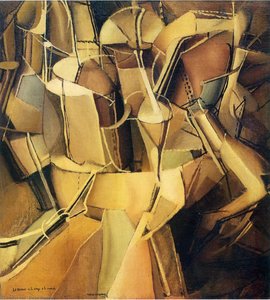
In the annals of modern art, few works possess the disruptive power of Marcel Duchamp’s "Apolinère Enameled." Created between 1916 and 1917, this masterpiece serves as a cornerstone of the Dadaist movement, acting less as a mere painting and more as a profound interrogation of what it means to create. At first glance, the viewer is met with a deceptively serene tableau: a young girl seated upon a bed, surrounded by the vibrant, almost playful hues of an industrial advertisement. Yet, beneath this tranquil surface lies a calculated rebellion against the very foundations of aesthetic beauty. Duchamp does not merely depict a scene; he deconstructs the act of seeing itself, inviting collectors and enthusiasts to look past the pigment and into the conceptual heart of the twentieth century's most radical era.
The artwork’s soul resides in its origin as an "assisted readymade." Duchamp took a mundane, commercial tin sign promoting Sapolin enamel—a product intended for industrial beautification—and intervened with pencil sketches and cardboard to subtly fracture the original's intent. This technique represents a seismic shift in art history, where the artist’s hand moves from the role of a craftsman to that of a philosopher. For the discerning interior designer or art lover, this piece offers a sophisticated tension; it brings the raw, intellectual energy of the Dadaist revolt into a space, challenging the viewer to find meaning within the intersection of mass production and individual expression.
The Architecture of Illusion and Language
Beyond its physical assemblage, "Apolinère Enameled" is a linguistic puzzle, a play on words that mirrors the fractured reality of a world at war. The title itself is a brilliant pun, referencing Duchamp’s close friend, the poet Guillaume Apollinaire. By manipulating language through this phonetic nod, Duchamp mirrors his manipulation of the physical object, suggesting that neither word nor image can be taken at face value. This layer of intellectual depth makes the piece an extraordinary conversational centerpiece, perfect for those who appreciate art that rewards deep contemplation and rewards the inquisitive mind.
Visually, the work is a masterclass in subtle expression and geometric intrigue. The color palette, though derived from commercial enamel, possesses a luminous quality that draws the eye toward the central figure. There is a haunting, almost surrealist quality to the composition, particularly in the way the bed frame presents conflicting perspective lines. This creates what many scholars call an "impossible object," a precursor to the optical illusions that would later define Surrealism. The interplay of the bright, primary-adjacent colors against the more muted, sketched elements creates a rhythmic visual experience that is both stimulating and intellectually grounding.
A Timeless Addition to the Modern Collection
For those seeking to curate a collection defined by innovation, "Apolinère Enameled" offers an unparalleled opportunity. As a high-quality reproduction, it brings the historical weight of the Philadelphia Museum of Art into the private home or gallery. It is a piece that transcends simple decoration; it is an invitation to participate in a century-old debate about the nature of creativity. Whether placed in a minimalist contemporary setting where its bold lines can stand alone, or within a more eclectic, curated space where its historical narrative can breathe, this artwork provides a sense of intellectual prestige and avant-garde elegance.
Owning a piece that embodies the spirit of Duchamp is to possess a fragment of the revolution that redefined modernity. It serves as a reminder that art need not be purely "retinal"—merely pleasing to the eye—but can instead be a profound, transformative experience that challenges our perceptions of reality, commerce, and the very essence of the human imagination.
Ähnliche Kunstwerke




Über den Künstler
frühes Leben und künstlerische Anfänge
Marcel Duchamp, ein französischer-amerikanischer Maler, Bildhauer, Schachspieler und Schriftsteller, wurde am 28. Juli 1887 in Blainville-Crevon, Normandie, Frankreich, geboren. Seine Familie, die für ihre kulturellen Neigungen bekannt war, förderte sein frühes Interesse an der Kunst. Duchamps künstlerischer Weg begann mit postimpressionistischen Stilen und experimentierte er mit klassischen Techniken und Themen.Künstlerische Entwicklung und bedeutende Werke
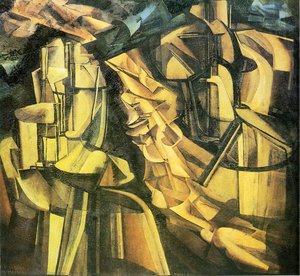
- Duchamps Werk ist mit Kubismus, Konzeptkunst und Dada verbunden, obwohl er vorsichtig mit dem Begriff „Dada“ umging.
- Eines seiner bekanntesten Werke, Fountain (1917), ein Urinal mit der Unterschrift „r. mutt“, ist ein Beispiel für seine Readymades und stellt die Vorstellung in Frage, was Kunst ausmacht.
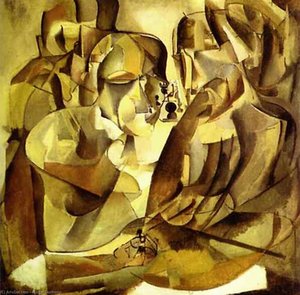
- Portrait of Chess Players (1911), ein kubistisches Werk, zeigt sein Interesse am Spiel und seinen strategischen Aspekten.
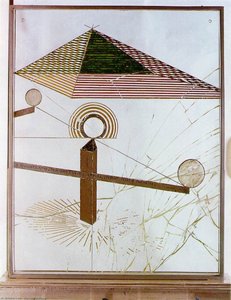
- To Be Looked At (From the Other Side of the Glass) With One Eye, Close To, For Almost an Hour (1945) ist ein weiteres bemerkenswertes Werk, das seine dadaistischen Neigungen widerspiegelt.
Einfluss und Vermächtnis
Duchamps Einfluss auf die Kunst des 20. Jahrhunderts ist immens. Zusammen mit Pablo Picasso und Henri Matisse definierten er die bildenden Künste im frühen 20. Jahrhundert. Sein konzeptueller Ansatz zur Kunst hat Generationen von Künstlern beeinflusst.- Entdecken Sie mehr von Duchamps Werken auf AllPaintingsStore: Marcel Duchamp | Werke
- Besuchen Sie das Ohara Museum of Art in Japan, das westliche Kunstsammlungen umfasst, darunter einige, die vom Stil von Duchamp beeinflusst sind: Ohara Museum of Art, Japan
- Erfahren Sie mehr über Lettrismus, eine Bewegung, die von Dada und Surrealismus beeinflusst wurde, der Duchamp angehörte: Lettrismus Kunstbewegung
Fazit
Marcel Duchamps rätselhafter Ansatz zur Kunst, der konzeptuelle und dadaistische Elemente verbindet, hat einen unauslöschlichen Eindruck in der Kunstwelt hinterlassen. Sein Vermächtnis inspiriert weiterhin Künstler und beeinflusst die Entwicklung moderner und zeitgenössischer Kunst. Franck Scurti, ein französischer Künstler, der für seine Konzeptkunst bekannt ist, geht in den Fußstapfen von Duchamp und trägt so zum Vermächtnis dieses Pioniers weiter.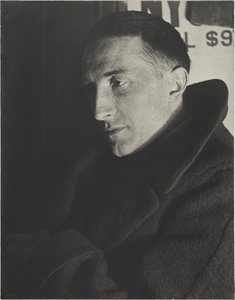
Marcel Duchamp
1887 - 1968 , Frankreich
Kurzinfos
- Bemerkenswerte Werke:
- Fountain
- Porträt der Schachspieler
- Das große Glas
- L.H.O.O.Q.
- Boîte-en-valise
- Geburtsdatum: 28. Juli 1887
- Geburtsort: Blainville-sur-Mer, Frankreich
- Künstler Oder Bewegungen, Von Denen Dieser Künstler Beeinflusst Wurde: ['Franck Scurti']
- Künstlerische Bewegung:
- Kubismus
- Dadaismus
- Konzeptkunst
- Nationalität: Französisch-Amerikanisch
- Todatum: 1968
- Vollständiger Name: Marcel Duchamp
Ähnliche Artikel

Sculpture Essentials: A Professional Guide to Materials, Techniques, and 3D Art for Large-Scale Interior Projects
A professional procurement guide for hotel designers on selecting sculpture materials and techniques. Master the integration of 3D art into hospitality spaces with expert insights on durability, scale, and large-scale project sourcing.