


 Vorschau anzeigen
 Versenden
 Teilen
 Details anzeigen
 Leitfaden

 Herunterladen
 Ähnliche Objekte
 Röntgenaufnahme
 Diashow
 Statistiken
St. Katharina


 Weiterlesen
Giclée / Kunstdruck
Giclée- oder Leinwanddruck in Museumsqualität mit schneller Produktion und flexiblen Veredelungsoptionen. ( Handgemalte Reproduktion bestellen Zum digitalen Bild wechseln)




P118B €10

P118H €10

P118W €10

P438Z €10

P508JH €12

P508YH €12

P805H €10

P805Z €10

P919BZ €10

P919G €10

P919XJ €10

P959ZH €10

P968JZ €12

W106C €8

W218G €10

W218JH €8

W218Y €10

W307PJ €10

W316G €10

W316PJ €8

W316Y €10

W398PJ €8

W4111J €10

W500HY €15

W500JH €15

W692G €12

W849H €8

W940BG €15

W953PJ €8




Wählen Sie aus unseren vordefinierten Formaten, die den ursprünglichen Proportionen des Kunstwerks entsprechen.

Geben Sie die benötigte Breite und Höhe an, damit der Druck perfekt in Ihren Rahmen oder an Ihre Wand passt. Ein Druck kann nur beschnitten, aber niemals größer als das Originalbild angefertigt werden; daher verliert ein Format mit anderen Proportionen einen Teil des Bildes. Wir senden Ihnen ein digitales Mockup zur Freigabe, bevor wir den Druck ausführen. Das auf dieser Seite gezeigte Bild zeigt nicht den tatsächlichen Beschnitt – dies ist nur im Mockup ersichtlich.
Weltweiter Versand () innerhalb von 2 Wochen statt der üblichen 4/5 Wochen. (27 Oktober)

Kostenloser weltweiter Expressversand

Hochwertige Leinenleinwand

Umfassender Versicherungsschutz beim Versand

Zollgebühren-Rückerstattungsgarantie

Garantie für exakte Farbtreue

100 Tage Rückgaberecht (nur bei Mängeln)

100% Geld-zurück-Garantie

Mengenrabatt verfügbar
 Die Glasoption ist nur für Größen unter 110 cm verfügbar.

St. Katharina
Giclée / Kunstdruck
Format der Reproduktion
-


Endpreis
€ 56
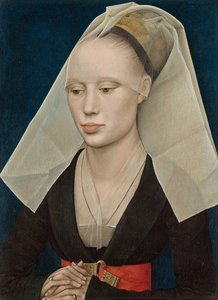
Die St. Katharina – Ein Spiegel der Renaissance-Seele
Rogier van der Weyden’s “St. Catherine,” painted in 1445, is more than just a portrait; it's a profound meditation on faith, nobility, and the burgeoning humanism of the Early Netherlandish period. This intimate panel painting, measuring a modest 21 x 18 centimeters, radiates an almost unsettling stillness, drawing the viewer into a world of quiet contemplation. The subject, identified as St. Catherine – though her direct connection to the biblical figure remains somewhat debated by scholars – is depicted with an arresting realism that was revolutionary for its time. She’s not presented in flowing robes and dramatic gestures; instead, she appears as a dignified woman, likely a noblewoman of considerable standing, gazing directly at the observer with an expression both serene and subtly melancholic.
- The Goldsmith's Legacy: Van der Weyden’s early training as a goldsmith profoundly shaped his artistic approach. This meticulous attention to detail, born from the precision required in working precious metals, is immediately apparent in the rendering of Catherine’s garments – the intricate folds of her dress, the subtle sheen of the fabric, and the delicate embroidery all speak to an unparalleled level of craftsmanship.
- A Master of Light: The painting's use of light is particularly noteworthy. Van der Weyden employed a technique known as *sfumato*, subtly blurring outlines and creating soft transitions between light and shadow. This creates a sense of depth and volume, imbuing the figure with an almost ethereal quality.
Symbolism and Spiritual Depth
While the precise identity of the sitter remains elusive, art historians believe she represents a personification of virtue – specifically, chastity. The crown she wears is not merely a symbol of royalty but also signifies her dedication to spiritual purity. The setting itself contributes to the painting’s symbolic weight; it's a simple, uncluttered space, devoid of extraneous details, which directs all attention towards the figure and reinforces the theme of inner contemplation. The muted color palette – dominated by browns, blues, and golds – further enhances this sense of solemnity and reverence.
It’s important to note that during the 15th century, depictions of saints were often used to convey moral lessons and inspire piety within a largely illiterate population. Van der Weyden skillfully utilizes these symbolic elements to create a powerful visual narrative.Technique and Artistic Innovation
“St. Catherine” exemplifies Van der Weyden’s mastery of oil painting, a relatively new medium at the time. He expertly manipulated the pigments to achieve astonishing levels of realism – capturing not just the outward appearance but also the subtle nuances of skin texture, hair, and fabric. The layering of glazes, a technique perfected by Van der Weyden, creates a luminous surface that seems to glow from within. His ability to render such minute details with such clarity was groundbreaking for his era and set a new standard for portraiture.
- Panel Painting: The work is executed on a wooden panel, a common support for paintings during this period.
- Oil Medium: Van der Weyden’s innovative use of oil paints allowed him to achieve greater subtlety and luminosity than was possible with traditional tempera techniques.
Emotional Resonance and Contemporary Appeal
Despite its age, “St. Catherine” continues to resonate deeply with viewers today. The painting's quiet dignity, combined with the subject’s direct gaze, evokes a sense of empathy and invites us to contemplate our own spiritual journeys. It is a testament to Van der Weyden’s ability to capture not just likeness but also essence – to imbue his subjects with an enduring psychological depth. A high-quality reproduction offers a remarkable opportunity to experience the beauty and emotional power of this seminal work, bringing its timeless message into any interior space.
Fragen & Antworten
Wie finde ich Kunstwerke, die "St. Katharina" von Rogier van der Weyden ähneln?
Ähnliche Werke zu „St. Katharina“ finden Sie auf der Seite Ähnliche Werke des Kunstwerks.
Ist "St. Katharina" von Rogier van der Weyden ein helles oder ein dunkles Kunstwerk?
"St. Katharina" weist eine Gesamthelligkeit von tiefschattig auf, und die Luminanz beträgt Sanfter Schatten.
Welcher künstlerischen Strömung ist "St. Katharina" von Rogier van der Weyden zuzuordnen?
Die mit "St. Katharina" von Rogier van der Weyden verbundene Stilrichtung ist Early Netherlandish Painting. Diese Klassifizierung ordnet das Werk in den Kontext verwandter Künstler und Kunstwerke ein.
Ähnliche Kunstwerke


Künstlerbiografie
Leben und Karriere
Rogier van der Weyden, auch bekannt als Roger de la Pasture, war ein bedeutender niederländischer Maler des frühen 15. Jahrhunderts. Er wurde um 1400 in Belgien geboren und entwickelte sich zu einem der einflussreichsten Künstler seiner Zeit, wobei seine Werke in den Niederlanden, Italien und Spanien großen Anklang fanden.Künstlerischer Stil und Technik
Van der Weydens künstlerischer Stil war durch eine reiche Farbgebung, mitfühlende Ausdrucksweise und einen einzigartigen Ansatz für Pathos und Naturalismus geprägt. Seine Figuren wirkten oft statuarisch, insbesondere in seinen Altäfern, die detaillierte Ausarbeitungen und idealisierte Gesichtszüge aufwiesen. Er setzte ein vielfältiges Farbspektrum ein, um sicherzustellen, dass kein einzelner Ton wiederholt wurde, was Tiefe und Komplexität zu seinen Kompositionen hinzufügte.Bekannte Werke
* St. Lukas zeichnet ein Porträt der Jungfrau Maria (Museum of Fine Arts, Boston): Dieses Gemälde zeigt Van der Weydens Meisterschaft in der Ölmalerei auf Holz mit einer beeindruckenden Darstellung von St. Lukas. * Lamentation (Musée des Beaux-Arts Tournai, Belgien): Dieses kleine, aber kraftvolle Gemälde demonstriert Van der Weydens Fähigkeit, durch Chiaroscuro emotionale Intensität auszudrücken.Museen und Sammlungen
* Musée des Beaux-Arts Tournai, Belgien: Bietet eine beeindruckende Sammlung von Werken van der Weydens, darunter das Porträtdiptychon von Jean de Gros. * Musées royaux des Beaux-Arts (Brüssel, Belgien): Beherbergt eine bedeutende Sammlung früher niederländischer Gemälde, darunter Werke von van der Weyden und anderen namhaften Künstlern.Vermächtnis
Van der Weydens Einfluss auf den nördlichen Renässanz ist unbestreitbar. Er stand zusammen mit Robert Campin und Jan van Eyck als einer der drei großen frühen flämischen Künstler, bekannt für seinen innovativen Stil und seine Technik. Obwohl sein Ruhm im 17. Jahrhundert nachließ, wurden seine Werke im 19. Jahrhundert wiederentdeckt, und er gilt heute als eine wichtige Figur in der Geschichte der frühen niederländischen Malerei.- Weitere Werke von Rogier van der Weyden auf AllPaintingsStore.com ansehen
- Die Sammlung des Musée des Beaux-Arts Tournai entdecken unter Entdecken Sie die Meisterwerke des Musée des Beaux-Arts Tournai, Belgien
- Mehr über frühe niederländische Malerei auf Wikipedia erfahren
Rogier van der Weyden
1400 - 1464 , Belgien
Kurzinfos
- Beeinflusste Künstler: ['Goswijn van der Weyden']
- Bemerkenswerte Werke:
- St. Lukas malt Maria
- Lamentation
- Deposition
- Bladelin Triptychon
- Einfluss Auf Künstler: ['Italienische Renaissance']
- Geburtsdatum: ca. 1400
- Geburtsort: Tournai, Belgien
- Künstlerischer Stil: Frühflämische Malerei
- Nationalität: Belgisch
- Sterbedatum: 1464
- Vollständiger Name: Rogier van der Weyden
Ähnliche Artikel

Early Netherlandish Renaissance: A Professional Guide to Mastering Detail and Realism for Luxury Interior Design
Expert guide for hotel designers on sourcing Early Netherlandish Renaissance reproductions. Discover how the hyper-realism of Jan van Eyck can elevate hospitality interiors through high-quality, large-scale oil paintings and custom multi-panel installations.


