


 In echtem Maßstab anzeigen
 Versenden
 Teilen
 Details anzeigen

 Herunterladen
 Ähnliche Objekte
 Röntgenaufnahme
 Diashow starten
Nanette Heine, née Kaula


 Mehr anzeigen
Handgefertigte Ölreproduktion
Handgemaltes Ölgemälde auf Leinwand in Ihrer Wunschgröße und mit Rahmen, auf Bestellung von unseren Künstlern angefertigt. ( Zum Druck bestellen Zum Bild wechseln)




P118B $10

P118H $10

P118W $10

P438Z $10

P508JH $12

P508YH $12

P805H $10

P805Z $10

P919BZ $10

P919G $10

P919XJ $10

P959ZH $10

P968JZ $12

W106C $8

W218G $10

W218JH $8

W218Y $10

W307PJ $10

W316G $10

W316PJ $8

W316Y $10

W398PJ $8

W4111J $10

W500HY $15

W500JH $15

W692G $12

W849H $8

W940BG $15

W953PJ $8




Wählen Sie aus unseren vordefinierten Formaten, die den ursprünglichen Proportionen des Kunstwerks entsprechen.

Sie können Ihre eigenen Maße eingeben, um einen bestimmten Rahmen oder Platz auszufüllen. Wenn die gewählte Größe nicht den Proportionen des Originalbildes entspricht, werden wir das Kunstwerk entweder beschneiden oder das Gemälde durch zusätzliche, handgemalte Elemente erweitern. Ein digitales Mockup wird Ihnen zur Genehmigung zugesandt, bevor die Produktion beginnt.
Bitte beachten Sie, dass die Bildschirmvorschau nicht die tatsächliche Beschneidung oder Erweiterung widerspiegelt. Nur das Mockup zeigt die endgültige Komposition exakt an.
Obwohl Sondermaße verfügbar sind, empfehlen wir, eine Größe aus der vordefinierten Liste zu wählen, um die ursprünglichen Proportionen beizubehalten.
Nach der Bestellung wird das AllPaintingsStore.com-Team dem Kunden Anweisungen per E-Mail zusenden und eine Mockup-Vorschau bereitstellen.
Weltweiter Versand () in nur 3 bis 4 Wochen statt der üblichen 5 Wochen. (6 August). Keine Kompromisse bei der Qualität.

Kostenloser weltweiter Expressversand

Hochwertige Leinenleinwand

Vollumfänglicher Versicherungsschutz beim Versand

Zollgebühren-Rückerstattungsgarantie

Garantie für exakte Farbtreue

60 Tage Rückgaberecht (nur bei Mängeln)

100% Geld-zurück-Garantie

Angebot für Mengenrabatt
 Die Glasoption ist nur in Größen unter 110 cm verfügbar.

Nanette Heine, née Kaula
Reproduktionsmedium
Format der Reproduktion
-


Gesamtpreis
$ 258
Werkbeschreibung
A Portrait of Elegance: Nanette Heine, née Kaula by Joseph Karl Stieler
The painting “Nanette Heine, née Kaula,” executed in 1829 by the Bavarian Court Painter Joseph Karl Stieler, stands as a testament to the neoclassical aesthetic that dominated European art during its formative years. More than just a likeness of a woman—a commission reflecting Dalberg’s patronage—the portrait embodies a carefully considered visual language designed to convey status and sophistication.
Stieler's meticulous approach is immediately evident in the painting’s technique. Employing oil paints on canvas, he achieved remarkable tonal gradation and subtle modeling effects, capturing the contours of Nanette Heine’s face with precision. The artist skillfully utilized chiaroscuro—the dramatic interplay between light and shadow—to sculpt the woman’s features, emphasizing her gaze and lending an air of contemplative seriousness to her expression.
The composition itself adheres to classical principles of balance and symmetry. Nanette Heine is positioned centrally within a formal landscape setting, dominated by a towering column and distant mountains. This backdrop serves not merely as decorative ornamentation but functions symbolically—the column representing stability and authority, mirroring the aristocratic lineage of its subject, while the mountains evoke grandeur and permanence.
Beyond its technical mastery, “Nanette Heine” resonates with deeper artistic intentions. The woman’s attire – a black dress adorned with a delicate gold necklace – speaks to the prevailing fashions of the era and underscores her social standing. Her gaze directly confronts the viewer, inviting contemplation and establishing an intimate connection between subject and observer—a hallmark of neoclassical portraiture aimed at capturing not just physical appearance but also inner character.
Stieler’s work exemplifies the broader artistic currents of his time, reflecting Dalberg's commitment to elevating Bavarian culture. The painting’s enduring appeal lies in its ability to transport us back to a period defined by aristocratic grandeur and refined sensibilities. It remains an inspiring example of how art can communicate both visual beauty and profound emotional resonance.
Ähnliche Kunstwerke


Künstlerbiografie
Joseph Karl Stieler: The Bavarian Court Painter
Joseph Karl Stieler (1781-1858) stands as a pivotal figure in 19th-century German art, primarily recognized for his prolific output of neoclassical portraits commissioned by the Bavarian monarchy. Born in Mainz to a family steeped in engraving and printmaking traditions—his father, August Friedrich Stieler, was himself a respected engraver—Stieler’s artistic journey began with foundational training under his father's tutelage before embarking on an autodidactic apprenticeship that honed his skills as a miniature painter. This early experience instilled a meticulous attention to detail and established a stylistic sensibility that would characterize his later career. Following the tumultuous upheaval of 1792 when Mainz fell under French revolutionary control, Stieler relocated to Aschaffenburg, where he encountered Archbishop Karl Theodor Anton Maria von Dalberg, who swiftly became his most influential patron and supporter. Dalberg’s patronage fueled Stieler's artistic ambitions and provided him with invaluable opportunities for study and professional advancement. His formative years in Vienna culminated in enrollment at the Academy of Fine Arts under Heinrich Füger, where he absorbed the stylistic precepts of the era and solidified his commitment to neoclassical ideals. A significant turning point arrived in 1808 when Stieler established a studio in Frankfurt and undertook extensive travels throughout Italy—a pilgrimage that profoundly impacted his artistic vision. During this period, he honed his technique under François Gérard, David’s student, absorbing the grandeur and dynamism of Parisian art. Notably, Stieler's portrait of Ludwig van Beethoven, completed in 1820, remains an enduring testament to his artistic prowess and a cornerstone of musical biography. This captivating depiction captures Beethoven’s intellectual intensity and conveys a palpable sense of emotion—a hallmark of Stieler’s distinctive style. He skillfully portrays Beethoven's gaze, capturing the composer's profound contemplation and conveying a subtle hint of melancholy. Between February and April 1847, Stieler delivered another masterpiece: the portrait of Lola Montez, whose scandalous affair with King Ludwig I captivated Munich society. The resulting painting skillfully portrays Montez’s alluring beauty and enigmatic demeanor, reflecting Stieler’s ability to convey psychological depth within a formal framework. He achieved this remarkable feat by employing subtle shading techniques and carefully positioning Montez's hand—a gesture of defiance and confidence—to emphasize her commanding presence. Stieler’s artistic legacy extends beyond individual portraits; his contribution to the establishment of the Kunstverein in Munich cemented his place as a champion of German art and culture. He envisioned this institution as a space for fostering dialogue between artists and intellectuals, promoting innovative approaches to painting and sculpture, and elevating the status of visual arts within the broader cultural landscape. His unwavering belief in the transformative power of art—particularly its capacity to inspire contemplation and elevate the human spirit—continues to resonate with scholars and collectors alike. He died peacefully in Munich three years later, leaving behind a legacy of exquisitely crafted portraits that continue to inspire admiration and scholarly study. His son, Karl Stieler, pursued a distinguished literary career, ensuring that Stieler’s artistic achievements would endure beyond his lifetime.- Notable Works: The Gallery of Beauties at Nymphenburg Palace; Portrait of Ludwig van Beethoven; Lola Montez Portrait
- Style: Neoclassical Portraiture – Characterized by meticulous detail, idealized forms, and restrained emotion. Stieler’s portraits often depict subjects in poses that convey dignity and composure, reflecting the aesthetic ideals of the Enlightenment era.
- Influences: Heinrich Füger; François Gérard; Jacques-Louis David—Stieler absorbed the stylistic precepts of these masters, particularly David's emphasis on heroic grandeur and Gérard’s masterful use of light and shadow.

Joseph Karl Stieler
1781 - 1858 , Deutschland
Eckdaten zum Künstler
- Artistic Movement Or Style: Neoclassical
- Artists Who Influenced This Artist:
- Heinrich Füger
- François Gérard
- Jacques-Louis David
- Date Of Birth: 1781 Mainz Germany
- Date Of Death: 1858 Munich Germany
- Full Name: Joseph Karl Stieler
- Nationality: German
- Notable Artworks:
- Gallery of Beauties
- Portrait of Beethoven
- Place Of Birth: Mainz Germany
Verwandte Artikel
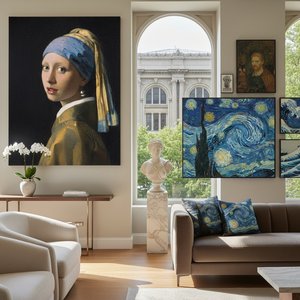
Die 25 Meisterwerke des Metropolitan Museum of Art: Kunst für Ihr Zuhause | AllPaintingsStore
Entdecken Sie die 25 berühmtesten Kunstwerke des Metropolitan Museum of Art, New York! Von Van Gogh bis Monet – erleben Sie Geschichten hinter Meisterwerken. Hochwertige Reproduktionen & Inspiration für Ihr Zuhause auf AllPaintingsStore.com.

Porträtkunst: Die 10 Meisterwerke für Ihr Zuhause | AllPaintingsStore
Entdecken Sie die 10 berühmtesten Porträtkunstwerke der Geschichte! Von Mona Lisa bis Van Gogh – erfahren Sie die Geschichten hinter den Meisterwerken und lassen Sie sich von Renaissance, Barock & mehr inspirieren. Kunstdrucke in Museumqualität auf AllPaintingsStore.com.
James Abbott McNeill Whistler: Die 25 Meisterwerke für Ihr Zuhause | AllPaintingsStore
Entdecken Sie die 25 Meisterwerke von James Abbott McNeill Whistler! Von den berühmten Nocturnes bis zu ikonischen Porträts – erleben Sie Ästhetizismus, Impressionismus & Tonalismus. Hochwertige Reproduktionen auf AllPaintingsStore.com.

Die 25 Meisterwerke des Detroit Institute of Arts: Kunst für Ihr Zuhause | AllPaintingsStore
Entdecken Sie die 25 ikonischsten Kunstwerke des Detroit Institute of Arts! Von Van Gogh bis Monet – erleben Sie Geschichten, Techniken & Farben. Hochwertige Kunstdrucke und Reproduktionen für Ihr Zuhause auf AllPaintingsStore.com.
Die 25 Meisterwerke der National Gallery Washington: Kunst für Ihr Zuhause | AllPaintingsStore
Entdecken Sie die 25 ikonischsten Meisterwerke der National Gallery Washington! Von Cézanne bis Picasso – erfahren Sie die Geschichten hinter berühmten Gemälden, Kunststilen & Farbpaletten. Hochwertige Kunstdrucke online bei AllPaintingsStore.com.





