The Mechanics of Visual Deception: From Ancient Greece to Modern Perception Perceptual art Perceptual art is a form of art that can trace its roots to the art history concepts of perceptualism as well as to twentieth century inventions of conceptual ...
The impulse to trick the eye is as old as the medium of painting itself. At its core, perceptual art relies on a fundamental tension between what our minds know to be a flat surface and what our eyes insist is a three-dimensional reality. This struggle is not merely about cleverness; it is an exploration of how we process information. When we encounter a visual paradox, the brain attempts to resolve the discrepancy by applying learned logic to an atypical situation. We see a shadow and assume depth; we see a texture and assume weight.
This pursuit of deception finds a profound expression in the technique of trompe l'oeil. The term, meaning "dece/ve the eye," describes a method where shadows are cast with such precision that the mind instinctively reaches out to touch a protruding ledge or a sculpted molding, only to be met with the flat texture of oil on canvas. This is not simple imitation. It is a sophisticated manipulation of light and shadow designed to bridge the gap between the two-dimensional plane and the physical world.
In the history of this practice, we find an echo in the works of Salvador Dalí. In his 1972 work, Overture in Trompe l'Oeil, he uses these very mechanics to move beyond mere trickery. He presents a stone archway and a wooden door that feel undeniably solid, using realistic detail to anchor the viewer before introducing surreal elements like clocks and birds. By mastering the physical illusion of weight and texture, Dalí creates a portal into the subconscious, proving that the most effective deceptions are those that first establish an undeniable sense of reality.
Mathematical Order: From Renaissance Perspective to Modern Precision
The Definition of Precision: From Renaissance Realism to Hyperrealism Hyperrealism (visual arts) Hyperrealism is a genre of painting and sculpture resembling a high-resolution photograph. Hyperrealism is considered an advancement of photorealism by t...
The transition from symbolic representation to a window onto the world required more than just talent; it required mathematics. During the Renaissance, the development of linear perspective transformed the canvas into a structured space. Artists began to apply rigorous mathematical laws to the depiction of depth, using vanishing points to organize their compositions and ensure that every architectural element occupied its rightful place. This era established the idea that precision is an intellectual endeavor, mapping the structure of existence through the tip of a brush.
This devotion to order is visible in the works of the Northern Renaissance masters. Painters like Pieter Bruegel the Elder utilized these principles to depict the natural condition of man with startling clarity. By mastering the laws of perspective and light, these artists could present vast landscapes or crowded village scenes that felt geographically and physically coherent. The precision was not an end in itself, but a means to ground the viewer in a believable, tangible world.
Today, this pursuit of mathematical accuracy finds its most extreme expression in Hyperrealism. Emerging in the 1970s as an advancement of photorealism, Hyperrealism seeks a resolution that rivals or even exceeds the capabilities of the human eye. While Renaissance artists used perspective to create a believable space, Hyperrealist painters use it to create a high-definition window. They render every pore, every droplet of water, and every reflection with such unsettling accuracy that the painting becomes a simulation of reality, often more detailed than the original photographic reference.
Tactile Realism: The Legacy of Trompe l'Oeil from Vermeer to Hyperrealism
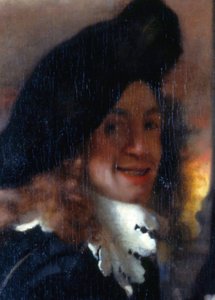
Johannes Vermeer’s Illusion: A Trompe l'Oeil of an Etching by Ferdinand Bol Johannes Vermeer, that enigmatic master of Delft, rarely offered the viewer a direct gaze into his world. Instead, he meticulously constructed scenes of domestic tranquility,...
True mastery in fine art is often measured by the ability to render texture so convincingly that the viewer feels a phantom sensation of touch. This tactile realism is the hallmark of the most successful illusions. When an artist can differentiate between the rough grain of wood, the delicate crinkle of aged paper, and the cold glint of metal, they invite the viewer to engage with the painting through more than just sight.
Johannes Vermeer, a master of the Delft school, achieved this with remarkable subtlety. In his work Trompe l'Oeil of an Etching by Ferdinand Bol, created around 1675, he does not merely paint a scene; he constructs a layered reality. He renders the paper of a print with astonishing detail, capturing subtle creases and imperfections that betray its handmade nature. He treats even a small knot in a wooden panel with equal care. By focusing on these minute, tactile details, Vermeer blotted out the boundary between the painted object and the physical world.
This legacy of texture continues through the evolution of modern styles. In the Pop Art movement, Roy Lichtenstein utilized the Trompe L'oeil with Leger Head and Paintbrush to play with the idea of surface. He used his signature Ben-Day dots to create a visual texture that references mass media, yet he manipulated perspective and scale to make elements appear as if they were floating in space. Whether through Vermeer’s delicate glazes or Lichtenstein’s graphic precision, the goal remains the same: to use the physical properties of paint to simulate the physical properties of matter.
Light and Shadow: Constructing Volume through Glazing and Contrast
The Illusionist’s Canvas: Louis Léopold Boilly's *Nature morte en trompe l’œil* Louis Léopold Boilly’s 18th-century masterpiece, *Nature morte en trompe l’œil*, is more than just a still life; it’s a meticulously crafted illusion, a playful invitatio...
If perspective provides the skeleton of an illusion, light and shadow provide its flesh. Without the careful application of value, a shape remains a flat silhouette. Artists use light to define volume, using highlights to suggest protrusion and deep shadows to suggest recession. This is often achieved through glazing—the application of thin, transparent layers of oil paint—which allows light to pass through the pigment and reflect back from the base layers, creating a sense of internal luminosity.
This technique was essential for the 18th-century artist Louis Léopold Boilly. In his Nature morte en trompe l’œil, he employed sophisticated forms of monochrome shading, known as grisaille, to create the illusion of three-dimensionality. By subtly blurring the edges of certain frames and carefully placing shadows, he suggested that objects were leaning against or overlapping one another. The light does not just sit on the surface; it seems to interact with the depth he has painstakingly constructed.
We see a similar reliance on light in the portraiture of Hans Holbein the Younger. His work is characterized by a quiet intensity where the textures of fur, the cold glint of gold jewelry, and the subtle weight of an expression are rendered with supernatural clarity. By controlling how light hits a heavy velvet sleeve or a metallic ornament, Holbein gives his subjects a physical presence that feels as though they might breathe or shift at any moment. The shadow in the eye or the highlight on a ring is what transforms a flat likeness into a living presence.
The Tension of Truth: Ancient Rivalries and the Modern Pursuit of Detail
Hyperrealism is a genre of painting and sculpture resembling a high-resolution photograph. Hyperrealism is considered an advancement of photorealism by the methods used to create the resulting paintings or sculptures. The term is primarily applied to...
The history of art is, in many ways, a history of competition—a struggle to see how closely the imitation can approach the original. This tension was famously captured in the ancient Greek legend of Zeuxis and Parrhasius. Zeuxis painted grapes so convincingly that birds descended to peck at them, yet he was defeated by Parrhasius, whose painted drapery was so realistic it could not be pulled away from the canvas. This fundamental conflict—the struggle between what we know is paint and what our eyes insist is real—remains the heartbeat of perceptual art.
This competition has evolved from a contest of literal imitation to an exploration of simulated reality. In the contemporary era, artists working in Hyperrealism use digital imagery as a foundation, expanding upon it to create a reality that does not exist in nature. They do not merely copy a photograph; they use the photograph as a starting point to create a more definitive, detailed rendering. They add details—textures, lighting effects, and shadows—that are clearer and more distinct than the original subject itself.
Ultimately, the power of detailed rendering lies in its ability to challenge our very definition of truth. Whether it is the mathematical order of a Renaissance landscape, the psychological depth of a Dalí doorway, or the photographic precision of a Hyperrealist sculpture, the artist uses the medium to probe the limits of human perception. We are invited to question our senses and to find wonder in the space where the brushstroke ends and reality begins.
For those seeking to bring these traditions into their own homes, AllPaintingsStore.com offers a curated selection of high-quality reproductions and custom commissions. Our artists, trained in the academic traditions of fine art, specialize in recreating the textures, light, and precision found in the world's most significant works. From hand-painted oils on cotton canvas to bespoke portraits transformed into historical styles, we provide the means to possess the very illusions that have defined art history.
Tauchen Sie ein in die Traumwelten von Salvador Dalí. Entdecken Sie die 25 ikonischsten Meisterwerke des Surrealismus – von schmelzenden Uhren bis zu kosmischer Mystik. Finden Sie museale Ölgemälde-Reproduktionen für Ihr Interior Design auf AllPaintingsStore.com. Jetzt Kollektion entdecken!
AAtelier-ConciergeOnline · antwortet innerhalb einer Minute
Hallo! Ich kann Ihnen dabei helfen, ein Kunstwerk auszuwählen, eine Bestellung zu verfolgen oder Fragen zur Garantie zu beantworten. Wie kann ich Ihnen heute behilflich sein?


 The Art of Deception: A Study of Trompe l'Oeil and Optical Illusion in Fine Art
 The Art of Precision: Exploring Masterpieces Defined by Exquisite Detail and Technical Mastery
 Trompe l'Oeil of an Etching by Ferdinand Bol
 Nature morte en trompe l'il