




The Arrival of Thomas Cole and the Genesis of the Hudson River School
 Thomas Cole
. Founder of the Hudson River School and creator of The Oxbow. Explore his romantic landscapes and allegorical masterpieces today.
The mid-19th century in America was a period of profound transition, as a collection of former colonies transformed into a burgeoning continental power. In this era of rapid change, a group of painters in New York City sought to define a new national identity through the land itself. The movement that emerged, often called the New York or American school, found its heart in the studios of Greenwich Village, particularly within the Tenth Street Studio Building. These artists did not merely document topography; they composed narratives of discovery and settlement.
The roots of this movement are closely associated with the English-born painter Thomas Cole. Born in Bolton, United Kingdom, in 1801, Cole emigrated to the United States in 1818, seeking a new beginning in a land of vast, unmapped territories. After a period of itinerant portrait painting in Ohio and Pennsylvania, he arrived in New York in 1825. His arrival marked a shift in American art, moving away from the structured traditions of Europe toward a focus on the grand scale of the natural world. Cole’s relocation to the Catskills proved to be the defining setting of his life, where he established a permanent studio at Cedar Grove. His ability to translate the surrounding topography into large-scale canvases provided a visual language for a nation still defining its own character.
This historical shift finds a parallel in the way we categorize artistic movements today. Just as Cole’s arrival in 1825 signaled the birth of a distinct American aesthetic, modern art history relies on clearly defined periods to understand the evolution of cultural identity. The legacy of Cole’s arrival remains a foundational pillar for anyone studying the development of American visual culture.
The Aesthetic of the Sublime: Finding Divinity in Rugged Terrain
For many artists of the Hudson River School, the American landscape was a direct reflection of the divine. They viewed the untamed wilderness as an unspoiled Eden, a stark contrast to the encroaching industrialization of the era. This perspective was rooted in the concept of the sublime—an aesthetic experience in which beauty, vastness, danger, and awe meet. To these painters, the ruggedness of the mountains and the power of a storm were not merely weather patterns, but manifestations of a higher power.
Cole’s compositions often utilized dramatic elements to evoke this sense of awe. He focused on the interplay of light and shadow across valleys, using the scale of the mountains to make the viewer feel the weight of nature's indomitable power. This was not a landscape meant for casual observation; it was a site of profound, almost sacred, contemplation. The use of light was particularly significant, often appearing as a celestial presence breaking through heavy, dark clouds to illuminate a specific part of the wilderness, suggesting a moment of spiritual encounter.
This reverence for the "unspoiled" finds a modern echo in the environmental movements of the present day. The same sense of awe that drove 19th-century painters to treat the landscape as a sacred cathedral now fuels the efforts of conservationists to protect our remaining natural spaces. The sublime, once a theological concept, has transitioned into a secular motivation for preservation.
The Tension of Settlement: Juxtaposing Cultivation and Wilderness
 The First Harvest in the Wilderness
, Asher Brown Durand
As the United States expanded, the landscape became a site of tension between the wild and the settled. The Hudson River School painters frequently addressed the theme of coexistence, often depicting the landscape as a pastoral setting where human beings and nature lived in a peaceful, albeit fragile, balance. This was not a simple depiction of nature, but a complex commentary on the changing face of the American continent.
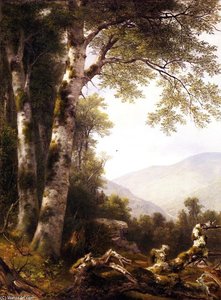
Asher Brown Durand, a prominent figure in the school, captured this duality with remarkable detail. In his 1855 work, The First Harvest in the Wilderness, held at the Brooklyn Museum, we see the intersection of human labor and the raw power of nature. The painting shows the American wilderness through a lens of peaceful agriculture, yet the presence of boulders and dense timber reminds the viewer of the untamed world that remains. This juxtaposition of peaceful agriculture and the disappearing wilderness of the Hudson Valley reflected the anxieties of a society watching its frontier recede even as it celebrated the fruits of settlement.
This tension between the wild and the managed is a recurring theme in human history. We see it in the way urban planners attempt to integrate green spaces into concrete cities, attempting to recreate that lost pastoral ideal within a modern, structured environment. The struggle to balance progress with the preservation of the natural world remains a central human concern.
Manifest Destiny on Canvas: The Second Generation and the Western Frontier
 Sierra Nevada
, Albert Bierstadt
As the 19th century progressed, the focus of the Hudson River School shifted westward, coinciding with the era of American expansion. The second generation of artists moved beyond the valleys of the Northeast to capture the epic scale of the West. This period was characterized by an obsession with the vastness of the new territories, often fueled by the doctrine of Manifest Destiny.
Albert Bierstadt became a central figure in this expansionist narrative. His immense paintings of the Sierra Nevada and the Yosemite region used forced perspective to make the viewer feel dwarfed by the mountains. These works were often theatrical in scale, designed to inspire awe and perhaps even serve as a visual sales pitch for westward movement. While some critics accused artists of exaggerating or even fabricating details to increase the drama, there is no denying that these paintings shaped the public's perception of the American West, turning distant mountains into legendary destinations.
The scale of these works finds a historical echo in the way we perceive our borders and territories today. The visual language used to define the "vastness" of a nation's territory continues to influence how we perceive and interact with our geographic boundaries, whether through photography, digital mapping, or cinematic depictions.
Building a National Vision: Landscape as a Tool of Identity
Landscape painting in the 19th century was far more than a decorative pursuit; it was a way to build a national vision. Because the United States lacked a cultural history comparable to that of Europe, many intellectuals believed that the nation's character would be shaped by its natural scenery. As one writer noted in 1819, natural scenery is intimately connected to taste, moral feeling, and instruction.
The artists of the Hudson River School provided the visual evidence for this new identity. By elevating the American wilderness to something spiritually and nationally significant, they helped define what Americans valued. They moved away from the structured, classical traditions of Europe to create a style that was uniquely American. This movement helped transform the landscape from mere topography into a symbol of the national spirit, a way for a young country to claim its own place in the world through the sheer majesty of its terrain.
This process of using art to forge a national identity is a phenomenon seen across many cultures. From the epic poems of ancient civilizations to the modern cinema of emerging nations, the way a people depicts its land is a primary method of establishing a shared sense of self and purpose.
The Conservationist Echo: From Romanticism to the National Park System
The legacy of the Hudson River School extends far beyond the canvas. The artists of this movement were among the first to visually argue for the intrinsic value of the wilderness, treating the landscape not as property to be exploited, but as a sacred space. Their work often reflected a suspicion of the rapid economic and technological development of the age, particularly the industrialization that threatened to consume the very landscapes they sought to celebrate.
This artistic advocacy had real-world consequences. The romantic language used by these painters to describe the "unspoiled" wilderness helped shape the rhetoric of the early conservation movement. The idea that certain areas of the land should be set aside for their beauty and spiritual value, rather than for resource extraction, is a direct descendant of the ideals expressed by Cole, Durand, and their contemporaries. The establishment of the National Park System in the United States can be seen, in many ways, as the institutionalization of the Hudson River School's aesthetic and moral vision.
Today, as we navigate new environmental challenges, the lessons of the 19th-century landscape painters remain relevant. Their work serves as a reminder of the enduring power of the natural world and the ongoing responsibility to protect the landscapes that define our collective heritage. For those seeking to bring this sense of history and scale into their own spaces, AllPaintingsStore.com offers a wide selection of high-quality, hand-painted reproductions and custom commissions that honor these significant traditions.


