


Defining the View: The Origins of the British Landscape
To understand the British landscape is to understand a shifting relationship between the observer and the earth. For centuries, the depiction of land was often secondary to the figures inhabiting it, serving as a backdrop for religious or mythological narratives. However, as the 18th century progressed, the landscape began to claim its own identity. This shift was not merely a change in subject matter but a fundamental change in how the land was perceived—moving from a mere setting to a primary subject capable of carrying profound meaning.
This evolution finds an early echo in the 17th-century Dutch Golden Age, where artists began to specialize in the subtle realities of light and weather. Just as the Dutch masters moved away from the hierarchy of genres to focus on the specificities of their own terrain, British artists began to look inward toward their own hills and valleys. This movement toward the specific allowed the landscape to become a vessel for national and personal identity, setting the stage for the more intense emotional expressions that would follow.
The transition from background to protagonist marked the beginning of a distinct tradition in British art, where the physical features of a region became the primary focus of the painter's eye.
The Picturesque Ideal: Gilpin and the Rules of Beauty
In 1770, William Gilpin published his observations on the River Wye, introducing a framework that would dictate the tastes of a generation. He championed the "picturesque," a concept that prioritized contrast, variety, and a certain ruggedness over the smooth perfection of the classical ideal. This was not a call for chaos, but for a structured appreciation of the irregular. The picturesque encouraged viewers to look for the texture of a crumbling ruin or the dramatic silhouette of a solitary tree against a shifting sky.
This pursuit of the picturesque finds a historical parallel in the Grand Tour, where young British aristocrats traveled to Italy to absorb the idealized Mediterranean vistas. While the Grand Tour often sought the harmonious and the classical, it simultaneously fueled a hunger for the varied and the dramatic that Gilpin would later codify. The tension between the idealized Italianate view and the rugged, textured reality of the British countryside created a fertile ground for artistic experimentation.
By establishing a set of visual rules, Gilpin provided artists with a vocabulary to translate the wildness of the natural world into a structured aesthetic experience.
The Romantic Sublime: Nature as Emotional Mirror
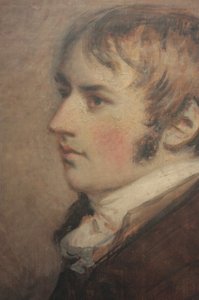 John Constable
. British Romantic landscape painter of the Stour Valley, known for textured impasto and capturing the shifting light of the English countryside.
As the 19th century arrived, the landscape underwent a profound transformation through the lens of Romanticism. Artists like John Constable and J.M.W. Turner moved beyond the mere documentation of topography to embrace a subjective, emotional realism. The landscape became a reflection of the internal state, where the scale of a mountain or the fury of a storm served to illustrate the tension between human smallness and the grandeur of the earth. This was the era of the sublime, where nature was viewed with a sense of awe and a touch of melancholy.
This emotional intensity echoes the earlier works of the Danube School in the 16th century, where pure landscape drawings began to emerge as independent expressions of the artist's vision. Just as those early masters sought to capture the spirit of the wilderness, the Romantics sought to capture the soul of the landscape. They moved away from the static and the composed, favoring instead the ephemeral qualities of light, cloud, and atmosphere.
In the hands of the Romantics, the landscape was no longer just a place to be seen, but a force to be felt, bridging the gap between the physical world and the human psyche.
The Watercolour Tradition: Precision and Topographic Detail
While the Romantics explored the sublime, another significant thread in British art was the mastery of watercolour. During the 18th and 19th centuries, watercolour became a British specialty, valued for its ability to capture the fleeting nuances of light and atmosphere with a precision that oil often lacked. This medium allowed for a delicate layering of washes, creating a sense of transparency and luminosity that was essential for depicting the soft, often misty, British climate.
This technical precision finds a fascinating parallel in the Company School in South Asia. There, Indian artists adapted European watercolour techniques to create highly detailed topographic views for British officials. This cross-cultural exchange demonstrated the versatility of the medium, as it was used both for the intimate, emotional expressions of the English countryside and the meticulous, empirical documentation of distant lands.
The watercolour tradition provided the technical foundation for a diverse range of landscape styles, from the highly detailed and scientific to the atmospheric and poetic.
Neo-Romanticism: Reclaiming the Wild in the 20th Century
 Paul Nash
Explore the evocative landscapes & poignant war art of Paul Nash (1889-1946), a key figure in British Modernism & Surrealism. Discover his unique style at AllPaintingsStore!
The 20th century brought a resurgence of interest in the landscape through the Neo-Romantic movement, which emerged around 1930. This was not a simple imitation of the past, but a complex reinterpretation. Artists such as Paul Nash, John Piper, and Graham Sutherland looked back to the works of William Blake and Samuel Palmer, seeking to find a sense of myth and mystery in the British terrain. This movement was deeply influenced by the anxieties of the era, particularly the threat of invasion during World War II, which prompted a renewed focus on the sanctity and the vulnerability of the home soil.
The Neo-Romantic approach also drew unexpected inspiration from the fragmentation of French Cubism. By incorporating the structural lessons of artists like Picasso and Masson, Neo-Romanticists were able to deconstruct the landscape into geometric planes and multiple viewpoints. This allowed them to represent the landscape not just as a view, but as a psychological space, often imbued with a sense of tension and modern disorientation.
Neo-Romanticism successfully bridged the gap between the traditional reverence for nature and the fractured, complex realities of the modern age.
The Persistent Lineage: From Romanticism to the Modern Era
 British Council
Experience the iconic British Council Collection in London featuring masterpieces by Lucian Freud and David Hockney through a dynamic journey of contemporary British art that invites you to explore its global legacy.
The trajectory from the Romanticism of the 19th century to the Neo-Romanticism of the 20th century reveals a continuous dialogue with the natural world. Whether through the grand, sweeping gestures of a Turner or the structured, symbolic landscapes of a Nash, the British landscape has remained a central pillar of artistic inquiry. It has served as a tool for national identity, a mirror for the soul, and a site for technical innovation.
This enduring legacy is reflected in the contemporary collections held by institutions like the British Council, where the evolution of landscape art—from the 19th century to the modern era—is documented through a vast array of styles. The tradition continues to evolve, as artists find new ways to interpret the relationship between humanity and the environment, ensuring that the study of the landscape remains a vital and living practice.
For those seeking to bring this rich history into their own spaces, AllPaintingsStore.com offers a curated selection of high-quality, hand-painted reproductions and professional prints that honor these significant traditions.


