100 Tage Geld-zurück-Garantie Weltweit versandkostenfrei
646.446Kunstwerke 53.409Künstlerinnen und Künstler 5.406Museen 32Sprachen
Porträt von Jakob Philipp Hackert

Gemälde von Jakob Philipp Hackert: Die 100 bekanntesten, nach Relevanz sortiert

Aktualisiert am Oktober 2026 · sortiert nach unserem Popularitätsindex (Suchanfragen, Aufrufe und Bestellungen für jedes Werk) · 161 Werke von Jakob Philipp Hackert in unserem Katalog

Kurze Antwort

Das bekannteste Gemälde von Jakob Philipp Hackert ist Blick auf die Kupfermühle in Vietri (1773). Sankt Franziskus' Grotten am Monte Verna (1801) und Landscape with a Waterfall and a Cowherd (1755) sind die Zahlen zwei und drei. Von den 161 Werken von Jakob Philipp Hackert in unserem Katalog sind dies die 100 bekanntesten, nach Bedeutung sortiert, jeweils mit Jahreszahl und Museum, damit Sie das gewünschte Gemälde auswählen können.

1737 – 1807, Prenzlau Romantische landschaftsmalerei Meiste Werke: Eremitage

Die Top 10 Gemälde von Jakob Philipp Hackert, nach Relevanz sortiert

1
Blick auf die Kupfermühle in Vietri (1773) von Jakob Philipp Hackert

Blick auf die Kupfermühle in Vietri

1773 · Öl auf Leinwand

Die Szenerie entfaltet sich in Blick auf die Kupfermühle in Vietri, einem Werk, das Jacob Philipp Hackert im Jahr 1773 schuf. Diese Landschaft fängt einen ganz spezifischen Winkel der italienischen Küste ein, gelegen in Vietri, südlich von Neapel, eingebettet zwischen den Städten Amalfi und Salerno. Die Luft scheint den stillen Rhythmus eines ländlichen Daseins in sich zu tragen, eingefroren in einem Moment der mittäglichen Ruhe.

2
Sankt Franziskus' Grotten am Monte Verna (1801) von Jakob Philipp Hackert

Sankt Franziskus' Grotten am Monte Verna

1801 · Öl auf Leinwand · Städel Museum, Frankfurt am Main

In der Stille der italienischen Landschaft tritt „Sankt Franziskus' Grotten am Monte Verna“ aus den Schatten der Geschichte hervor. Um 1801 gemalt, fängt dieses Werk einen heiligen Ort in der Provinz Arezzo ein. Der Künstler Jacob Philipp Hackert lenkt unseren Blick auf eine schroffe Höhle, die einst als Eremitage diente – ein Ort, an dem die massive Präsenz des Steins auf die sanfte Weichheit der Wildnis trifft. Es ist eine…

Gemälde von Jakob Philipp Hackert, Platzierung 11 bis 100

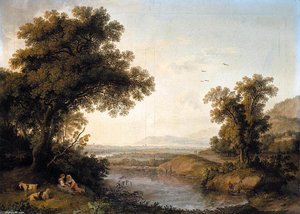
11The port of Livorno I (1779) von Jakob Philipp HackertThe port of Livorno I1779 12A view of Rome seen from the Villa Patrizi, with Santa Maria Maggiore and San Giovanni in Laterano beyond (1784) von Jakob Philipp HackertA view of Rome seen from the Villa Patrizi, with Santa Maria Maggiore and San Giovanni in Laterano beyond1784 13Coastal landscape near Vietri (1776) von Jakob Philipp HackertCoastal landscape near Vietri1776 14A shipwreck (1776) von Jakob Philipp HackertA shipwreck1776 15great heroic arcadic scenery with Apollo, 5 muses and cattle under oak-trees (1779) von Jakob Philipp Hackertgreat heroic arcadic scenery with Apollo, 5 muses and cattle under oak-trees1779 16View of Massa Lubrense. (1791) von Jakob Philipp HackertView of Massa Lubrense.1791 · Nationalmuseum Warschau 17Portrait of a Poodle (1795) von Jakob Philipp HackertPortrait of a Poodle1795 18View of the Sele and the Monti Alburni massif (1788) von Jakob Philipp HackertView of the Sele and the Monti Alburni massif1788 19Aeneas and Dido Flee the Storm into a Grotto (1804) von Jakob Philipp HackertAeneas and Dido Flee the Storm into a Grotto1804 · Niedersächsisches Landesmuseum Hannover 20Rome Seen from the Via Appia (1796) von Jakob Philipp HackertRome Seen from the Via Appia1796 21Imaginary Landscape with the River Volturno (1797) von Jakob Philipp HackertImaginary Landscape with the River Volturno1797 · Attingham Park 22Two Warriors in a Landscape of Trees and Rocks (1800) von Jakob Philipp HackertTwo Warriors in a Landscape of Trees and Rocks1800 · Alte Nationalgalerie 23A view of the Bay of Pozzuoli (1798) von Jakob Philipp HackertA view of the Bay of Pozzuoli1798 24Forest Landscape with the Sleeping Boy Horaz Protected by Pigeons (1805) von Jakob Philipp HackertForest Landscape with the Sleeping Boy Horaz Protected by Pigeons1805 · Staatliche Kunsthalle Karlsruhe 25River Landscape (1805) von Jakob Philipp HackertRiver Landscape1805 · Alte Nationalgalerie 26Arcadian Landscape (1805) von Jakob Philipp HackertArcadian Landscape1805 · Alte Nationalgalerie 27Große Kaskaden bei Tivoli (1783) von Jakob Philipp HackertGroße Kaskaden bei Tivoli1783 · Eremitage 28Landschaft mit einem antiken Fest (1781) von Jakob Philipp HackertLandschaft mit einem antiken Fest1781 · Eremitage 29Zerstörung der türkischen Flotte in der Bucht von Chesme (1771) von Jakob Philipp HackertZerstörung der türkischen Flotte in der Bucht von Chesme1771 · Eremitage 30Landschaft mit Fluss (1778) von Jakob Philipp HackertLandschaft mit Fluss1778 · Szépművészeti Múzeum 31Landscape with the Palace of Caserta and Vesuvius von Jakob Philipp HackertLandscape with the Palace of Caserta and Vesuvius 32Ansicht von Caserta (1784) von Jakob Philipp HackertAnsicht von Caserta1784 · Eremitage 33The Tents in the Tiergarten (1761) von Jakob Philipp HackertThe Tents in the Tiergarten1761 34Park Landscape with the Goldfish Pond in the Berlin Tiergarten I (The Venus Pond in the Berlin Tiergarten with the Statue of Venus in the Foreground) (1761) von Jakob Philipp HackertPark Landscape with the Goldfish Pond in the Berlin Tiergarten I (The Venus Pond in the Berlin Tiergarten with the Statue of Venus in the Foreground)1761 · Stiftung Stadtmuseum 35The Spree with the Palace Bridge by Charlottenburg II. (1762) von Jakob Philipp HackertThe Spree with the Palace Bridge by Charlottenburg II.1762 36Forest Landscape (1766) von Jakob Philipp HackertForest Landscape1766 · Bayerische Staatsgemäldesammlungen 37Fisher on the Coast. Left in the Background a Fortress on a Rock (1767) von Jakob Philipp HackertFisher on the Coast. Left in the Background a Fortress on a Rock1767 38Ruins of the Palaces of the Emperors on the Palatine Hill in Rome (1771) von Jakob Philipp HackertRuins of the Palaces of the Emperors on the Palatine Hill in Rome1771 39View of Saint Peter’s in Rome (1774) von Jakob Philipp HackertView of Saint Peter’s in Rome1774 · Städel Museum 40Vesuvius Eruption in 1774 (1774) von Jakob Philipp HackertVesuvius Eruption in 17741774 · Gemäldegalerie Alte Meister 41Landscape in Switzerland (1769) von Jakob Philipp HackertLandscape in Switzerland1769 · Royal Collection 42Fireworks over Castel Sant'Angelo in Rome (1775) von Jakob Philipp HackertFireworks over Castel Sant'Angelo in Rome1775 43French Landscape (1767) von Jakob Philipp HackertFrench Landscape1767 · Nationalmuseum 44River Landscape with Ruins (1768) von Jakob Philipp HackertRiver Landscape with Ruins1768 · Nationalmuseum 45A view across the Alban Hills a hilltop on the right and the ses in the far distance (1772) von Jakob Philipp HackertA view across the Alban Hills a hilltop on the right and the ses in the far distance1772 46Peasants grazing their cattle beside a lake, in a campagna landscape (1770) von Jakob Philipp HackertPeasants grazing their cattle beside a lake, in a campagna landscape1770 47Coastal landscape with Sea Storm (1773) von Jakob Philipp HackertCoastal landscape with Sea Storm1773 48The Eruption of Vesuvius in 1774 (1774) von Jakob Philipp HackertThe Eruption of Vesuvius in 17741774 49Sea Battle Episode (1771) von Jakob Philipp HackertSea Battle Episode1771 50Study of Two Cows (1781) von Jakob Philipp HackertStudy of Two Cows1781 51The Plain of Capua, Seen from Caserta (1784) von Jakob Philipp HackertThe Plain of Capua, Seen from Caserta1784 52Southern Landscape with Lake and Staffage (1779) von Jakob Philipp HackertSouthern Landscape with Lake and Staffage1779 53Ferdinand I hunting the wild boar at Carditello (1783) von Jakob Philipp HackertFerdinand I hunting the wild boar at Carditello1783 · Musée Condé 54Rocky Landscape with Anglers (1776) von Jakob Philipp HackertRocky Landscape with Anglers1776 55View of the Plain of Caserta seen from the Royal Belvedere with Vesuvius in the distance (1785) von Jakob Philipp HackertView of the Plain of Caserta seen from the Royal Belvedere with Vesuvius in the distance1785 · Saltram House 56The Lake of Nemi (1784) von Jakob Philipp HackertThe Lake of Nemi1784 · Szépművészeti Múzeum 57Villa of Maecenas and the Waterfalls at Tivoli (1783) von Jakob Philipp HackertVilla of Maecenas and the Waterfalls at Tivoli1783 · Eremitage 58View of the Bay of Baja (1785) von Jakob Philipp HackertView of the Bay of Baja1785 · Eremitage 59View of the Basilica and Poseidon Temple of Paestum (1777) von Jakob Philipp HackertView of the Basilica and Poseidon Temple of Paestum1777 60The Temple of Hercules in Cori near Velletri (1783) von Jakob Philipp HackertThe Temple of Hercules in Cori near Velletri1783 · J. Paul Getty Museum 61Rome Viewed from the Baths of Caracalla (1779) von Jakob Philipp HackertRome Viewed from the Baths of Caracalla1779 62Landscape with the Sanctuary of Loreto by Ancona/Marche (Landscape with a Resting Shepherd) (1776) von Jakob Philipp HackertLandscape with the Sanctuary of Loreto by Ancona/Marche (Landscape with a Resting Shepherd)1776 63The falls at Tivoli (1780) von Jakob Philipp HackertThe falls at Tivoli1780 64A custom house, Naples, by moonlight with dancers and musicians by a fire (1780) von Jakob Philipp HackertA custom house, Naples, by moonlight with dancers and musicians by a fire1780 65Landscape with Cattle (1781) von Jakob Philipp HackertLandscape with Cattle1781 · Eremitage 66The Seasons: Summer (1784) von Jakob Philipp HackertThe Seasons: Summer1784 · Deutsches Nationalmuseum 67The Seasons: Winter (1784) von Jakob Philipp HackertThe Seasons: Winter1784 · Deutsches Nationalmuseum 68View of Villa Albani in Rome (1779) von Jakob Philipp HackertView of Villa Albani in Rome1779 69View of Lipari and Stromboli (1778) von Jakob Philipp HackertView of Lipari and Stromboli1778 · Tsarskoye Selo 70Fisher Family at Nighttime Campfire with Turbulent Sea (1778) von Jakob Philipp HackertFisher Family at Nighttime Campfire with Turbulent Sea1778 · Museum Georg Schäfer 71View of Catania and Etna (1778) von Jakob Philipp HackertView of Catania and Etna1778 · Tsarskoye Selo 72Russian navy near Catania coast (1778) von Jakob Philipp HackertRussian navy near Catania coast1778 73Italianate Landscape (1778) von Jakob Philipp HackertItalianate Landscape1778 74The Waterfalls at Terni (1779) von Jakob Philipp HackertThe Waterfalls at Terni1779 75An italian capriccio veduta, with a greek temple near a shoreline, and a distant volcano (1779) von Jakob Philipp HackertAn italian capriccio veduta, with a greek temple near a shoreline, and a distant volcano1779 76River Valley of Isernia near Neapel (1791) von Jakob Philipp HackertRiver Valley of Isernia near Neapel1791 77Villa d'Este near Tivoli (1792) von Jakob Philipp HackertVilla d'Este near Tivoli1792 78Returning Long-Haired Cattle in the Roman Campagna. Evening Mood (1793) von Jakob Philipp HackertReturning Long-Haired Cattle in the Roman Campagna. Evening Mood1793 · Kunsthalle Kiel 79View of the Small Marina of Sorrento (1794) von Jakob Philipp HackertView of the Small Marina of Sorrento1794 · Königliche Residenz 80Two Views of a Dead Boar with a Mastiff and two other Dogs (1795) von Jakob Philipp HackertTwo Views of a Dead Boar with a Mastiff and two other Dogs1795 · Attingham Park 81Landscape with a Bridge, with a View of Monte Sarchio (1792) von Jakob Philipp HackertLandscape with a Bridge, with a View of Monte Sarchio1792 · Attingham Park 82Imaginary River Landscape (1795) von Jakob Philipp HackertImaginary River Landscape1795 · Attingham Park 83Veduta d’Itri (Landscape with a View of Itri) (1788) von Jakob Philipp HackertVeduta d’Itri (Landscape with a View of Itri)1788 · Museum Kunstpalast 84La Perdita del Liri a Anatrelle (1793) von Jakob Philipp HackertLa Perdita del Liri a Anatrelle1793 · Royal Collection 85River Landscape with Women Playing with a Child (1791) von Jakob Philipp HackertRiver Landscape with Women Playing with a Child1791 · Royal Collection 86The Large Waterfall at Tivoli near Rome (1790) von Jakob Philipp HackertThe Large Waterfall at Tivoli near Rome1790 87View of Montesarchio (1791) von Jakob Philipp HackertView of Montesarchio1791 · Eremitage 88Marina Piccola in Sorrento (1794) von Jakob Philipp HackertMarina Piccola in Sorrento1794 89View of Posillipo on the Isle of Capri (1795), (1795) von Jakob Philipp HackertView of Posillipo on the Isle of Capri (1795),1795 90Isola di Sora (1794) von Jakob Philipp HackertIsola di Sora1794 91Ideal Landscape with Juno Temple of Agrigento (1794) von Jakob Philipp HackertIdeal Landscape with Juno Temple of Agrigento1794 · Deutsches Nationalmuseum 92View of the Volturno Valley towards Capua (1802) von Jakob Philipp HackertView of the Volturno Valley towards Capua1802 93Hare in the Bush (1803) von Jakob Philipp HackertHare in the Bush1803 94View of the Gulf of Pozzuoli from Solfatara (1803) von Jakob Philipp HackertView of the Gulf of Pozzuoli from Solfatara1803 · Cleveland Museum of Art 95The Lake of Avernus (1800) von Jakob Philipp HackertThe Lake of Avernus1800 · Attingham Park 96The Excavations at Pompeii (1799) von Jakob Philipp HackertThe Excavations at Pompeii1799 · Attingham Park 97The Gulf of Pozzuoli (1799) von Jakob Philipp HackertThe Gulf of Pozzuoli1799 · Attingham Park 98Capriccio View of the River Volturno with Monte Epomeo beyond (1796) von Jakob Philipp HackertCapriccio View of the River Volturno with Monte Epomeo beyond1796 · Attingham Park 99River Landscape with Elements of the English Garden at Caserta (1797) von Jakob Philipp HackertRiver Landscape with Elements of the English Garden at Caserta1797 · Attingham Park 100Goat and Lamb (1804) von Jakob Philipp HackertGoat and Lamb1804 · Alte Nationalgalerie

Gemälde von Jakob Philipp Hackert nach Themen

Die vier häufigsten Motive in diesem Ranking, jeweils mit dem besten Gemälde.

Museen mit Originalen von Jakob Philipp Hackert

Die 8 Museen, in denen sich die meisten Gemälde dieser Seite befinden.

Museum Stadt Werke von Jakob Philipp Hackert Gemälde aus dieser Liste
Eremitage, Sankt PetersburgEremitage Sankt Petersburg 10 Temple Ruins in Sicily, Große Kaskaden bei Tivoli, Landschaft mit einem antiken Fest
Attingham ParkAttingham Park 10 Imaginary Landscape with the River Volturno, Two Views of a Dead Boar with a Mastiff and two other Dogs, Landscape with a Bridge, with a View of Monte Sarchio
Alte Nationalgalerie, BerlinAlte Nationalgalerie Berlin 6 Two Warriors in a Landscape of Trees and Rocks, River Landscape, Arcadian Landscape
Royal Collection, LondonRoyal Collection London 4 Landscape in Switzerland, La Perdita del Liri a Anatrelle, River Landscape with Women Playing with a Child
Deutsches Nationalmuseum, NürnbergDeutsches Nationalmuseum Nürnberg 3 The Seasons: Summer, The Seasons: Winter, Ideal Landscape with Juno Temple of Agrigento
Nationalmuseum, StockholmNationalmuseum Stockholm 4 French Landscape, River Landscape with Ruins
Städel Museum, Frankfurt am MainStädel Museum Frankfurt am Main 2 Sankt Franziskus' Grotten am Monte Verna, View of Saint Peter’s in Rome
Szépművészeti Múzeum, BudapestSzépművészeti Múzeum Budapest 2 Landschaft mit Fluss, The Lake of Nemi

Jakob Philipp Hackert nach Jahrzehnten: das Top-Gemälde aus jedem Jahrzehnt

Werke nach Jahrzehnten

Wählen Sie ein Jahrzehnt aus, um das bedeutendste Gemälde zu sehen.

Gemälde von Jakob Philipp Hackert: häufig gestellte Fragen

Was ist das bekannteste Gemälde von Jakob Philipp Hackert?Antwort anzeigen

Blick auf die Kupfermühle in Vietri (1773) belegt den ersten Platz, gefolgt von Sankt Franziskus' Grotten am Monte Verna (1801) und Landscape with a Waterfall and a Cowherd (1755).

Wie alt war Jakob Philipp Hackert, als Blick auf die Kupfermühle in Vietri gemalt wurde?Antwort anzeigen

Jakob Philipp Hackert war 36 Jahre alt: Blick auf die Kupfermühle in Vietri datiert auf 1773, und Jakob Philipp Hackert wurde in 1737 geboren.

Was sind die Top 10 Gemälde von Jakob Philipp Hackert?Antwort anzeigen

Blick auf die Kupfermühle in Vietri, Sankt Franziskus' Grotten am Monte Verna, Landscape with a Waterfall and a Cowherd, River Landscape with Lovers, From the Banks of Arques, The Tiber in Rome, View of ruins by a river (the Seine), View of Château Gaillard and the Seine, Travellers resting beside a river, with a town und Temple Ruins in Sicily. Jahr und Museum sind in der obigen Rangliste aufgeführt.

Wie viele Werke von Jakob Philipp Hackert sind gelistet?Antwort anzeigen

161 Werke von Jakob Philipp Hackert sind in unserem Katalog enthalten, datiert von 1755 bis 1805.

Wo werden die Originalgemälde von Jakob Philipp Hackert aufbewahrt?Antwort anzeigen

Vorwiegend in Eremitage (Sankt Petersburg), Attingham Park und Alte Nationalgalerie (Berlin). Die vollständige Liste finden Sie in der obenstehenden Museumstabelle.

Welche Epoche brachte die berühmtesten Gemälde von Jakob Philipp Hackert hervor?Antwort anzeigen

In 1770s: 31 der 100 hier aufgeführten Gemälde stammen aus dieser Zeit, einschließlich Blick auf die Kupfermühle in Vietri.

Welches sind die frühesten und neuesten berühmten Gemälde von Jakob Philipp Hackert?Antwort anzeigen

Früheste auf dieser Seite: Landscape with a Waterfall and a Cowherd (1755). Neueste: Forest Landscape with the Sleeping Boy Horaz Protected by Pigeons (1805).

Was sind die Hauptmotive in den Gemälden von Jakob Philipp Hackert?Antwort anzeigen

Unter den 100 hier aufgeführten Gemälden: Berge (3), Bäume (3) und Menschen (3).

In welchem Medium sind die meisten Originale von Jakob Philipp Hackert ausgeführt?Antwort anzeigen

Öl auf Leinwand, für 7 von insgesamt 100 hier aufgeführten Gemälden.

Welcher Stilrichtung wird Jakob Philipp Hackert zugeordnet?Antwort anzeigen

Romantische landschaftsmalerei, basierend auf den auf dieser Seite gerankten Gemälden.

Welche Originalwerke von Jakob Philipp Hackert befinden sich im Eremitage?Antwort anzeigen

Das Eremitage, Sankt Petersburg beherbergt 9 der hier aufgeführten Gemälde, darunter Temple Ruins in Sicily, Große Kaskaden bei Tivoli und Landschaft mit einem antiken Fest.

Kann ich eine Reproduktion von Jakob Philipp Hackert bestellen?Antwort anzeigen

Ja. Jedes Gemälde auf dieser Seite kann als handgemalte Ölreproduktion oder als Druck bestellt werden. Öffnen Sie das Gemälde, wählen Sie die Größe und geben Sie Ihre Bestellung auf.

Über den Künstler: Jakob Philipp Hackert

Early Life and Artistic Foundations

Jacob Philipp Hackert wurde im September 1737 in Prenzlau, Brandenburg, geboren – eine Region, die heute Teil Deutschlands ist. Seine Kindheit war von Kunst durchdrungen; sein Vater, Philipp Hackert, praktizierte sowohl als Porträtist als auch als Tierzeichner und legte damit den Grundstein für Jacobs künstlerische Reise. Diese familiäre Einflüsse erstreckten sich auf seinen Onkel, unter dessen Anleitung er seine Fähigkeiten weiter verfeinerte. Eine formale Ausbildung folgte in der renommierten Prussian Academy of Arts in Berlin ab 1758, wo er die technischen Grundlagen entwickelte, die später seinen Stil prägen sollten. Hackerts frühes Berufsleben war jedoch nicht auf Ateliers beschränkt. Seine Reisen führten ihn durch Schwedisch Pommern und schließlich nach Stockholm, wo ihm eine wichtige Bestellung von Baron Adolf Friedrich von Olthof – dekorative Wandmalereien für den Barons Anwesenheit – seinen künstlerischen Horizont erweiterte und ihn mit verschiedenen ästhetischen Einflüssen vertraut machte. Diese prägenden Jahre waren entscheidend für die Formung seines Blickes und bereiteten ihn auf die größeren Bühnen seiner Karriere vor.

The Italian Awakening: Paris, Rome, and Naples

Ein einschneidendes Kapitel begann mit Hackerts Umzug nach Paris zwischen 1765 und 1768 zusammen mit dem Schweizer Künstler Balthasar Anton Dunker. Diese Zeit erwies sich als transformativ, indem sie ihn in ein lebendiges künstlerisches Milieu eintauchte. Er ließ sich von Claude Joseph Vernet, dem gefeierten Maler von Landschaften und Seeschiffen, beeinflussen und übernahm Elemente von Vernets dramatische Kompositionen und atmosphärische Effekte in seinen eigenen aufkeimenden Stil. Gleichzeitig trug ein Studium bei dem deutschen Kupferstecher Johann Georg Wille zur Verfeinerung seiner Präzision und Detailgenauigkeit bei. Im Jahr 1768 begab sich Hackert mit seinem Bruder Georg auf eine Reise, die seinen künstlerischen Lauf für immer verändern sollte – er ließ sich hauptsächlich in Rom und Neapel nieder und gründete dort einen außergewöhnlich produktiven Zeitraum, der von zahlreichen Aufträgen für Ansichten des italienischen Landes geprägt war, insbesondere von Sir William Hamilton. Er durchquerte das gesamte Italien, dokumentierte seine Schönheit akribisch und erlangte als Meister des Landschaftsbildnerns Anerkennung. Das Licht, die Farben, die Essenz der italienischen Halbinsel fesselten ihn, wurden zum bestimmenden Merkmal seiner Werke.

Patronage, Recognition, and Artistic Flourishing

Hackerts künstlerische Karriere stieg durch Talent und strategische Förderung zu neuen Höhen auf. Seine Fähigkeit, die sublimen Schönheiten Italiens einzufangen, resonierte mit bedeutenden Persönlichkeiten in ganz Europa. Ein Meilensteinauftrag kam von Katharina der Großen aus Russland – ein Zyklus von Gemälden, der den entscheidenden Kampf von Chesma darstellt und seinen Ruf international festigte. Darüber hinaus stärkte eine fruchtbare Beziehung zu Papst Pius VI seine Position durch bedeutende künstlerische Projekte, die seine Vielseitigkeit demonstrierten. Im Jahr 1786 wurde Hackert zum Hofmaler König Ferdinand I. der beiden Sizilien in Neapel ernannt – eine prestigeträchtige Rolle, die über reine Malerei hinausging; er beriet bei der Erstellung eines Malrestaurierungs laboratories im Museo di Capodimonte und beaufsichtigte den Transfer der angesehenen Farnesischen Sammlungen von Rom nach Neapel. Er schuf bemerkenswerte Gemälde, die Caserta und den Königlichen Palast von Caserta darstellten sowie eine Reihe, die die Häfen des Bourbon-Hauses illustrierten. Interessanterweise diente Hackert auch als Geheiminformant für Russland während dieser Zeit – ein Beweis für das komplexe politische Umfeld, in dem er operierte. Eine besonders geschätzte Verbindung entwickelte sich zwischen Hackert und Johann Wolfgang von Goethe während der späteren Besuche des Dichters in Neapel, wodurch eine Freundschaft entstand, die seinen intellektuellen Status weiter erhöhte.

Style, Legacy, and Historical Significance

Hackerts künstlerischer Stil stellt eine überzeugende Synthese aus klassischem Landschaftsbildern und einer aufkommenden Romantik dar. Er ist stark von den Werken Claud Lorrain beeinflusst und zeichnet sich durch sorgfältig ausgewogene Anordnungen aus, die beobachtete Realität mit einer idealisierten ästhetischen Vision verbinden. Dennoch unterschied er sich durch ein unerschütterliches Engagement für botanische Genauigkeit und den Wunsch nach erkennbaren Darstellungen von Orten. Seine Gemälde sind durch scharfe Darstellungen natürlicher Details und realistische Darstellungen italienischer Landschaften gekennzeichnet, oft in warmem, goldenem Licht getaucht. Er gilt als einer der größten Interpreten des *Vedutismo*-Genres – Gemälde, die Ansichten von Städten und Landschaften mit topographischer Präzision darstellen. Hackerts historisches Ansehen erstreckt sich über seine künstlerischen Beiträge hinaus; er diente als wichtiger kultureller Botschafter zwischen Deutschland und Italien im späten 18. Jahrhundert und förderte den Austausch zwischen künstlerischen Traditionen. Er starb am 28. April 1807 in San Pietro di Careggi in der Nähe von Florenz und hinterließ ein beträchtliches Werk, das weiterhin Bewunderung und Inspiration für seine Schönheit, sein technisches Können und seine dauerhafte historische Bedeutung hervorruft. *Seine Landschaften sind nicht nur Darstellungen von Landschaftsbildern; sie sind Fenster zu einer Welt, die sowohl klassische Anmut als auch romantische Emotionen vereint.*

Alle 161 Werke von Jakob Philipp Hackert →