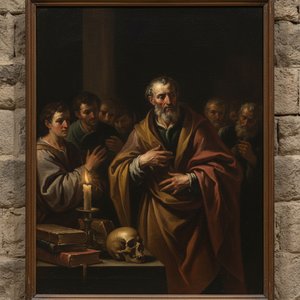
1680. Oil On Canvas, 52.0 x 44.0 cm. Ερμιτάζ.

§ 1Στοιχεία καταλόγου

- 52.0 x 44.0 cm


§ 2Αφηρημένο
Περιγραφή Συλλεκτικού Αντικειμένου
Admire Claudio Coello's masterful Self-Portrait (1680), a baroque masterpiece housed at Museo Nacional del Prado, showcasing his skill and capturing the essence of his era.
 Περισσότερα
Βιογραφικό Καλλιτέχνη
Claudio Coello, κορυφαίος Ισπανός ζωγράφος του Μπαρόκ. Γνωστός για τα έντονα χρώματα και τις συνθέσεις του, όπως η 'Προσκύνηση της Θείας Ευχαριστίας'. Ανακαλύψτε την κληρονομιά του!
§ 3Σχολιασμός
Claudio Coello’s Self-Portrait: A Baroque Reflection of Confidence
Claudio Coello’s “Self-Portrait,” painted in 1680, stands as a testament to the artistic fervor of the Baroque period and represents one of the most striking examples of self-representation during that era. More than just a likeness of the artist himself, it embodies the ideals of humanist introspection and aristocratic grandeur characteristic of Spanish art under Charles II.
Style and Technique: Coello’s masterful use of chiaroscuro—the dramatic interplay between light and shadow—immediately draws the viewer's eye. The dark background serves to accentuate the luminous flesh tones of his face, creating a palpable sense of depth and dimensionality that transcends mere visual representation. Precise brushstrokes meticulously capture the contours of his features, conveying both physical realism and psychological nuance.
Historical Context: Created during a time of royal patronage and artistic experimentation, Coello’s portrait reflects the broader cultural landscape of Spain in the late 17th century. The Habsburg monarchy actively fostered artistic endeavors, commissioning works that celebrated royal power and piety—a tradition exemplified by the opulent interiors of El Escorial.
Symbolism: The artist's neutral expression, subtly tilted head, and slight smile convey a quiet confidence and contentment – qualities considered desirable in an aristocratic gentleman. These gestures speak to the humanist preoccupation with inner virtue and self-awareness that permeated Baroque art.
The Hermitage Museum’s Acquisition
Currently housed at The Hermitage museum in St. Petersburg, Russia, “Self-Portrait” is a remarkable survivor of its time. Its journey through history underscores the enduring appeal of artistic masterpieces and their ability to transcend cultural boundaries.
Provenance: Originally part of the royal collection, the painting’s provenance adds to its significance as an emblem of Spanish Baroque art. The Hermitage's acquisition ensures that future generations can appreciate Coello’s skill and contribute to ongoing scholarly research into his oeuvre.
Comparisons with Fellow Artists
Alongside artists like Anthony Van Dyck and Aert De Gelder, Claudio Coello achieved considerable renown for his self-portraits. Van Dyck's portraits often employed a similar technique of luminous flesh tones against dark backgrounds, emphasizing the sitter’s aristocratic bearing.
Aert De Gelder’s works similarly explored themes of introspection and psychological portraiture, demonstrating that Coello was part of a broader artistic dialogue concerning the representation of the human spirit.
Light in Painting: A Baroque Cornerstone
As discussed on Light in painting, the manipulation of light is paramount to creating impactful art—a principle vividly realized in “Self-Portrait.” The artist’s deliberate use of chiaroscuro elevates the image beyond mere depiction, transforming it into a conduit for conveying emotion and intellectual contemplation.
The composition itself—centered on Coello's face—reinforces this effect. It invites viewers to engage with the subject on an emotional level, prompting reflection on themes of identity and self-assurance – core concerns of Baroque art’s humanist vision.
A Detailed Examination
The meticulous attention to detail evident in “Self-Portrait” speaks volumes about Coello's artistic prowess. From the subtle texture of his skin to the precise rendering of his hair, every element contributes to a portrait that captures not only physical likeness but also psychological character.
Furthermore, the painting’s placement within El Escorial—a symbol of royal power and religious devotion—underscores its significance as an artistic monument reflecting the cultural values of its era.
Ερωτήσεις και Απαντήσεις
Ποιο συναίσθημα προκαλούν τα χρώματα του έργου "Self-Portrait" του Κλαούντιο Κοέλο;
Στο "Self-Portrait", οι αποχρώσεις του Earthy συνοδεύουν μια αίσθηση που είναι Reflective.
Πώς συνδυάζονται το υλικό και η κίνηση στο "Self-Portrait";
Το έργο "Self-Portrait" του Κλαούντιο Κοέλο συνδυάζει την τεχνική του Oil On Canvas με το στυλ της Baroque Art. Η τεχνική και το καλλιτεχνικό κίνημα περιγράφουν τον τρόπο δημιουργίας και το ύφος του έργου.
Ποιος δημιούργησε το "Self-Portrait" και πότε;
Το έργο "Self-Portrait" δημιουργήθηκε από τον/την Κλαούντιο Κοέλο το 1680.


 Μετάβαση σε Εκτυπώσεις


 Για έργα τέχνης ή αναπαραγωγές με πλευρά υπερβαίνουσα των 105 εκ. (περίπου 41 ίντσες), το πλαίσιο θα αποσταλεί αποσυναρμολογημένο, σε μορφή κιτ. Η μέθοδος αυτή διασφαλίζει την ασφαλή παράδοση και προλαμβάνει τυχόν ζημιές κατά τη μεταφορά.