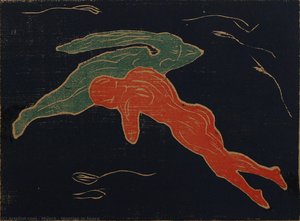
1901. Acrylic.

§ 1Στοιχεία καταλόγου


§ 2Αφηρημένο
Περιγραφή Συλλεκτικού Αντικειμένου
Captured in stark black and white, Edvard Munch’s ‘Envy’ embodies profound psychological anguish through its depiction of a man concealing his face amidst a desolate landscape—a poignant emblem of existential dread from the Symbolist era.
 Περισσότερα
Βιογραφικό Καλλιτέχνη
Ο πρωτοπόρος του εξπρεσιονισμού Έντβαρντ Μουνχ δημιούργησε το εμβληματικό Το Σοκ. Ανακαλύψτε τα συγκλονιστικά αριστουργήματά του σήμερα.
§ 3Σχολιασμός
A Portrait of Inner Turmoil: Exploring Edvard Munch’s “Envy”
The painting "Envy," created by Edvard Munch in 1901, isn't merely a depiction of a man; it’s an embodiment of psychological distress—a visceral representation of the anxieties that defined Munch’s artistic output and resonate powerfully with audiences today. Captured in stark black and white, the artwork immediately commands attention through its unsettling composition and masterful execution. It speaks volumes about the artist’s personal struggles and his profound understanding of human emotion.- Subject Matter: At first glance, the painting presents a solitary figure—a man clutching his face in anguish—a gesture universally recognized as indicative of despair or overwhelming emotion. The subtle blue shirt he wears adds a touch of color against the monochrome backdrop, subtly highlighting the vulnerability of the subject.
- Style: Munch’s style is firmly rooted in Expressionism, prioritizing emotional intensity over realistic representation. He abandons conventional perspective and strives to convey inner feelings rather than external appearances. This stylistic choice aligns perfectly with his preoccupation with themes of anxiety, fear, and psychological torment—elements that permeate throughout his oeuvre.
Technique: Impressionistic Brushstrokes Amidst Darkness
Munch employed a technique characterized by loose, agitated brushstrokes—a hallmark of Expressionism. These strokes aren’t intended to capture precise details but rather to convey the artist's subjective experience of the scene. The textured surface of the painting contributes significantly to its emotional impact, mirroring the turbulent state of mind depicted within. Notice how Munch skillfully utilizes tonal variations to heighten drama and create a sense of unease; the darker shades dominate, emphasizing the oppressive atmosphere.- Color Palette: Although presented in black and white, Munch’s masterful use of tonal shading creates an illusion of color. The dominant blues evoke feelings of melancholy and isolation, reinforcing the painting's overarching mood.
- Composition: The composition is deliberately unbalanced, drawing the viewer’s eye to the central figure while simultaneously emphasizing the desolate landscape surrounding him. The placement of the houses and boat serves as a visual anchor, grounding the image but also subtly highlighting the man’s isolation from society.
Historical Context: Fin-de-Siècle Anxiety and Munch's Personal Demons
“Envy” emerged during the Fin-de-Siècle period—a time of profound social and intellectual upheaval in Europe. Artists like Munch wrestled with anxieties about modernity, industrialization, and the decline of traditional values. Munch’s own life was marked by tragedy and illness, profoundly influencing his artistic vision. He suffered from debilitating anxiety attacks and struggled to reconcile his faith with the horrors he witnessed during World War I. These experiences fueled his exploration of psychological themes—fear, grief, and despair—themes that find expression in “Envy” as a reflection of the broader cultural anxieties of the era.Symbolism: Faces of Fear and Isolation
The man’s gesture of clutching his face is laden with symbolic significance. It represents not only physical pain but also emotional anguish—a desperate attempt to shield oneself from overwhelming feelings. The blue shirt symbolizes vulnerability and fragility, mirroring the artist's own struggles with mental illness. Furthermore, the desolate landscape serves as a visual metaphor for inner turmoil—representing the emptiness and despair that characterize Munch’s psychological state. “Envy” is ultimately a portrait of existential dread—a haunting reminder of humanity’s inherent vulnerability to suffering.Ερωτήσεις και Απαντήσεις
Με ποιο υλικό έχει εκτελεστεί το έργο "Envy" του Έντβαρντ Μουνχ;
Ο/Η Έντβαρντ Μουνχ χρησιμοποίησε την τεχνική του/της Acrylic για το έργο "Envy". Η τεχνική αυτή ορίζει τη υλική φύση του πρωτότυπου έργου.
Υπάρχει σελίδα οδηγού για το "Envy" του Έντβαρντ Μουνχ;
Η σελίδα Οδηγός για το έργο "Envy" του Έντβαρντ Μουνχ προσφέρει ένα εκτυπώσιμο ενημερωτικό φυλλάδιο δύο σελίδων: το έργο τέχνης με τον πίνακα ταυτότητάς του, μια χρονική ζώνη που το τοποθετεί μέσα στη διάρκεια της ζωής του καλλιτέχνη, άλλα έργα του ίδιου δημιουργού, την αναλυτική παλέτα χρωμάτων και έτοιμες για αντιγραφή αναφορές σε τέσσερα στυλ.
Ποιον καλλιτέχνη αποδίδεται το "Envy";
Ο καλλιτέχνης πίσω από το "Envy" είναι ο/η Έντβαρντ Μουνχ. Το έργο καταχωρείται υπό το όνομα του/της Έντβαρντ Μουνχ.


 Μετάβαση σε Εκτυπώσεις


 Για έργα τέχνης ή αναπαραγωγές με πλευρά υπερβαίνουσα των 105 εκ. (περίπου 41 ίντσες), το πλαίσιο θα αποσταλεί αποσυναρμολογημένο, σε μορφή κιτ. Η μέθοδος αυτή διασφαλίζει την ασφαλή παράδοση και προλαμβάνει τυχόν ζημιές κατά τη μεταφορά.