

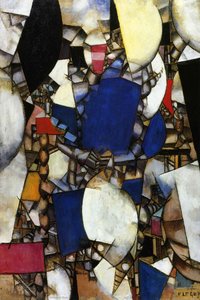
1924. Acrylic On Canvas.

§ 1Catalogue data


§ 2Abstract
Περιγραφή Συλλεκτικού Αντικειμένου
Explore Fernand Léger’s ‘Mechanical components on a red background,’ a pioneering Cubist masterpiece! Geometric abstraction, bold reds & dynamic forms – a unique artwork.
 Περισσότερα
Βιογραφικό Καλλιτέχνη
Ο Φρανς Λέγκερ (1881-1955): Ένας πρωτοποριακός ζωγράφος, γνωστός για τον κυνισμό και το μοναδικό του στυλ που τιμά την μηχανική αισθητική & τη σύγχρονη ζωή. Προκάλεσε επανάσταση στην τέχνη!
§ 3Commentary
A Symphony of Form: Fernand Léger’s Mechanical Components
Mechanical Components on a Red Background, painted in 1924 by French artist Fernand Léger, is a striking example of his distinctive “Tubism” – a personal offshoot of Cubism. This artwork isn't merely a depiction of objects; it’s a bold exploration of form, color, and the burgeoning machine age that captivated the early 20th century.Deconstructing the Still Life
The composition presents a fragmented still life – a classic subject reimagined through a modern lens. We discern elements of a vase, fruit (likely apples), and draped cloth, but these are not rendered realistically. Instead, Léger breaks them down into geometric shapes—cylinders, cones, and planes—and reassembles them in an abstracted arrangement. This deliberate fracturing challenges traditional notions of perspective and representation. The objects aren’t *seen* so much as they are *constructed*.Color & Technique: A Bold Palette
Léger employs a limited yet powerful color palette, dominated by shades of red, grey, and black. The vibrant red background isn't simply a backdrop; it actively participates in the composition, creating dynamic tension with the cooler tones of the objects. His technique is meticulous, involving careful layering of paint to define each geometric form. While texture isn’t explicitly rendered, it’s implied through subtle variations in shading and the interplay of planes. The sharply defined lines contribute to the overall sense of structure and order.Historical Context: Between Wars & Movements
Born in 1881, Léger experienced a rapidly changing world. He initially trained as an architect before turning to painting, and this architectural sensibility is evident in the structural rigor of his work. Following early influences from Impressionism, he became a key figure in the Cubist movement alongside Picasso and Braque. However, Léger diverged by incorporating elements of machinery and industrial design into his art – reflecting a fascination with modernity. Painted after World War I, this artwork embodies a desire for order and clarity amidst societal upheaval—a characteristic of the *rappel à l’ordre* (return to order) movement.Symbolism & Interpretation
The fragmented forms in Mechanical Components on a Red Background can be interpreted as a deconstruction of reality, mirroring the fragmentation experienced during and after the war. The machine-like quality of the shapes suggests an embrace of industrialization and the dynamism of modern life. Some scholars also see Léger’s work as a commentary on the relationship between humans and technology—a theme that would become increasingly relevant throughout the 20th century.Emotional Impact & Aesthetic Appeal
Despite its geometric abstraction, this painting evokes a sense of energy and vitality. The bold colors and dynamic composition create a visually stimulating experience. It’s a work that invites contemplation—encouraging viewers to look beyond surface appearances and explore the underlying structures of form and space. Its strong aesthetic appeal makes it an ideal statement piece for modern interiors, adding sophistication and intellectual depth to any collection.Key Features
- Style: Cubism / Tubism
- Medium: Oil on Canvas
- Date: 1924
- Subject: Still Life – Vase, Fruit, Cloth
- Color Palette: Red, Grey, Black
Ερωτήσεις και Απαντήσεις
Ποια τοποθέτηση ταιριάζει με το σχήμα του "Mechanical components on a red background" του Φρανς Λέγκερ;
Με το σχήμα του (Portrait), μια αναπαραγωγή του "Mechanical components on a red background" προτείνεται για ένα Living Room.
Πού και για τι χρήση συνιστάται το "Mechanical components on a red background";
Οι προτάσεις για τη χρήση (Accent) και τον χώρο (Living Room) που καταγράφονται για το "Mechanical components on a red background" του Φρανς Λέγκερ είναι δύο.
Παρουσιάζει το "Mechanical components on a red background" έντονες αντιθέσεις φωτός και σκότους;
Το επίπεδο αντίθεσης του έργου "Mechanical components on a red background" του Φρανς Λέγκερ είναι Balanced.




 Μετάβαση σε Εκτυπώσεις


 Για έργα τέχνης ή αναπαραγωγές με πλευρά υπερβαίνουσα των 105 εκ. (περίπου 41 ίντσες), το πλαίσιο θα αποσταλεί αποσυναρμολογημένο, σε μορφή κιτ. Η μέθοδος αυτή διασφαλίζει την ασφαλή παράδοση και προλαμβάνει τυχόν ζημιές κατά τη μεταφορά.


