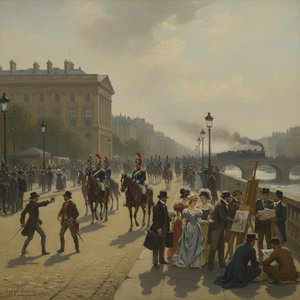
The Chronicler of Conquest: The Life and Legacy of Hippolyte Bellangé
Joseph Louis Hippolyte Bellangé, born in the dawn of the nineteenth century on January 17, 1800, was an artist whose very soul seemed forged in the fires of the Napoleonic era. Growing up within a family deeply rooted in the sculptural arts, Bellangé inherited a profound respect for form and anatomical precision from his father. This early immersion in the tactile world of sculpture provided him with a unique foundation, allowing him to approach the canvas not merely as a surface for color, but as a stage for three-dimensional drama. His journey into the heights of French Romanticism was guided by the legendary Alexandre Gros, a master whose influence instilled in Bellangé a lifelong devotion to the grand narrative and the meticulous depiction of military splendor.
While many of his contemporaries wandered through various genres, drifting between portraiture and landscape, Bellangé remained a steadfast sentinel of the battle-piece. His early explorations into lithography served as a vital crucible for his talent; the disciplined nature of printmaking demanded an acute understanding of light, shadow, and the rapid movement of cavalry and infantry. These formative years as a printmaker allowed him to develop a keen eye for the minute details of military life—the glint of a saber, the texture of a uniform, and the chaotic energy of a charging line—qualities that would later define his monumental oil paintings.
A Mastery of Romantic Realism
The brilliance of Bellangé’s work lies in its rare ability to marry unflinching historical realism with the sweeping emotional intensity of the Romantic movement. He was not a mere illustrator of war; he was a dramatist of history. To achieve this, Bellangé undertook rigorous research, transforming historical records into living, breathing spectacles. His canvases do not simply document troop movements; they capture the palpable tension of the battlefield and the heroic, often tragic, essence of the soldier's experience.
In masterpieces such as 'The Entry of Bonaparte into Milan,' one can witness his ability to weave grand political triumph with human emotion. His brushwork, though precise enough to render the intricate details of a regiment's regalia, possesses an expressive vitality that conveys the heat of combat and the dust of the march. This duality—the technical accuracy of a historian and the passionate heart of a Romantic—allowed him to create works that resonated deeply with a public still reeling from the echoes of the Napoleonic Wars.
His repertoire extended beyond the grand scale of imperial triumphs to include more intimate, yet equally evocative, scenes:
- The Despatch: A poignant exploration of the quiet, heavy moments of military life, focusing on the tension held by officers amidst the backdrop of conflict.
- Prise de la smalah d'Abd el Kader: A dynamic and visceral depiction of the 1843 battle in Algeria, showcasing his mastery of complex, multi-figure compositions.
- Le Barbier du Pays de Caux: A departure from the battlefield that reveals his ability to capture the gentle rhythms of French provincial life with equal grace.
Historical Significance and Lasting Impression
Bellangé’s career was marked by significant institutional recognition, reflecting his standing within the prestigious French art hierarchy. His receipt of a second-class medal for a historical painting in 1824 signaled his arrival on the national stage, and his eventual elevation to the rank of officer in the Legion of Honour in 1861 stands as a testament to his enduring contribution to French culture. He was an artist who successfully bridged the gap between the rigid traditions of Neoclassicism and the burgeoning emotional freedom of the mid-nineteenth century.
As the decades progressed, Bellangé’s work became a vital visual archive of an era that shaped modern Europe. Through his eyes, the glory and the grit of the Napoleonic age were preserved for posterity. He remains a titan of battle painting, remembered not just for the scale of his canvases, but for the profound way he captured the heartbeat of history itself. His legacy lives on in every stroke that depicts the courage of the fallen and the sweeping grandeur of an empire's zenith.
Ερωτήσεις και Απαντήσεις
Πόσα έργα του/της Hippolyte Bellangé είναι διαθέσιμα για περιήγηση;
Μπορείτε να περιηγηθείτε σε 26 έργα τέχνης έργα του Hippolyte Bellangé στη σελίδα Όλα τα έργα.
Με τι άλλα ονόματα είναι γνωστός/η ο/η Hippolyte Bellangé;
Ο/Η Hippolyte Bellangé αναγνωρίζεται και με τα εναλλακτικά ονόματα Hippolyte Bellange.
Πού μπορώ να δω τα έργα του/της Hippolyte Bellangé ταξινομημένα ανά ατμόσφαιρα;
Στη σελίδα Κόρνερ Αίσθησης του καλλιτέχνη, μπορείτε να δείτε τα έργα του Hippolyte Bellangé ταξινομημένα ανάλογα με την ατμόσφαιρά τους.