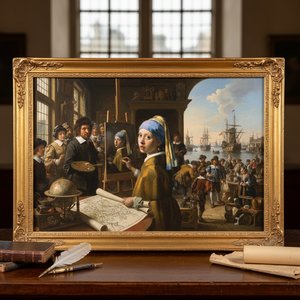
A Master of Light and Domestic Drama
In the vibrant tapestry of the Dutch Golden Age, few names evoke the intimate tension of a flickering candlelit room quite like Peter Wtewael. Born in Utrecht in 1596, Wtewael was an artist shaped by a profound lineage of creativity; he was the son of the esteemed painter and engraver Joachim Wtewael and the brother of Johan Wtewael. This familial immersion in the arts provided him with more than just technical training—it offered a window into the very soul of Netherlandish visual storytelling. Though his active period as a painter was relatively brief, spanning roughly between 1624 and 1630, the impact of his brushwork remains etched in the history of the Baroque era.
Wtewael’s artistic identity was deeply forged by the revolutionary influence of Caravaggio. He became a dedicated follower of this dramatic style, embracing the technique of tenebrism to transform ordinary subjects into profound psychological studies. By utilizing stark contrasts between deep, swallowing shadows and piercing highlights, he breathed life into his canvases. This mastery of chiaroscroll allowed him to elevate the mundane—a simple kitchen gathering or a piece of fruit—into something monumental and spiritually resonant. His ability to manipulate light created an immersive atmosphere where the viewer feels less like an observer and more like a silent participant in the scene.
The Intimacy of the Kitchen and the Grandeur of Myth
While many of his contemporaries sought the vastness of landscapes, Wtewael found infinite complexity within the confines of domestic interiors. He became a pioneer of the kitchen scene, a genre that allowed him to showcase an extraordinary command of texture and detail. In these works, one can almost feel the cold roughness of stone walls or the glistening, succulent surfaces of meat and pewter. However, beneath this surface-level realism lay a layer of complex symbolism and even risqué humor. His depictions of domestic life often featured subtle visual jokes and erotic undertones, where the abundance of foodstuffs served as an allegory for the pleasures of the flesh, blending the sensual with the everyday.
Beyond the kitchen, Wtewael’s imagination soared into the realm of the mythological and the biblical. He possessed a rare ability to weave complex narratives through gesture and expression, as seen in masterpieces like The Denial of Peter. In these compositions, the dramatic lighting does more than illuminate; it underscores themes of human vulnerability, doubt, and faith. Whether he was painting a jester with a flute or a sacred biblical moment, his work remained anchored in a meticulous observation of the human condition, making him a singular voice in the Utrecht school of painters.
Legacy and Artistic Significance
The true measure of Peter Wtewael’s significance lies in his ability to bridge the gap between the gritty realism of genre painting and the high drama of mythological storytelling. Though his known oeuvre is relatively small—consisting of a handful of signed works and several attributed pieces—each canvas serves as a testament to his technical prowess and emotional depth. His influence can be traced through the evolution of Dutch genre painting, particularly in how he utilized light to imbue domesticity with a sense of the extraordinary.
Today, his contributions are preserved in some of the world's most prestigious institutions, including The Metropolitan Museum of Art, where his kitchen scenes continue to captivate scholars and art lovers alike. Wtewael remains a vital figure for anyone seeking to understand the transformative power of the Baroque period, reminding us that even in the smallest, most shadowed corner of a room, there is a universe of drama waiting to be discovered.
Ερωτήσεις και Απαντήσεις
Μπορώ να περιηγηθώ στα έργα του/της Peter Wtewael ανά καλλιτεχνικό κίνημα;
Τα καλλιτεχνικά κινήματα στα οποία συμμετείχε ο/η Peter Wtewael μπορείτε να τα δείτε στη σελίδα των καμπανών του/της Όλα τα Ρευmatά, η οποία ομαδοποιεί τα έργα ανά καλλιτεχνικό κίνημα.
Μπορώ να επισκεφτώ ένα εικονικό μουσείο με τα έργα του Peter Wtewael;
Μια εικονική επίσκεψη είναι εφικτή: η σελίδα 3D Μουσείο του Peter Wtewael παρουσιάζει τα έργα του καλλιτέχνη σε μια τρισδιάστατη γκαλερί.
Πόσα έργα του/της Peter Wtewael είναι διαθέσιμα για περιήγηση;
Μπορείτε να περιηγηθείτε σε 11 έργα τέχνης έργα του Peter Wtewael στη σελίδα Όλα τα έργα.