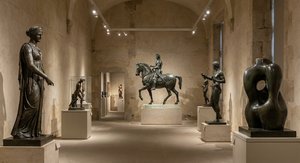
2012. Acrílico sobre lienzo. Culturgest - Fundação Caixa Geral de Depósitos.

§ 1Catalogue data
 Acrílico sobre lienzo
- Arte de pared
- Contemporary Minimalism
 2012
2012 Culturgest - Fundação Caixa Geral de Depósitos
Esta obra está protegida por derechos de autor
La obra de arte que se muestra en esta página está protegida por las leyes de propiedad intelectual, lo que significa que no podemos crear ni vender legalmente una reproducción idéntica. Esta protección se hace cumplir en virtud de acuerdos internacionales como el Convenio de Berna y por las leyes nacionales, incluidas aquellas establecidas por el Ley de derechos de autor de los EE. UU. - Título 17.
Como una alternativa respetuosa y legal, ofrecemos obras de arte personalizadas y pintadas a mano inspiradas en la original. Nuestros expertos y profesionales del arte estudian cuidadosamente el estilo, el sentimiento y la esencia artística de la obra original para crear una pieza nueva y única que evoque la misma sensación, siendo al mismo tiempo una creación original por derecho propio.
Este método cumple plenamente con las normativas de derechos de autor, ya que no implica la copia ni la duplicación de la obra protegida. En su lugar, se trata de una reinterpretación creativa: una nueva pintura influenciada por la original, pero que no es idéntica a ella.
 Leer más información
§ 2Abstract
Descripción del objeto
Una instalación escultórica de madera blanca y arena que captura la esencia del espacio cotidiano. Obra destacada en la exposición "Todas quiero", artistas portugueses mujeres desde 1900 hasta 2020.
Biografía del artista
Explore las instalaciones y dibujos de la artista portuguesa armanda duarte. Capturando la vida cotidiana y la comunidad, su obra combina colores intensos y texturas.
§ 3Commentary
Head, Torso and Limbs – Armanda Duarte
Armanda Duarte’s “Head, Torso and Limbs,” created in 2012, stands as a testament to the understated elegance of minimalist sculpture and the profound exploration of materiality inherent in Portuguese contemporary art. This piece embodies Duarte's signature approach—a deliberate reduction to essential forms combined with meticulous attention to texture and surface treatment—reflecting a broader trend toward conceptual abstraction that emerged during the early 2010s. The artwork’s simplicity belies its complex implications, inviting viewers to contemplate notions of presence, stillness, and the inherent beauty found within geometric precision.Materiality and Technique
The sculpture utilizes balsa wood strip—a lightweight tropical hardwood known for its stability and ease of shaping—sandpaper, and a small shelf as its components. Duarte’s technique prioritizes careful layering and smoothing, resulting in a surface that is remarkably tactile. The sandpaper application isn't merely decorative; it serves to subtly alter the wood grain, creating subtle variations in texture that contribute significantly to the overall aesthetic experience. This meticulous process underscores Duarte’s commitment to honoring the inherent qualities of her chosen material—a deliberate rejection of overt ornamentation and an embrace of natural form.Historical Context: Minimalism and Conceptual Sculpture
“Head, Torso and Limbs” aligns itself with the influential movement of Minimalism that gained prominence in American sculpture during the 1960s and 70s. Artists like Donald Judd and Sol LeWitt championed geometric forms—cubes, rectangles, lines—stripped down to their purest essentials, rejecting representational imagery altogether. Duarte’s work echoes this ethos by eschewing figurative depiction, focusing instead on exploring fundamental sculptural principles. Furthermore, it speaks to a wider cultural preoccupation with reducing complexity to its core elements – mirroring the broader philosophical currents of the time that questioned traditional artistic conventions.Symbolism and Emotional Resonance
Despite its apparent austerity, “Head, Torso and Limbs” possesses an undeniable emotional resonance. The sculpture’s geometric form—a simple rectangular block supported by a horizontal shelf—suggests stability and grounding, mirroring the human torso and limbs. The smooth surface achieved through sanding evokes feelings of calmness and serenity, inviting contemplation on notions of balance and harmony. Duarte's deliberate choice of material – balsa wood – symbolizes resilience and adaptability, reflecting the enduring spirit of Portuguese art in confronting new challenges.Provenance and Artistic Vision
Presented at “All I want: Portuguese women artists from 1900 to 2020,” this artwork exemplifies Armanda Duarte’s dedication to exploring the relationship between form and material—a core element of her artistic vision. Her work consistently seeks to capture fleeting moments of beauty within seemingly unremarkable objects, prompting viewers to reconsider their perceptions of everyday life and art's capacity to inspire introspection. The piece serves as a powerful reminder that profound artistic expression can emerge from the simplest gestures and materials.Preguntas y respuestas
¿Qué tono emocional transmite el estilo Contemporary Minimalism de "Cabeza"?
La emoción Reflexivo de "Cabeza" acompaña a su estilo Contemporary Minimalism.
¿Qué paleta y qué color predominante definen a "Cabeza"?
"Cabeza" de Armanda Duarte utiliza una paleta de Tonos neutros, con el Arcilla (#946640) como color dominante.
¿Dónde puedo comprar reproducciones pintadas a mano de "Cabeza" de Armanda Duarte?
"Cabeza" está disponible como una reproducción al óleo pintada a mano sobre lienzo de lino. Puede realizar su pedido en la página de Reproducción al óleo pintada a mano, con una variedad de tamaños disponibles.


 Cambiar a impresiones


 Para obras de arte o reproducciones que midan más de 105 cm (aproximadamente 41 pulgadas) en cualquiera de sus lados, el marco se enviará como un kit desmontado. Este método garantiza una entrega segura y evita daños durante el transporte.