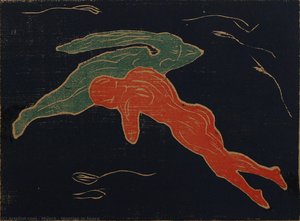
1897. Acrílico sobre lienzo, 135.0 x 163.0 cm. Nasjonalgalleriet.

§ 1Datos del catálogo

- 135.0 x 163.0 cm


§ 2Abstracto
Descripción del objeto
"Madre e hija" de Edvard Munch: Una obra maestra expresionista que captura la conexión emocional entre dos mujeres en un entorno urbano tranquilo iluminado por una luz suave y cálida. Descubre esta pintura icónica en el Museo Nacional de Oslo.
 Ver más
Biografía del artista
Descubre a Edvard Munch (1863-1944), pionero del Expresionismo. Explora 'El Grito' y su arte que ahonda en la ansiedad, la mortalidad, el amor y temas psicológicos. ¡Reproducciones exclusivas en AllPaintingsStore!
§ 3Comentario
Mother and Daughter: A Portrait of Anxiety and Connection
The painting “Mother and Daughter” by Edvard Munch stands as a cornerstone of Expressionist art—a testament to Munch’s profound ability to distill complex psychological states onto canvas. Created in 1897, this oil on canvas masterpiece resides at the Nasjonalgalleriet in Oslo, Norway, offering viewers an intimate glimpse into Munch's exploration of human emotion and vulnerability. Measuring 135 x 163 cm, it’s more than just a depiction; it’s a conduit for feeling—a visual embodiment of anxiety and the enduring bond between parent and child.Composition and Symbolism: A Dialogue Between Darkness and Light
Munch's compositional choices are deliberate and laden with symbolic significance. Two women dominate the scene, positioned in stark contrast against a muted backdrop of buildings and a prominent clock. The woman seated exudes stillness and quiet contemplation, while her daughter stands beside her, gazing intently outwards—a visual representation of observation and perhaps apprehension. The inclusion of the clock serves as a poignant reminder of time’s relentless passage and its impact on human experience. Munch skillfully employs light to heighten the emotional atmosphere; soft illumination casts shadows that deepen the sense of unease and intimacy simultaneously.Expressionism: Capturing Inner Turmoil
“Mother and Daughter” exemplifies Expressionist principles—a movement characterized by prioritizing subjective emotion over objective representation. Munch, alongside artists like Ernst Ludwig Kirchner and Emil Nolde, sought to convey inner psychological states rather than merely portraying external reality. He achieved this through bold brushstrokes, distorted forms, and a palette dominated by muted tones—techniques designed to evoke feelings of dread and melancholy. Munch’s artistic vision was deeply influenced by his own personal struggles with mental illness and loss—themes that permeate throughout his oeuvre.Light in Painting: Enhancing Emotional Depth
The masterful use of light is crucial to understanding the painting's emotional impact. Munch employs chiaroscuro—the dramatic interplay between light and shadow—to sculpt the figures and create a palpable sense of atmosphere. The gentle illumination highlights the faces of the women, emphasizing their expressions and conveying a feeling of vulnerability. Simultaneously, shadows envelop the surroundings, symbolizing darkness and uncertainty—mirroring the anxieties that underlie the scene. This careful manipulation of light contributes significantly to the painting's haunting beauty and its ability to resonate with viewers on an emotional level.Beyond Munch: Influence and Legacy
Edvard Munch’s “Mother and Daughter” transcends its immediate context as a depiction of familial relationships; it speaks to universal themes of anxiety, fear, and connection. Its influence extends far beyond the Expressionist movement, inspiring artists across generations who grapple with similar emotional concerns. The painting continues to captivate audiences today—a timeless masterpiece that invites contemplation on the complexities of human experience and the enduring power of art to convey profound psychological truths. For more information about Edvard Munch and his artistic journey, visit AllPaintingsStore.com/@/Edvard-Munch.Preguntas y respuestas
¿Dónde puedo comprar una imagen digital de "Madre e hija" de Edvard Munch?
Para obtener una copia digital de "Madre e hija" de Edvard Munch, puede solicitar descarga de una imagen digital en alta resolución en su página de Imagen digital de alta resolución.
¿Cuáles son las dimensiones de la obra original "Madre e hija" de Edvard Munch?
La obra original "Madre e hija" de Edvard Munch mide 135 x 163 cm.
¿Permaneció "Madre e hija" en el país de origen de su artista?
No; la obra se encuentra en el extranjero. Edvard Munch nació en Suecia, y el original de "Madre e hija" se encuentra en un museo de Noruega.


 Cambiar a impresiones


 Para obras de arte o reproducciones que midan más de 105 cm (aproximadamente 41 pulgadas) en cualquiera de sus lados, el marco se enviará como un kit desmontado. Este método garantiza una entrega segura y evita daños durante el transporte.