

1912. Xilografía.

§ 1Catalogue data


§ 2Abstract
Descripción del objeto
Descubre 'Animal Legend' de Franz Marc, una obra maestra del expresionismo alemán que captura la energía primitiva y el espíritu de la naturaleza en un diseño monocromo impactante.
 Ver más
Biografía del artista
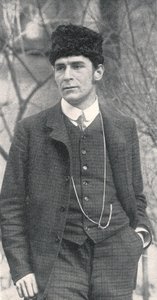
Explora a Franz Marc (1880-1916), un pionero del expresionismo alemán y cofundador del Der Blaue Reiter. Descubre sus icónicos cuadros con animales, colores vibrantes y temas espirituales. ¡Aprende sobre su legado!
§ 3Commentary
Animal Legend: A Symphony of Monochrome and Instinct
Franz Marc’s “Animal Legend,” created in 1912 during the height of Expressionism, isn't merely a depiction of animals; it’s an embodiment of spiritual yearning rendered in breathtaking simplicity. This woodcut on Japan paper transcends mere representation, plunging viewers into a realm where form and emotion converge with remarkable force.
Composition and Technique: Flattened Space, Dynamic Movement
The artwork eschews traditional perspective, opting instead for a flattened picture plane that amplifies the feeling of movement. Marc skillfully arranges overlapping animal figures—likely horses, deer, and perhaps others—within a densely populated composition. Thick, jagged lines define these forms, mirroring the turbulent energy of the scene. The artist’s masterful use of woodcut technique ensures crisp lines and a tonal range limited to stark blacks and whites, enhancing the artwork's dramatic impact.
Color Palette: Absence Speaks Volumes
The deliberate restriction to monochrome—primarily black and white with subtle shades of grey—is crucial to “Animal Legend’s” expressive power. Rather than concealing detail, this absence amplifies the emotional resonance of the piece. It forces us to focus on texture and line weight, conveying a profound sense of immediacy and capturing the essence of primal instinct.
Symbolism: Echoes of Spiritual Harmony
Marc’s fascination with animals stemmed from his belief that they possessed inherent spiritual qualities—a connection to nature untouched by human intellect. The artwork evokes themes of harmony between animal life and the natural world, mirroring Marc's own philosophical convictions. The stylized depiction of these creatures suggests a quest for transcendence, reflecting the broader spirit of Der Blaue Reiter movement.
Historical Context: Expressionism’s Bold Vision
"Animal Legend" emerged during a period marked by significant artistic and intellectual upheaval—the aftermath of World War I. Expressionist artists sought to convey inner emotions and psychological states through distorted forms and vibrant colors (though Marc's piece deliberately avoids color). This artwork stands as a testament to the movement’s commitment to capturing subjective experience, prioritizing emotional intensity over objective realism.
Provenance & Recognition
The artwork was gifted by Michael Brooks to the National Gallery of Art in 1943. Catalogued as Lankheit 831.2 and associated with Der Blaue Reiter, “Animal Legend” continues to inspire admiration for its masterful execution and profound symbolic depth.
Preguntas y respuestas
¿De qué técnica y estilo se compone "Animal Legend"?
"Animal Legend" está realizada en Xilografía, con el estilo Expressionist Painting.
¿Qué color predomina en "Animal Legend"?
El Negro (#0e0e0e) es el color predominante de "Animal Legend" de Franz Marc.
¿En qué año se creó "Animal Legend" de Franz Marc?
"Animal Legend" de Franz Marc fue creada en 1912.


 Cambiar a impresiones


 Para obras de arte o reproducciones que midan más de 105 cm (aproximadamente 41 pulgadas) en cualquiera de sus lados, el marco se enviará como un kit desmontado. Este método garantiza una entrega segura y evita daños durante el transporte.


