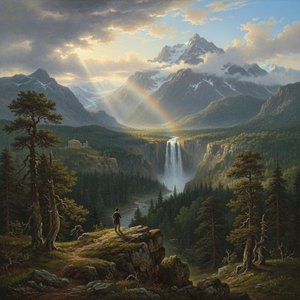
Early Life and Career
Abram Louis Buvelot (1814-1888), a Swiss landscape painter, was born in Morges, Vaud, Switzerland on March 3, 1814. He spent his early years in Brazil for 17 years, followed by a brief period of 5 years in Switzerland before moving to Melbourne, Australia in 1864. His family had been citizens of Morges since 1677 where they had arrived as Protestant refugees from Condé-en-Barrois. He attended art school at Lausanne and studied briefly with Camille Flers before travelling to Paris in about 1834. After a few months there he migrated to Bahia, Brazil where his uncle François Buvelot had a coffee plantation. In October 1840 Buvelot married Marie-Félicité Lalouette (born 1816). He worked under Marc-Louis Arland at Lausanne and from around 1834 continued his studies at Paris with Camille Flers, a well-known landscape painter of the day.Artistic Contributions
Buvelot is considered the father of Australian landscape painting and had a profound influence on the Heidelberg School of painters. His works, characterized by their serene and idyllic depictions of the australian landscape, continue to inspire artists to this day. He developed his style from subtle adjustments to European techniques towards a plein air style that hovered on the brink of Australian Impressionism. The Heidelberg School’s distinctive aesthetic was largely shaped by Buvelot's pioneering approach to capturing the essence of the Australian bush.Notable Works and Legacy
Buvelot produced several masterpieces, including “Tree Study” (1870), which exemplifies his unique blend of european techniques with australian subject matter. Also "Landscape, near Melbourne" (1865) captures the beauty of the australian environment. His paintings are displayed in museums like the National Gallery of Victoria and Art Gallery of New South Wales. James Smith praised Buvelot’s contribution to Australian art as “the first colonial artist to really ‘see’ the local landscape,” after years in which “the memory of England prevented any appreciation of the australian landscape.” Tom Roberts (who etched a portrait of Buvelot in or shortly before 1888) noted that Buvelot “began the real painting of Australia.”Museums and Collections
Buvelot's works can be found in various museums and collections, including: National Gallery of Victoria, Melbourne, Australia Art Gallery of New South Wales, Sydney, Australia. Explore AllPaintingsStore’s abram-louis buvelot page and discover the treasures of his art!Preguntas y respuestas
¿Qué estados de ánimo expresan las obras de Abram Louis Buvelot?
La página de Rincón de emociones del artista muestra las obras de Abram Louis Buvelot organizadas según su atmósfera.
¿Puedo explorar las obras de Abram Louis Buvelot por tema?
Las obras de Abram Louis Buvelot pueden explorarse por tema en la página Índice temático del artista.
¿Dónde puedo explorar las obras de Abram Louis Buvelot organizadas por color?
El Índice de color de Abram Louis Buvelot organiza las obras del artista por colores.