The Soul of the Norwegian Landscape: The Life and Art of Bernhard Folkestad
Bernhard Folkestad (1879–1933) was far more than a mere chronicler of scenery; he was a painter of profound atmosphere, a man who sought to bridge the gap between the tangible world of nature and the intangible depths of human emotion. Born in London to a Norwegian father serving the Seamen's Mission, Folkestad’s early years were marked by a sense of movement and cultural intersection, eventually settling in Drammen, Norway. His artistic journey was one of disciplined observation and wandering curiosity, leading him from the decorative apprenticeships of Christiania to the prestigious art circles of Copenhagen and Paris. Through his brush, the rugged textures of the Norwegian landscape became a medium for literary reflection, making him a singular figure who occupied the delicate space between naturalist precision and romantic introspection.A Journey Through Light and Tradition
The development of Folkestad’s technique was shaped by a series of encounters with some of the most significant masters of his era. His education at the Royal Academy of Art in Oslo under Wilhelm Schirmer instilled in him a foundational respect for tonal harmony and the realistic depiction of light. However, it was his time in Copenhagen, studying under Kristian Zahrtmann, and his subsequent training under the naturalist Laurits Tuxen, that truly refined his ability to capture the ephemeral qualities of the natural world. These influences did not lead him toward the fragmented brushwork of Impressionism, but rather toward a more grounded, meticulous realism. His travels through Lübeck, Hamburg, Amsterdam, and eventually Paris allowed him to absorb the diverse light of Europe, yet he always returned to the quiet, evocative essence of his Scandinavian roots.The Interplay of Nature and Narrative
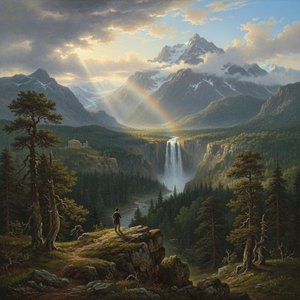
Folkestad’s oeuvre is celebrated for its ability to evoke a palpable sense of place, particularly within the breathtaking fjordlands and dense forests of Norway. He possessed a rare talent for rendering the subtle gradations of tone that define the changing seasons, as seen in his masterful depictions of autumn foliage where light and shadow dance across deciduous leaves. Yet, there was always an underlying narrative pulse in his work, a quality often linked to his dual identity as both a painter and an essayist. Drawing inspiration from the psychological depth found in the works of Scandinavian Romanticists like Henrik Ibsen, Folkestad infused his landscapes with a humanist sensibility. His paintings, such as Mørkeloftet or his delicate studies of gardens, suggest a world that is not only seen but felt—a place where the external environment serves as a mirror to the inner human experience.Legacy and Artistic Significance
The historical significance of Bernhard Folkestad lies in his refusal to follow the fleeting trends of his contemporaries, choosing instead to cultivate a voice that was authentically naturalist and deeply contemplative. His debut at the Autumn Exhibition in Oslo, which resulted in the immediate acquisition of his work by the National Gallery, signaled the arrival of an artist capable of profound emotional resonance. As his career progressed, his focus shifted slightly toward the written word, with his essays and books such as Sol og morild reflecting a mind deeply engaged with the rhythms of life and nature. Today, his legacy endures through works that remain timeless—paintings that do not merely document the Norwegian landscape but breathe life into its very soul, inviting every viewer to find their own reflection within the quiet beauty of his canvases.Preguntas y respuestas
¿Puedo explorar las obras de Bernhard Folkestad por técnica?
La página Todas las técnicas agrupa las obras de Bernhard Folkestad por técnica.
¿Existe una cronología de las obras de Bernhard Folkestad?
Las obras de Bernhard Folkestad pueden verse en orden cronológico en la página de Cronología de obras del artista.
¿Puedo explorar las obras de Bernhard Folkestad por movimiento?
Puedes ver los movimientos en los que trabajó Bernhard Folkestad en la página de Todos los movimientos del artista, donde las obras se agrupan por movimiento.