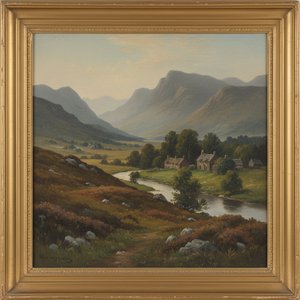
A Vision of Scottish Identity: The Life and Legacy of James Currie
James Currie stands as a singular figure in the landscape of 19th-century Scottish portraiture, celebrated for his meticulous realism and profound understanding of familial bonds. Born in the rugged, windswept beauty of Caithness, Scotland, around 1808, Currie’s artistic journey was indelibly shaped by the Highlands. This formative environment, characterized by dramatic light and untamed landscapes, would later inform his lifelong dedication to capturing the true essence of human character through paint. His early training at the Edinburgh Academy provided the technical foundation necessary for his ascent, placing him alongside notable contemporaries such as David Octavius Hill and Robert Muir. This trio of talented pupils shared a disciplined approach to observation that would eventually lead them toward a revolutionary intersection of traditional art and emerging technology.
The evolution of Currie’s career is inextricably linked to his collaborative spirit. Alongside Hill and Muir, he became a vital part of the Edinburgh Photographic Studio, a partnership that helped redefine the boundaries of portraiture. Together, they pioneered the use of albumen printing, a process that offered an unprecedented level of detail and tonal range compared to the more generalized strokes of traditional oil painting. This period marked a significant shift in how Scottish society was documented; it was no longer merely about idealized representations but about an unflinching honesty. Through this lens, Currie sought to capture the subtle nuances of expression and the quiet dignity of his subjects, bridging the gap between the permanence of fine art and the burgeoning precision of photography.
Mastery of Realism and the Art of Observation
Currie’s artistic style is defined by an unwavering adherence to realism, a quality that demanded rigorous study and intense concentration. He was a master of anatomy, drapery, and the complex interplay of light, skills he honed through extensive anatomical drawings and a keen eye for natural illumination. Unlike many of his contemporaries who favored romanticized or idealized versions of their sitters, Currie pursued an astonishing level of accuracy. His portraits are characterized by a deep psychological depth, where every fold of fabric and every flicker of emotion in the eyes serves to convey the inner life of the subject. This commitment to truth allowed him to create works that felt vibrantly alive, long after the brush had left the canvas.
His prolific output was often centered around the prominent families of Scotland, most notably the Brodie clan. His ability to capture the essence of nobility and the warmth of familial connection made him a sought-after portraitist for those wishing to preserve their lineage. Some of his most evocative works include:
- Elizabeth Baillie, Wife of William Brodie: A romantic oil painting that showcases his ability to blend formal elegance with a soft, atmospheric seascape.
- The Family of William Brodie, 22nd Laird: A testament to his skill in capturing group dynamics and the shared identity of a prominent Scottish lineage.
- George and Hugh Brodie as Children in Highland Dress: A poignant depiction that utilizes the rugged textures of traditional attire to evoke a sense of cultural heritage.
Ultimately, the historical significance of James Currie lies in his role as a chronicler of a changing Scotland. By blending the classical traditions of oil painting with the innovative spirit of early photographic processes, he helped create a visual record that was both technically sophisticated and emotionally resonant. His work remains a vital window into the 19th century, offering a glimpse into the faces, the fashions, and the enduring spirit of the Scottish people.
Preguntas y respuestas
¿Dónde puedo encontrar estadísticas sobre las obras de James Currie?
Puedes consultar la página de Estadísticas de James Currie, donde se presentan estadísticas sobre sus obras en este sitio web.
¿Cuántas obras de James Currie hay disponibles para explorar?
Puede explorar 5 obras obras de James Currie en la página Todas las obras de arte.
¿Qué colores utilizaba con más frecuencia James Currie?
El uso del color de James Currie en las obras listadas en este sitio web puede estudiarse en la página ADN de la Paleta del artista.