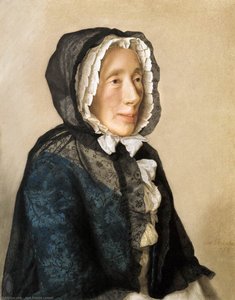
Jean-Étienne Liotard (1702–1789)
Jean-Étienne Liotard, a Genevan painter, art connoisseur, and dealer, was born on December 22, 1702, in Geneva, Switzerland. His parents, French Protestants, had fled to Geneva after 1685. Liotard’s artistic journey began under the guidance of professors Daniel Gardelle and Petitot, whose enamels and miniatures he skillfully replicated. These formative influences instilled a meticulous attention to detail that would characterize his entire oeuvre.Early Life and Training
Liotard received an exceptional education for his time, focusing on both painting techniques – particularly enamel work and miniature painting – and the study of classical art history. He honed his skills under the tutelage of Gardelle and Petitot, mastering the intricacies of these mediums and absorbing the stylistic principles of the Baroque era. This rigorous training laid the foundation for his later success as a portraitist and pastel artist.Artistic Career: Travels and Patronage
Liotard embarked on extensive travels throughout Europe – Paris, Rome, Constantinople (Istanbul), Vienna – establishing himself as one of the most sought-after painters of his generation. His portraits commanded considerable prestige among aristocratic circles, securing him lucrative commissions and cementing his reputation as a master craftsman. Notably, he served as painter to Emperor Joseph II in Vienna, gaining access to royal courts and influencing artistic tastes across Central Europe. He cultivated relationships with influential collectors and patrons who recognized the exceptional quality of his work.Notable Works and Style
Liotard’s distinctive style is primarily defined by his mastery of pastel – a medium he embraced wholeheartedly and elevated to new heights of expressive subtlety. His canvases shimmer with delicate hues and luminous textures, capturing fleeting moments of beauty with remarkable precision. Among his most celebrated paintings are *Dutch Girl at Breakfast*, a masterful depiction of domestic tranquility; *La Liseuse, The Chocolate Girl*, an exquisitely rendered portrait conveying grace and contemplation; and *Maria Frederike van Reede-Athlone at Seven*, showcasing Liotard’s ability to convey psychological depth through naturalistic observation. His meticulous attention to detail—particularly in capturing the nuances of facial expression—established him as a pioneer of psychological realism within his era. Furthermore, he was an avid collector of antiquities and artworks from antiquity and Renaissance, which profoundly impacted his artistic vision and informed his stylistic choices.Legacy and Influence
Jean-Étienne Liotard’s legacy extends beyond his impressive body of work. He championed the importance of drawing as a fundamental element of painting, advocating for clarity, firmness, fluidity, delicacy, and truthfulness—principles that resonated deeply with fellow artists of his time. His treatise *Traité des principes et des règles de la peinture* (1781) remains a seminal text on artistic technique and aesthetic philosophy. Liotard died in Geneva in June 12, 1789, leaving behind an enduring contribution to European art history—a testament to the power of observation, meticulous craftsmanship, and unwavering devotion to artistic excellence. He is remembered as one of the foremost pastel artists of his era and a champion of classical ideals within the burgeoning Romantic movement.Preguntas y respuestas
¿Puedo explorar las obras de Jean-Étienne Liotard por espectro de color?
Las obras de Jean-Étienne Liotard pueden explorarse por color en la página Índice Espectral del artista.
¿Puedo explorar las obras de Jean-Étienne Liotard por estado de ánimo?
Las obras de Jean-Étienne Liotard pueden explorarse por estado de ánimo en la página Galería de estados de ánimo del artista, donde las piezas se organizan según sus emociones registradas.
¿Puedo estudiar el uso del color de Jean-Étienne Liotard en toda su obra?
El uso del color de Jean-Étienne Liotard en las obras listadas en este sitio web puede estudiarse en la página Genoma de la Paleta del artista.