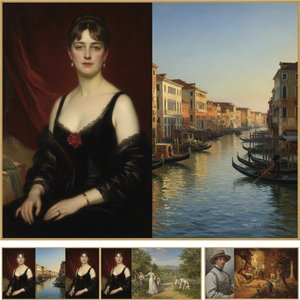
John Haughton Hague (1842–1934): A Lancashire Landscape Painter
John Haughton Hague was born in Oldham, Lancashire, in 1877, the son of John Hague Sr., a solicitor, and Eliza Hargreaves. His artistic talent emerged early, nurtured by his father’s encouragement and a family tradition of appreciation for visual arts. Hague's formative years were spent absorbing the beauty of the surrounding countryside – the Pennines and the Rochdale Canal – landscapes that would become central to his oeuvre. This intimate connection with Lancashire instilled in him a deep understanding of its vernacular culture and geological formations, informing his artistic vision throughout his career.- Early Influences: Hague’s artistic sensibilities were shaped by Romantic landscape painting, particularly the works of Turner and Constable. These artists championed atmospheric perspective and emotional expression, principles that Hague skillfully adopted in his own paintings.
- Training & Technique: He studied at Oldham Lyceum under John Dodd, honing his skills in oil paint and mastering techniques for capturing light and shadow with remarkable precision. His meticulous brushwork conveyed a palpable sense of realism while simultaneously conveying the grandeur and serenity of the natural world.
- Notable Works: Among Hague's most celebrated paintings are “The Old Bridge,” a haunting depiction of a crumbling stone structure overlooking the Rochdale Canal, and “The Chadderton Taxidermist,” which portrays a solitary figure examining specimens in a workshop—a poignant commentary on Victorian scientific curiosity. These pieces exemplify his ability to distill complex ideas into evocative visual narratives.
- Legacy & Significance: Hague’s contribution to Lancashire art history is considerable. He helped establish Oldham Art Gallery, furthering the appreciation of regional artistic traditions and ensuring that his landscapes would endure for generations to come. His paintings remain treasured examples of Romantic landscape painting, offering invaluable insights into Victorian England and its relationship with the natural environment.
Preguntas y respuestas
¿Cómo evolucionó el arte de John Haughton Hague a lo largo del tiempo?
La Trayectoria de John Haughton Hague es una línea de tiempo con desplazamiento vertical que presenta las obras del artista en orden cronológico, agrupadas en capítulos por periodos de su carrera.
¿Qué estados de ánimo expresan las obras de John Haughton Hague?
La Rincón de emociones de John Haughton Hague organiza las obras del artista según el estado de ánimo.
¿Existe un resumen de todos los temas que pintó John Haughton Hague?
Las obras de John Haughton Hague pueden explorarse por tema en la página Índice temático del artista.