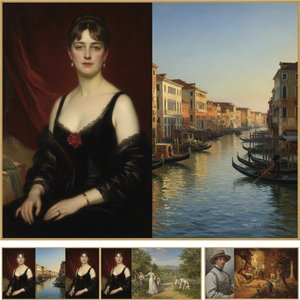
The Enigmatic Vision of Louis Sicardi
Louis Sicardi, a name perhaps less immediately recognizable than some of his Surrealist contemporaries, nevertheless occupies a crucial and fascinating position within the movement’s evolution. Born in 1904, his life was one deeply intertwined with the political and artistic upheavals of the 20th century, shaping a body of work that is both intensely personal and powerfully symbolic. Sicardi wasn't merely *a* Surrealist; he was a pivotal figure in its Romanian manifestation, bringing a unique blend of abstraction, automatism, and social consciousness to the group’s explorations of the subconscious. His early life provided little indication of the artistic path he would forge. He initially pursued a legal education, but the allure of creative expression proved too strong, leading him to abandon his studies and immerse himself in the burgeoning avant-garde scene of Bucharest. This decision marked not just a change in profession, but a fundamental shift in worldview – a rejection of established norms in favor of exploring the hidden realms of human experience.Early Influences and the Romanian Surrealist Group
Sicardi’s artistic development was profoundly influenced by his encounter with Victor Brauner, a fellow Romanian artist who would become a lifelong friend and collaborator. Together, they formed the core of the Romanian Surrealist group in the early 1930s, actively engaging with international Surrealist principles while simultaneously developing their own distinct aesthetic language. The group’s manifesto, published in 1933, was a bold declaration of artistic independence and a scathing critique of bourgeois society. It called for an art that was rooted in the unconscious, free from rational control, and capable of challenging conventional perceptions of reality.- Early Abstraction: Sicardi’s initial works demonstrate a strong leaning towards abstract forms, influenced by artists like Wassily Kandinsky and Joan Miró.
- Automatism & Dream Imagery: He quickly embraced automatist techniques – allowing the hand to move freely across the canvas without conscious direction – as a means of accessing the subconscious mind. This led to paintings filled with biomorphic shapes, enigmatic symbols, and dreamlike landscapes.
- Political Engagement: Unlike some Surrealists who remained aloof from political concerns, Sicardi actively used his art to express his opposition to fascism and social injustice. His work often contained veiled critiques of authoritarianism and expressions of solidarity with the oppressed.
Development of a Personal Symbolism
As his career progressed, Sicardi developed an increasingly complex and personal symbolism. Recurring motifs – eyes, hands, labyrinths, and fragmented figures – populated his canvases, each imbued with multiple layers of meaning. The eye, in particular, became a central symbol, representing both perception and surveillance, knowledge and control. His paintings often depict distorted bodies trapped within claustrophobic spaces, suggesting feelings of alienation, anxiety, and psychological torment. “The Labyrinth,” a recurring theme, can be interpreted as a metaphor for the human psyche – a complex network of desires, fears, and repressed memories. Sicardi’s technique also evolved during this period. He moved away from purely abstract forms, incorporating more figurative elements into his compositions, though always rendered in a highly stylized and dreamlike manner. His palette became richer and more nuanced, employing bold contrasts of color to create a sense of emotional intensity.Exile and Late Works
The rise of fascism in Europe forced Sicardi into exile in Paris in 1938, where he continued to work alongside other Surrealist artists like Max Ernst and Yves Tanguy. However, his experience as an outsider – a Romanian artist living in the heart of the Surrealist movement – contributed to a sense of isolation and alienation that is palpable in his later works. He participated in several important Surrealist exhibitions during this period, but struggled to gain widespread recognition. After World War II, Sicardi’s art became increasingly introspective and melancholic. His paintings from the 1950s and 60s are characterized by a sense of quiet desperation and existential angst. He experimented with new materials and techniques, incorporating collage elements into his compositions and exploring the possibilities of monochrome painting. His late works, though less overtly political than his earlier paintings, retain a powerful emotional resonance – a testament to his lifelong commitment to exploring the darker aspects of human experience.Historical Significance and Legacy
Louis Sicardi’s contribution to Surrealism extends beyond his individual artistic achievements. He played a crucial role in establishing Surrealism as an international movement, bringing its principles to Eastern Europe and fostering a vibrant creative community in Romania. His work challenged conventional notions of art and politics, advocating for an art that was both aesthetically innovative and socially engaged. While he may not be as widely celebrated as some of his contemporaries, Sicardi’s paintings continue to captivate viewers with their enigmatic symbolism, emotional intensity, and profound psychological depth. He remains a vital figure in the history of Surrealism – a testament to the power of art to explore the hidden realms of human experience and challenge the established order. His legacy lies not only in his individual works but also in his unwavering commitment to artistic freedom and social justice, inspiring generations of artists to push boundaries and question conventional norms.Preguntas y respuestas
¿Dónde puedo explorar las obras de Louis Marie Sicardi organizadas por color?
El Índice de color de Louis Marie Sicardi organiza las obras del artista por colores.
¿Con qué otros nombres se conoce a Louis Marie Sicardi?
Louis Marie Sicardi también es conocido como Louis-Marie Sicardi, Sicardi, Louis Marie, L.M. Sicardi, Louis Marie Sicard.
¿Puedo estudiar el uso del color de Louis Marie Sicardi en toda su obra?
El uso del color de Louis Marie Sicardi en las obras listadas en este sitio web puede estudiarse en la página ADN de la Paleta del artista.