

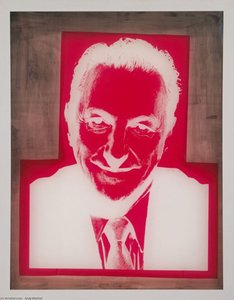
1976. Silkscreen.

§ 1Kataloogandmed


See teos on autoriõigusega kaitstud
Sellel lehel kuvatav kunstiteos on kaitstud autoriõigusega, mis tähendab, et meil ei ole seaduslikku õigust luua või müüa identset reproduktsiooni. Seda kaitset rakendatakse rahvusvaheliste kokkulepete alusel, nagu näiteks Berne konventsioon ning riiklike seadustega, sealhulgas nendega, mida on sätestatud USA autoriõiguse seadus – 17. peatükk.
Austasena ja seaduslikuna alternatiivina pakume originaalist inspireeritud, käsitsi maalitud isikupärastatud teoseid. Meie osutavad ja professionalsed kunstnikud uurivad hoolikalt originaali stiili, meelemoi ja kunstilist olemust, et luua uus, ainulaadne teos, mis tekitab sama tunnet – olles samal ajal omaette originaalne looming.
See meetod järgib täielikult autoriõiguse reegleid, kuna see ei põhine kaitstud kunstiteose kopeerimisel või dupliteerimisel. Selle asemel on tegu loova reinterpreetatsiooniga – uue maaldisega, mis on algteosest inspireeritud, kuid ei ole sellest identiline.
 Loe lähemalt
§ 2Abstraktne
Kogumisobjekti kirjeldus
A striking red hammer and sickle emblem sits atop a chair in this powerful 1976 Pop Art silkscreen by Andy Warhol that captures Cold War tensions and invites you to explore his iconic political imagery.
Kunstniku elulugu
Avasta Andy Warholi (1928–1987) ikooniline popkunst – Marilyni siidisõeltrükid, Campelli tosupurgid ja kuulsuste kultuur. Tutvu tema püsiva mõjuga kunstile!
§ 3Kommentaar
The Resonance of Red: Encountering Warhol’s Political Still Life
In the vast landscape of Pop Art, few images command attention with such stark, unapologetic clarity as Andy Warhol’s 1976 masterpiece, Hammer and Sickle. At first glance, the viewer is met with a deceptively simple composition: a vibrant, blood-red emblem of the hammer and sickle superimposed upon the quiet, unassuming presence of a chair. Yet, beneath this surface-level simplicity lies a profound tension, a visual dialogue that captures the very essence of the Cold War era. Warhol, a master of transforming the mundane into the monumental, utilizes this piece to bridge the gap between political propaganda and fine art, inviting us to contemplate the intersection of ideology and everyday existence. The presence of other scattered objects—a pair of scissors, a knife, and a bottle—adds a layer of domesticity that contrasts sharply with the revolutionary weight of the central symbol, creating a sense of an interrupted moment in time, where the tools of industry and the artifacts of daily life collide.
Technique as Democracy: The Power of the Screen
To truly grasp the impact of this work, one must look toward Warhol’s revolutionary use of the silk screen printing process. This technique, which allowed for the production of multiple identical prints, was not merely a choice of convenience but a profound philosophical statement on the democratization of art. By utilizing screenprinting, Warhol stripped away the traditional aura of the "unique" masterpiece, instead embracing the rhythmic, mechanical nature of mass production. This method allowed for the achievement of incredibly vibrant colors and precise tonal gradations that make the red of the emblem pulse against its backdrop with an almost electric intensity. For the collector or interior designer, this technique offers a unique opportunity to possess a piece that embodies the industrial spirit of the 20th century. The repetition inherent in his process mirrors the very nature of the symbols he depicts—symbols designed for mass consumption and widespread recognition—thereby blurring the lines between high culture and the pervasive imagery of popular propaganda.
An Enduring Statement for Contemporary Interiors
For those seeking to infuse a modern space with intellectual depth and visual drama, Hammer and Sickle serves as an incomparable focal point. It is far more than mere decoration; it is a provocative conversation starter that challenges the viewer to look beyond the aesthetic and engage with the historical currents of the late 1970s. The bold, graphic nature of the work makes it particularly suited for contemporary settings where minimalism meets conceptual strength. Whether placed in a curated gallery or as a striking element in a sophisticated residential study, the piece brings an unmistakable energy—a blend of industrial grit and artistic refinement. Owning a high-quality reproduction of this work allows one to celebrate Warhol’s legacy of provocation, ensuring that the echoes of revolution and the beauty of Pop Art continue to resonate powerfully within the walls of the modern home.
Korduvad küsimused
Kuidas teose „Hammer and Sickle“, autor Andy Warhol meeleolu on kirjeldatud?
Teose „Hammer and Sickle“, autor Andy Warhol üldine meeleolu on Bold. See meeleolu kirjeldab teose üldist atmosfääri.
Milline „Hammer and Sickle“, autor Andy Warhol trükkimõõt sobib soovitud ruumile?
Living Room ruumis on teose "Hammer and Sickle" jaoks soovitatav trükkimõõt Large.
Mida „Hammer and Sickle“, autor Andy Warhol kujutab?
Teemad, mis teoses „Hammer and Sickle“, autor Andy Warhol esinevad, hõlmavad symbolism, communism, industrial, tool, iconography, reproduction, warholesque. Koos need kokkuvõtavad teose sisu.





 Lülita trükkitoodetele


 Kunstiteoste või reproduktsioonide puhul, mille üks külg on üle 105 cm (umbikmolt 41 tolli), saadetakse raam kirjal asendis, la Dismantlitud komplektina. See meetod tagab ohutuse kohaletoimetamisel ja väldib transpordil tekkivaid kahjustusi.


