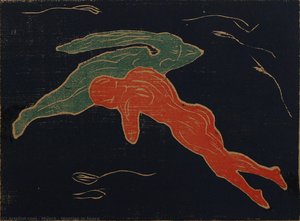
1892. Acrylic On Canvas.

§ 1Catalogue data


§ 2Abstract
Kogumisobjekti kirjeldus
Edvard Munch's 'Despair' (1892) captures profound human suffering with bold brushstrokes and symbolic depth. A poignant Expressionist masterpiece exploring isolation and emotional turmoil.
 Loe lähemalt
Kunstniku elulugu
Avasta Edvard Munch (1863-1944), ekspressionismi pioneer! Tutvu "Karjega" ja kunstiga, mis käsitleb ärevust, suremist, armastust ning psühholoogilisi teemasid. Põhjamaa kunsti ikoon!
§ 3Commentary
Despair by Edvard Munch: A Deep Dive into Human Suffering
Edvard Munch's "Despair" is a profoundly moving oil on canvas painting created in 1892, serving as a quintessential representation of the artist’s unique style blending Expressionism and Symbolism. This artwork isn't merely a depiction; it's an exploration of human suffering, isolation, and the weight of existence.
Composition and Visual Elements
The scene portrays a solitary man seated at a piano in a dimly lit room, his head bowed in what appears to be deep contemplation or despair. Two figures are faintly visible in the background – one standing to the left and another further back on the right – observing the central figure with an air of detachment. The color palette is dominated by dark, muted tones that amplify the somber atmosphere. Thick, expressive brushstrokes contribute to a sense of unease and movement, while the simplified landscape below recedes into the distance, emphasizing the man's isolation.
Expressionism and Symbolism in "Despair"
Munch masterfully employs Expressionist techniques to convey intense emotions. The bold use of color and distorted forms are not meant to represent reality accurately but rather to express an inner emotional state. The dark hues evoke a sense of melancholy and hopelessness, while the slumped posture of the central figure symbolizes resignation or despair. Symbolism is also prevalent; the piano itself can be interpreted as representing creativity and emotional expression, yet in this context, it seems unable to alleviate the man's suffering. The figures in the background represent the indifference of society towards individual struggles.
Historical Context and Munch’s Life
“Despair” was created during a period of significant personal turmoil for Munch. His childhood was marked by loss and illness, including the deaths of his mother and sister from tuberculosis – events that profoundly impacted his artistic vision. This painting reflects the anxieties and psychological struggles prevalent in late 19th-century Europe, a time of rapid industrialization and social change that often led to feelings of alienation and despair. Munch's own battles with mental health further fueled the emotional intensity of his work.
Emotional Impact and Legacy
“Despair” resonates deeply with viewers due to its raw portrayal of human suffering and isolation. It’s a powerful reminder of the fragility of the human condition and the universality of feelings like loneliness and despair. Munch's influence on modern art is undeniable, paving the way for future generations of artists who sought to express their inner worlds through bold and expressive styles. The painting continues to captivate audiences worldwide, offering a glimpse into the complexities of the human experience that transcends time and culture.
Further Exploration
- Edvard Munch Biography: Explore more about Munch's life and artistic development on Wikipedia: https://en.wikipedia.org/wiki/Edvard_Munch
- WikiArt - Despair: View additional details and interpretations of the painting on WikiArt: https://www.wikiart.org/en/edvard-munch/despair-1892
- MoMA Audio Guide: Listen to an audio guide discussing Munch's work, including "Despair": https://www.moma.org/audio/playlist/194/2592
Korduvad küsimused
Millist emotsionaalset toonikut saadab endale kuulutada teose "Despair" Expressionism stiil?
Expressionism suunangu raames on teos "Despair" üles seabetud Melancholic toonil.
Milline rahvuslik päritolu seisab teose "Despair" Expressionism taga?
Expressionism suunaga teos "Despair" on loodud kunstniku poolt, kes on pärit riigist Sweden.
Milline palett ja domineeriv värv määravad teose "Despair"?
Teose „Despair“, autor Edvard Munch värvimaailm: Dark palett, mille domineerib Quinacridone Magenta (#814b52).


 Lülita trükkitoodetele


 Kunstiteoste või reproduktsioonide puhul, mille üks külg on üle 105 cm (umbikmolt 41 tolli), saadetakse raam kirjal asendis, la Dismantlitud komplektina. See meetod tagab ohutuse kohaletoimetamisel ja väldib transpordil tekkivaid kahjustusi.