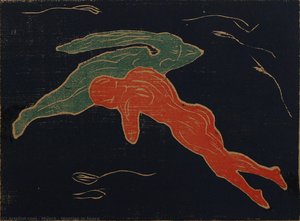
1899. Õlimaal kangaruumil.

§ 1Catalogue data


§ 2Abstract
Kogumisobjekti kirjeldus
Delve into Edvard Munch's 'Melancholy, Laura': A poignant portrait capturing introspection and sorrow through vibrant colors & symbolic details. Explore the artist’s soul painting style.
 Loe lähemalt
Kunstniku elulugu
Avasta Edvard Munch (1863-1944), ekspressionismi pioneer! Tutvu "Karjega" ja kunstiga, mis käsitleb ärevust, suremist, armastust ning psühholoogilisi teemasid. Põhjamaa kunsti ikoon!
§ 3Commentary
Melancholy, Laura: A Portrait of Introspection by Edvard Munch
Edvard Munch’s “Melancholy, Laura,” painted in 1899, is not merely a portrait; it's an intimate and profoundly moving exploration of the human psyche. This work, housed within the esteemed collection of the Munch Museum in Oslo, offers a rare glimpse into the artist’s deeply personal world – a realm saturated with emotion, memory, and the ever-present shadow of mortality. The painting captures a moment of quiet contemplation, inviting viewers to share in Laura’s internal landscape, a space defined by both vulnerability and a poignant sense of longing.
Munch's artistic journey was inextricably linked to his own tumultuous life experiences. Born in 1863 amidst illness and loss – the early deaths of his mother and sister profoundly shaping his worldview – he developed a unique style he termed ‘soul painting.’ This approach wasn’t about objective representation but rather the raw, unfiltered expression of inner turmoil. “Melancholy, Laura” exemplifies this perfectly; it's less a depiction of a physical scene and more an embodiment of a feeling, a carefully constructed atmosphere designed to evoke empathy and introspection.
The painting immediately draws the eye with its warm, enveloping color scheme dominated by rich oranges and browns. This palette isn’t simply decorative; it establishes an immediate sense of intimacy and warmth, creating a space where vulnerability feels safe. Laura sits bathed in this light, positioned before a window that serves as a crucial symbolic element. The window acts as a visual metaphor for the boundary between her inner world – a realm of profound emotion – and the external reality she observes. The potted plants flanking her table are particularly significant. They represent the duality inherent in life: growth alongside decay, beauty intertwined with sorrow. Their presence subtly underscores the painting’s central theme—the acceptance of both joy and melancholy as integral parts of the human experience.
Furthermore, Laura's scarf, draped around her neck, is a powerful symbol of protection and isolation. It suggests a desire to shield herself from the world, perhaps seeking solace in solitude. Munch’s masterful use of brushstrokes—loose, expressive, and almost frantic in places—contributes significantly to the painting’s emotional intensity. The lines are not clean or precise; they ripple and flow, mirroring the turbulent currents of Laura's thoughts and feelings. This technique is characteristic of Munch’s Expressionist style, prioritizing subjective experience over objective reality. The overall effect is one of profound resonance—a feeling that transcends mere visual representation and taps directly into our own capacity for empathy and understanding.
“Melancholy, Laura” stands as a testament to Edvard Munch's ability to capture the essence of human emotion with unparalleled depth and sensitivity. It’s an artwork that invites viewers not just to observe but to *feel*, prompting reflection on their own experiences of melancholy, introspection, and the complexities of the human heart. For those seeking a piece that transcends mere decoration and offers a profound connection to the artistic spirit, a high-quality reproduction of this iconic work is an invaluable addition to any collection.
Korduvad küsimused
Kust teose „Melancholy, Laura“, autor Edvard Munch külastajad pärit on?
Teose „Melancholy, Laura“, autor Edvard Munch statistika on saadaval teose lehel Statistika: teose kuukaudsed külastused, kunstniku teoste külastused ning viimaste külastajate riikide ja keelte jaotus.
Kas ma saan enne ostmist näha teost „Melancholy, Laura“, autor Edvard Munch oma seinal?
Teose „Melancholy, Laura“, autor Edvard Munch leht AR-eelvaade teose kohta kasutab täiendatud reaalset, et näidata teost ühilduva seadme abil teie enda ruumis.
Mis on teose „Melancholy, Laura“, autor Edvard Munch loomisaeg ja stiil?
Teos „Melancholy, Laura“, autor Edvard Munch on pärinev aastast 1899 ning kuulub suunale Expressionism.


 Lülita trükkitoodetele


 Kunstiteoste või reproduktsioonide puhul, mille üks külg on üle 105 cm (umbikmolt 41 tolli), saadetakse raam kirjal asendis, la Dismantlitud komplektina. See meetod tagab ohutuse kohaletoimetamisel ja väldib transpordil tekkivaid kahjustusi.