

Charcoal.

§ 1Kataloogandmed


§ 2Abstraktne
Kogumisobjekti kirjeldus
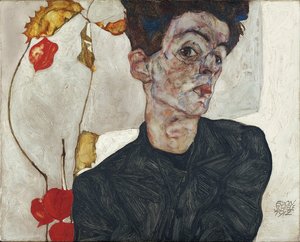
This 1918 Expressionist sketch by Egon Schiele captures raw vulnerability. Explore the intense emotion of this masterpiece today.
 Loe lähemalt
Kunstniku elulugu
Egon Schiele oli austria ekspressionistlik kunstnik, kes tuntakse oma dünaamikaline stiil ja tema teoste sügav psühholoogiline tähendus ning suur osa maailma muuseumikollektiivides olevate tööde tõttu. Tema esimeste tööde keskendusid seksuaalsusele ja surnule ning Schiele oli üks vähese kunstniku, kes ei tundnud piire.
§ 3Kommentaar
Standing Nude, Facing Right – An Exploration of Vulnerability and Expression
Egon Schiele’s “Standing Nude, Facing Right,” created in 1918, is a deceptively simple sketch that embodies the core tenets of Expressionism—a movement characterized by intense emotional honesty and rejection of academic conventions. This artwork isn't merely a depiction of the human form; it’s a distillation of psychological turmoil rendered with remarkable precision through masterful line work.
- Subject Matter: The nude figure dominates the composition, positioned centrally against a stark white background. Schiele’s deliberate choice to omit shading underscores his focus on capturing the essence of physicality and emotion rather than achieving photographic realism.
- Style & Technique: Executed in charcoal on paper, “Standing Nude” exemplifies Schiele's signature style—rapid, gestural drawing prioritizing contour lines over volumetric modeling. The artist’s hand moves swiftly across the surface, conveying a palpable sense of urgency and immediacy.
- Composition: The pose itself is significant. One arm extends upwards behind the head, creating a dynamic counterbalance to the outstretched right hand, which reaches towards the shoulder—a gesture that speaks volumes about vulnerability and introspection. This asymmetrical arrangement contributes to the artwork’s unsettling beauty.
The artist's technique relies heavily on thin, flowing lines – predominantly black – meticulously drawn to delineate the contours of the nude body. These lines aren’t uniformly thick; they subtly vary in weight to suggest curves and contours, mirroring the natural form while simultaneously conveying a feeling of fragility. Angular lines punctuate the facial features and around joints, adding a fragmented quality that reflects Schiele's preoccupation with psychological states.
- Historical Context: Created during the turbulent years leading up to World War I, “Standing Nude” reflects the anxieties and uncertainties of the era. Schiele’s work aligns with Expressionist explorations of themes like mortality, sexuality, and inner conflict—subjects that were considered taboo by mainstream artistic circles at the time.
- Symbolism & Emotional Impact: The simplified rendering amplifies the artwork's emotional resonance. It evokes a feeling of exposure and vulnerability, mirroring Schiele’s own struggles with illness and loss. The stark monochrome palette reinforces this sense of raw emotion, inviting viewers to contemplate profound questions about human existence.
“Standing Nude, Facing Right” transcends mere visual representation; it's a testament to Schiele’s ability to translate psychological experience into artistic form. Its enduring appeal lies in its uncompromising honesty and its capacity to provoke contemplation on themes of vulnerability, introspection, and the human condition—qualities that continue to resonate with audiences today.
Korduvad küsimused
Mis on teose „Standing Nude, Facing Right“, autor Egon Schiele orientatsioon?
Teose „Standing Nude, Facing Right“, autor Egon Schiele vorm on Portrait. See vorm kirjeldab kompositsiooni proportsioone.
Kust kohalt Egon Schiele korduvad teemad teoses "Standing Nude, Facing Right" ilmumisel?
Egon Schiele korduvad teemad hõlmavad expressionist gestural style, mortality exploration themes, psychological vulnerability focus, schiele’s recurring motif”, “vienna artistic landscape”; teos "Standing Nude, Facing Right" keskendub nude figure, sketch drawing, contour lines, minimal shade, human form, emotional rawness, austrian art.
Kuidas seda teost „Standing Nude, Facing Right“, autor Egon Schiele saab kasutada kodukujunduses?
Teos „Standing Nude, Facing Right“, autor Egon Schiele on soovitatav kasutada Mood jaoks, ideaalselt Living Room ruumis. Kasutusala ja ruum annavad suuniseid selle kohta, kuhu reproduktsioon hästi sobida.


 Lülita trükkitoodetele


 Kunstiteoste või reproduktsioonide puhul, mille üks külg on üle 105 cm (umbikmolt 41 tolli), saadetakse raam kirjal asendis, la Dismantlitud komplektina. See meetod tagab ohutuse kohaletoimetamisel ja väldib transpordil tekkivaid kahjustusi.


