

Head constructor (Fernand Léger, 1950)
1950. Oil On Canvas, 50.0 x 45.0 cm.

Lentekadmed ja fine art trükised alates €40 suuruses 33 x 30 cm
Käsinmaalitud õlireproduktsioon alates €170
- Tasuta rahvusvaheline tarne 3–4 nädalaga
- Rullitud trükised – täisteenus 3–4 nädalat
- 100 päeva tagasimaksumise õigus ja raha tagastamine
- ArtShopReviews.com-is 241 kliendi arvamus: 4.9/5
§ 1Kataloogandmed

- 50.0 x 45.0 cm


§ 2Abstraktne
Head constructor kunstnikult Fernand Léger, maali kirjeldus
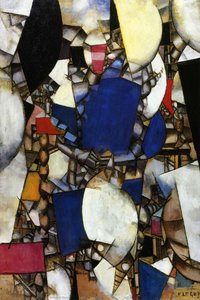
Fernand Léger's 'Head Constructor' is a striking Cubist portrait embodying modernity and industrialization. Bold lines, geometric shapes, and a stark white background create a powerful visual statement of the human form in the machine age.
 Loe teose Head constructor täielikku kirjeldust autori Fernand Léger kohta
Fernand Léger: biograafia
1916. aasta sinapisgaasi rünnak muutis tema vormitunnet: ärkage tema masinlikku perioodi torulistele kujunditele.
§ 3Kommentaar
A Fragmented Portrait of the Machine Age
Fernand Léger’s “Head Constructor,” painted in 1950, isn't merely a portrait; it’s a distilled essence of the burgeoning modernity that gripped Europe after World War I. This striking monochrome work, rendered in a bold and assertive Cubist style, immediately commands attention with its stark contrast between the solid black outlines and the pristine white background – a deliberate choice that emphasizes the geometric forms at the heart of Léger's vision. The image presents a stylized human head, partially obscured by a simple hat or cap, a subtle detail hinting at a profession or perhaps even anonymity within the rapidly changing urban landscape.
Léger’s approach to Cubism wasn’t about deconstructing reality into an abstract puzzle; rather, he sought to integrate the dynamism and structure of the machine age directly into his representation of the human figure. He viewed industrialization not as a destructive force but as a new form of beauty – one characterized by clean lines, precise angles, and a sense of mechanical order. This is powerfully evident in “Head Constructor,” where the head itself is broken down into a series of interlocking squares, rectangles, and triangles—a deliberate rejection of traditional perspective and a celebration of geometric abstraction. The work feels less like a depiction of an individual and more like a schematic diagram, a blueprint for a new kind of human being shaped by the tools and technologies of his time.
The Language of Form: Cubism and Léger’s Vision
To understand “Head Constructor,” it's crucial to grasp the principles of Cubism as Léger embraced them. Unlike Picasso and Braque, who initially focused on dismantling objects into fragmented planes, Léger retained a sense of volume and three-dimensionality within his compositions. He didn’t entirely abandon representation; instead, he simplified forms to their most essential geometric components, creating an effect that is both abstract and strangely familiar. The thick black lines defining the head, hat, and facial features aren't delicate or subtle—they are assertive and deliberate, conveying a sense of construction and engineering. This bold use of line is characteristic of Léger’s style, which he termed “Tubism,” referencing his fascination with cylindrical forms – a visual echo of the pipes and machinery that dominated the industrial world.
The choice of monochrome—black lines on white—further amplifies this sense of construction. It eliminates any distractions from color, forcing the viewer to focus entirely on the interplay of shapes and lines. This deliberate austerity reflects Léger’s desire to strip away sentimentality and emotionalism, presenting a purely rational and objective view of the human figure. The work evokes a feeling of detachment, almost as if we are observing a machine rather than a person—a powerful statement about the increasing mechanization of modern life.
Symbolism and the Modern Condition
The title itself, “Head Constructor,” offers valuable insight into Léger’s intentions. He was deeply interested in the role of labor and industry in shaping society, and he saw the construction worker as a symbol of progress and innovation. The hat or cap worn by the figure could be interpreted as a uniform—a badge of membership within this new industrial order. The overall effect is one of both celebration and unease; Léger acknowledges the beauty and efficiency of modern technology but also hints at its potential to dehumanize individuals.
“Head Constructor” isn’t simply a depiction of a head; it's a meditation on the nature of humanity in an age of rapid technological change. It’s a work that continues to resonate today, prompting us to consider our relationship with machines and the evolving definition of what it means to be human.
Korduvad küsimused
Kas teose Head constructor reproduktsioon on käsitsi maalitud või trükitud?
Trükis: teos Head constructor on reprodukteeritud giclée-trükkina puuvillasel lærvarõkal või Epson'i arhivipaberil.
Millise suuruse teose Head constructor jaoks valida?
Originaali mõõtmed on 50 x 45 cm. Suurused on vahemikus 33.2 x 30.1 cm (€40) kuni 248.1 x 224.6 cm (€471); sellel lehel olev tabel on toodud peamised sammud ja nende hinnad.
Kui kaua kohalelymine aega võtab?
Torus lahtisena olev trükiseeritud pilt saabub tasuta tavapostiga 3–4 nädalaga; pingitud või raamiga pildid saabuvad 4–5 nädalaga. Express-kulleriga kohaletoimetamine on võimalik vaid tasulise Express-tarne valiku korral. Toote võib tagastada 100 päeva jooksul täies summaga tagasitelemiseks ilma igasuguste tingimusteta.
Millist materjali Fernand Léger teoseks Head constructor kasutas?
Oil On Canvas




 Õlimaalingu ostmine


 Kunstiteoste või reproduktsioonide puhul, mille üks külg on üle 105 cm (umbikmolt 41 tolli), saadetakse raam kirjal asendis, la Dismantlitud komplektina. See meetod tagab ohutuse kohaletoimetamisel ja väldib transpordil tekkivaid kahjustusi.


