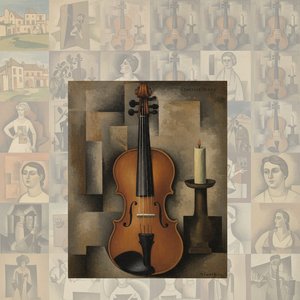
Acrylic On Canvas.

§ 1Catalogue data

See teos on autoriõigusega kaitstud
Sellel lehel kuvatav kunstiteos on kaitstud autoriõigusega, mis tähendab, et meil ei ole seaduslikku õigust luua või müüa identset reproduktsiooni. Seda kaitset rakendatakse rahvusvaheliste kokkulepete alusel, nagu näiteks Berne konventsioon ning riiklike seadustega, sealhulgas nendega, mida on sätestatud USA autoriõiguse seadus – 17. peatükk.
Austasena ja seaduslikuna alternatiivina pakume originaalist inspireeritud, käsitsi maalitud isikupärastatud teoseid. Meie osutavad ja professionalsed kunstnikud uurivad hoolikalt originaali stiili, meelemoi ja kunstilist olemust, et luua uus, ainulaadne teos, mis tekitab sama tunnet – olles samal ajal omaette originaalne looming.
See meetod järgib täielikult autoriõiguse reegleid, kuna see ei põhine kaitstud kunstiteose kopeerimisel või dupliteerimisel. Selle asemel on tegu loova reinterpreetatsiooniga – uue maaldisega, mis on algteosest inspireeritud, kuid ei ole sellest identiline.
 Loe lähemalt
§ 2Abstract
Kogumisobjekti kirjeldus
Discover Georges Braque's 'Untitled (3777)': A captivating black & white study of a Parisian room, showcasing furniture and figures within a Cubist-inspired composition. Explore the artist’s innovative style and legacy.
Kunstniku elulugu
Georges Braque oli kubismi üks rajajaid ja fauvismiga tuntud kunstnik. Tema suurimad teosed hõivatakse L’Estaque maja maalidega ning tänu koostöösele Pablo Picasso'ga jäi ta kunstiloo tähtsamaks esindajaks.
§ 3Commentary
The Enigmatic Room: An Exploration of Georges Braque's "Untitled (3777)"
Georges Braque’s “Untitled (3777)” presents a deceptively simple scene – a modestly furnished room bathed in the stark contrast of black and white. Yet, within this apparent stillness lies a complex interplay of form, perspective, and human presence, hallmarks of the artist's pivotal role in developing Cubism alongside Pablo Picasso. The painting isn’t merely a depiction of an interior; it’s a carefully constructed puzzle designed to challenge our perception of space and reality, inviting us to actively engage with its fragmented composition.
The central focus is undeniably the chair, positioned deliberately near the viewer's eye line, anchoring the scene. However, Braque doesn’t offer a straightforward representation. Instead, he deconstructs the object into geometric planes – sharp angles and overlapping forms that suggest multiple viewpoints simultaneously. This technique, characteristic of Cubism, dismantles traditional notions of depth and perspective, forcing us to reconsider how we see the world. The two figures within the room—a man and a woman—are similarly rendered with an emphasis on their constituent parts, their bodies fragmented and reassembled into abstract shapes. They are not presented as unified individuals but rather as elements contributing to the overall spatial arrangement of the scene.
A Fusion of Fauvism and Proto-Cubism
Created around 1927, “Untitled (3777)” sits firmly within a transitional period in Braque’s artistic development. It showcases elements of his earlier work with the Fauves – particularly the bold use of color and expressive brushstrokes—while simultaneously foreshadowing the more rigorous geometric explorations that would define Cubism. The subdued palette, dominated by grays and blacks, creates an atmosphere of quiet contemplation, a deliberate shift from the vibrant hues of his Fauvist phase. The meticulous attention to detail in rendering the furniture – the texture of the couch, the sheen of the clock – reveals Braque’s continued mastery of technique, even as he pushes against established artistic conventions.
Notably, the inclusion of everyday objects—a dining table, a book, a vase—elevates the scene beyond mere architectural study. These items become symbols of domesticity and routine, subtly hinting at the lives of those within the room. The clock, in particular, introduces an element of temporal awareness, suggesting that time itself is being fragmented and reconfigured by Braque’s artistic vision.
Symbolism and Emotional Resonance
While seemingly objective in its monochrome presentation, “Untitled (3777)” possesses a subtle emotional depth. The arrangement of the figures and objects creates a sense of contained tension—a quiet stillness punctuated by the implied presence of human interaction. The fragmented forms can be interpreted as representing the complexities of modern life, where individuals are often isolated within their own thoughts and experiences. The painting’s ambiguity invites viewers to project their own interpretations onto the scene, fostering a personal connection with the artwork.
Braque's exploration of geometric abstraction in this piece anticipates the broader artistic movements of the 20th century, solidifying his position as a key innovator in modern art. Reproductions of “Untitled (3777)” offer a unique opportunity to experience firsthand the intellectual and aesthetic rigor that defined Braque’s groundbreaking work – a testament to the power of fragmentation and the enduring appeal of a meticulously constructed visual puzzle.
Korduvad küsimused
Kuidas teos „untitled (3777)“, autor Georges Braque seob Cubism kunstniku kodumaaga?
Teos "untitled (3777)" ühendab oma looja sünneloolise piirkonna ja Prantsusmaa läbi Cubism suunaga.
Mis tüüpi teos on „untitled (3777)“, autor Georges Braque?
Kataloogis on teos „untitled (3777)“, autor Georges Braque liigitatud kui WallArt. See kategooria aitab leida sarnaseid teoseid.
Kes on teose "untitled (3777)" autor ja millises stiilis see on kujutatud?
Teose "untitled (3777)" on loonud Georges Braque Cubism stiilis. Kunstnik ja suunamine määratlevad teose traditsiooni.



 Lülita trükkitoodetele


 Kunstiteoste või reproduktsioonide puhul, mille üks külg on üle 105 cm (umbikmolt 41 tolli), saadetakse raam kirjal asendis, la Dismantlitud komplektina. See meetod tagab ohutuse kohaletoimetamisel ja väldib transpordil tekkivaid kahjustusi.