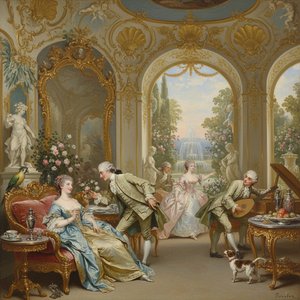
1743. Akrüül võimlusel, 270.0 x 398.0 cm. Mauritshuis.

§ 1Catalogue data

- 270.0 x 398.0 cm


§ 2Abstract
Kogumisobjekti kirjeldus
Jacob de Wit’i suurejoonuline maal "Эпос" kuulub Leideni linnale ja on olnud selles aastast 1912. Selle keskteos kujutab Apollo kohta ning ümber teda paiknevad üheksa müüsi, kes esindavad erinevaid kunstilisi haru.
 Loe lähemalt
Kunstniku elulugu
Avastage Jacob de Wit: hollandi rokokoomaalari, kes tuntub apne hämmastavate lae- ja uksamaalide poolest. Uurige tema meistriteoseid grisaille-stiilis ja mõju Antwerpi kunstile.
§ 3Commentary
A Symphony of Myth and Technique: Jacob de Wit’s “The Epic Poem”
This magnificent ceiling painting, originating from a residence in Leiden (Rapenburg 48) since 1912, stands as a testament to the artistic prowess of the Dutch Baroque era. More than just decoration—it's an immersive experience—a carefully orchestrated illusion crafted by Jacob de Wit himself, arguably the foremost expert in this genre during his time. Its enduring presence within the Mauritshuis’s collection speaks volumes about its significance and continues to inspire awe among art historians and enthusiasts alike.The Narrative Tapestry: Mythological Allegory
At its core lies a retelling of Homer's Iliad, reimagined through the lens of classical allegory. De Wit meticulously depicts Apollo, the revered god of music and poetry—a figure embodying artistic inspiration—seated at the center of an oval composition. Surrounding him are nine muses, each representing one of the liberal arts: poetry, music, dance, painting, sculpture, astronomy, philosophy, rhetoric, and geography. These goddesses aren’t merely decorative elements; they embody the very essence of creative endeavor, symbolizing the multifaceted nature of artistic expression.The Four Grisailles: Echoes of Dramatic Verse
Framing Apollo's central tableau are four grisailles—large monochrome panels—that delve into the themes of elegy, comedy, pastoral song, and epic poetry. These canvases capture the spirit of theatrical performance, mirroring the dramatic conventions prevalent in Elizabethan England. The meticulous detail achieved through grisaille technique – utilizing shades of grey to create depth and texture – underscores De Wit’s mastery of illusionistic painting, a hallmark of his distinctive style.A Masterpiece of Grisaille Technique
Jacob de Wit's skill shone particularly brightly in his use of grisaille, a technique that involved applying thin layers of pigment over a gesso ground to achieve remarkable tonal gradations and textural effects. This method allowed him to convey emotion and atmosphere with unparalleled subtlety—consider the solemn grandeur conveyed by the depiction of Jupiter and Mnemosyne, or the vibrant energy captured in the portrayal of Apollo surrounded by his muses. The meticulous preparation and execution of these grisailles exemplify De Wit’s dedication to artistic excellence.Legacy and Influence: Antwerp's Baroque Visionary
Born in Amsterdam in 1695, Jacob de Wit honed his craft under Albert van Spiers and Jacob van Hal—masters who instilled in him a profound understanding of Baroque principles while nurturing his burgeoning talent for Rococo aesthetics. His guild membership solidified his position within the artistic community, propelling him to Antwerp where he continued to refine his technique and establish himself as one of the most influential interior decorators of his era. “The Epic Poem” stands as a poignant reminder of De Wit’s contribution to Dutch Baroque art—a captivating blend of mythological narrative and masterful illusionistic painting that continues to resonate with audiences today.Korduvad küsimused
Kui karge on teose "Эпос" väripalett?
Teose „Эпос“, autor Jacob De Wit värvitoit on Kerge värvitoon kütkusega.
Millised on teose „Эпос“, autor Jacob De Wit proportsioonid ja millised on selle mõõdud?
Teose "Эпос" vorming on Horisontaalne suund ning originaali mõõdud on 270 x 398 cm. Mõlemad on kasulikud reproduktsiooni planeerimisel.
Kui vana oli Jacob De Wit, kui ta loositud teose "Эпос" aastal 1743?
Jacob De Wit oli 48 aastane, kui ta teosest "Эпос" aastal 1743 lõi. Vanus on arvutatud kunstniku sünnaaasta põhjal, 1695.


![Vida De Miguel De Cervantes Saavedra (life Of Miguel De Cervantes Saavedra). Book V Of The Edition Of Don Quixote (biblioteca Nacional De España)\n\n[7] — Martín Fernández De Navarrete Y Ximénez De Tejada, Academic Art](/media/artworks/images-thumb/8c/b6/8cb67a4dd450447373a546c8dd039e57.jpg)

![La Verdadera Patria De Miguel De Cervantes (miguel De Cervantes’s True Homeland) (biblioteca Nacional De España)\n\n[4][fol.1] — Pedro José García Balboa, Baroque Rococo Revival](/media/artworks/images-thumb/a6/d8/a6d842058b3ffb23732e0ff43fd89aac.jpg)

 Lülita trükkitoodetele


 Kunstiteoste või reproduktsioonide puhul, mille üks külg on üle 105 cm (umbikmolt 41 tolli), saadetakse raam kirjal asendis, la Dismantlitud komplektina. See meetod tagab ohutuse kohaletoimetamisel ja väldib transpordil tekkivaid kahjustusi.