

1959. Acrylic On Canvas.

§ 1Kataloogandmed


See teos on autoriõigusega kaitstud
Sellel lehel kuvatav kunstiteos on kaitstud autoriõigusega, mis tähendab, et meil ei ole seaduslikku õigust luua või müüa identset reproduktsiooni. Seda kaitset rakendatakse rahvusvaheliste kokkulepete alusel, nagu näiteks Berne konventsioon ning riiklike seadustega, sealhulgas nendega, mida on sätestatud USA autoriõiguse seadus – 17. peatükk.
Austasena ja seaduslikuna alternatiivina pakume originaalist inspireeritud, käsitsi maalitud isikupärastatud teoseid. Meie osutavad ja professionalsed kunstnikud uurivad hoolikalt originaali stiili, meelemoi ja kunstilist olemust, et luua uus, ainulaadne teos, mis tekitab sama tunnet – olles samal ajal omaette originaalne looming.
See meetod järgib täielikult autoriõiguse reegleid, kuna see ei põhine kaitstud kunstiteose kopeerimisel või dupliteerimisel. Selle asemel on tegu loova reinterpreetatsiooniga – uue maaldisega, mis on algteosest inspireeritud, kuid ei ole sellest identiline.
 Loe lähemalt
§ 2Abstraktne
Kogumisobjekti kirjeldus
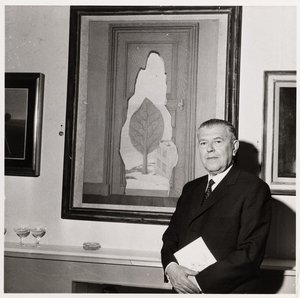
René Magritte's 'The Flash' (1959) is a surreal masterpiece blending nature and abstraction, questioning reality through fragmented forms and a striking blue sky. Explore the enigmatic beauty of this iconic work.
Kunstniku elulugu
René Magritte (1898–1967) – belgia sürrealist kunstnik, tuntud teostega nagu "The Lovers" ja "Ceci n’est pas une pipe". Tema pilkupüüdvad kompositsioonid sepitavad reaalsust ja kujutist, mõjutades pop-kunsti ja kontseptuaalset kunsti.
§ 3Kommentaar
René Magritte’s “The Flash”: A Surrealist Exploration of Perception
René Magritte's "The Flash," painted in 1959, is not merely a depiction of a tree and its blossoms; it’s an arresting invitation to question the very nature of reality. This seemingly simple still life, rendered with Magritte’s signature meticulous detail and unsettling juxtapositions, embodies the core tenets of Surrealism – a movement dedicated to unlocking the subconscious mind and challenging conventional ways of seeing. The painting immediately draws the viewer in with its vibrant palette: the deep purple hues of the leaves contrast sharply with the luminous white of the flowers, while the cool blues of the sky peek through the gaps in the foliage, creating an almost dreamlike atmosphere.
Magritte’s technique is deceptively straightforward. He employs a precise, almost photographic realism, meticulously rendering each leaf and petal as if capturing them with a camera. However, this technical mastery serves to heighten the painting's surreal effect. The tree itself appears slightly off-kilter, its branches reaching towards the sky in an unnatural manner. More significantly, the inclusion of the open blue sky behind the foliage is profoundly disorienting. It suggests that what we perceive as a solid, contained natural scene is actually an illusion, a window into something beyond our immediate understanding. This deliberate disruption of spatial relationships is characteristic of Magritte’s work and reflects his broader interest in exposing the constructed nature of visual representation.
The Symbolism of Absence and Hidden Realities
“The Flash” is laden with symbolic meaning, deeply rooted in Magritte's personal experiences and philosophical leanings. The recurring motif of obscured faces – a hallmark of his oeuvre – subtly echoes the trauma he experienced as a child when his mother’s body was recovered from the River Sambre, her face hidden beneath her dress. This event instilled within him a fascination with what remains unseen, with the mysteries that lie just beyond our perception. In "The Flash," this theme is manifested through the fragmented nature of the tree and flowers; they are not presented as whole entities but rather as partial representations, hinting at something incomplete or obscured.
Furthermore, the title itself – “The Flash” – carries a double meaning. It refers to both the speed of light and the fleeting nature of perception. Magritte seems to be suggesting that our experience of reality is inherently transient and unstable, constantly shifting and subject to interpretation. The white flowers, often associated with purity and innocence, are presented in this context as vulnerable and exposed, further emphasizing the fragility of our understanding.
Historical Context and Surrealist Influence
Created during the height of the Surrealist movement, “The Flash” aligns perfectly with the group’s core principles. Surrealism sought to liberate art from the constraints of logic and reason, exploring the realm of dreams, fantasies, and the unconscious mind. Magritte, along with artists like Salvador Dalí and Max Ernst, embraced this approach, creating works that defied conventional expectations and provoked viewers to reconsider their assumptions about the world.
Magritte’s work was influenced by a diverse range of sources, including Symbolism, Cubism, and Dadaism. However, he developed a unique style characterized by meticulous detail, precise composition, and a deliberate use of incongruity. “The Flash” exemplifies this approach, seamlessly blending realism with surrealism to create an image that is both familiar and unsettling.
A Timeless Exploration of Reality
“The Flash” remains one of René Magritte’s most iconic works, captivating viewers with its enigmatic beauty and profound philosophical implications. It's a testament to the artist's ability to transform the mundane into the extraordinary, prompting us to question our perceptions and consider the hidden realities that lie beneath the surface of everyday life. A reproduction of this piece offers a unique opportunity to bring this thought-provoking artwork into your home or office, serving as a constant reminder of the power of art to challenge and inspire.
Korduvad küsimused
Millist kintust ja intensiivsust „The flash“, autor René Magritte näitab?
Teose "The flash" värvitoon on kroomi方面 Subtle Color ja intensiivsuse方面 Balanced.
Kas René Magritte teos "The flash" kuulub avalikku omandisse ja miks?
René Magritte teos "The flash" on on endiselt autoriõiguse all under kaitse. Autoriõiguse kaitseajad arvutatakse alates kunstniku surmaõigustest ning René Magritte suri aastal 1967.
Kas teose "The flash" värvid on tugevad või pehmed?
Teoses „The flash“, autor René Magritte on Balanced värvitoon.


 Lülita trükkitoodetele


 Kunstiteoste või reproduktsioonide puhul, mille üks külg on üle 105 cm (umbikmolt 41 tolli), saadetakse raam kirjal asendis, la Dismantlitud komplektina. See meetod tagab ohutuse kohaletoimetamisel ja väldib transpordil tekkivaid kahjustusi.


