


 Eelvaade
 Saada
Saada Jaga
Jaga
 Teave teose kohta

 Laadi alla
 Sarnased teosed
 Röntgenuuring
 Slaidietendus
Springtime

 Loe lähemalt
Giclée / Kunstiprint
Muuseumikvaliteediga giclée- või kangasprint kiire tootmisega ja paindlikud viimistlusvõimalused. ( Osta käsitsi maalitud maal Osta pilt)




































Vali meie eelmääratud suurused, mis vastavad teose algupärastele proportsioonidele.

Saate sisestada oma mõõdud, et need sobiks konkreetse raami või ruumi sisse. Kui valitud suurus ei vasta originaalteose proportsioonidele, lõigame teose ära või laiendame pilti peegeldatud või ühtlase servaga. Enne tootmisprotsessi algust saadetakse Teie kinnitamiseks digitaalne näidis.
Palun märka, et ekraanil kuvatav eelvaade ei kajasta tegelikku lõigamist või laiendamist. Ainult näidis kujutab täpselt lõplikku kompositsiooni.
Kuigi erimõõdu on saadaval, soovitame originaaproportsioonide säilitamiseks valida mõõt ette määratud nimekirjast.
Ülemaailmne tarne () 2 nädala jooksul, tavalise 4/5 nädala asemel. (17 august)

Tasuta ekspresssaatmine üle maailma

Kõrgekvaliteediline linakangas

Täielik transpordikindlustus

Tollimaksude tagastamise garantii

Värvitoime täpsuse garantii

60-päevane tagastusõig: ainult tootmisdefektide korral

100% raha tagasi garantii

Hulgusoodustus
 Klaasivalik on saadaval ainult suuruses kuni 110 cm

Springtime
Giclée / Kunstiprint
Reproduktsiooni suurus
-


Kogusumma
$ 64
Sarnased teosed


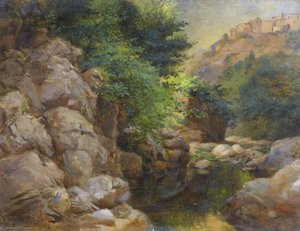


Kunstniku elulugu
Thomas James Lloyd: A Victorian Visionary of Landscape
Thomas James Lloyd (1849–1910) stands as a pivotal figure in British landscape painting during the Victorian era, embodying a meticulous approach to observation and an unwavering dedication to capturing the sublime beauty of the English countryside. Born in Melbourne, Australia, Lloyd’s formative years instilled within him a profound appreciation for natural grandeur—a sensibility that would profoundly shape his artistic vision. Returning to England in 1873, he swiftly established himself as a respected artist, primarily associated with the Royal Watercolour Society (RWS), where he honed his skills and cultivated collaborations with fellow luminaries of the Impressionist movement.- Early Influences: Lloyd’s artistic trajectory was significantly impacted by the Romantic landscape painters of Turner and Constable, whose emphasis on atmospheric perspective and emotive rendering served as a cornerstone for his own stylistic development. These masters championed the idea that art should strive to convey not merely what is seen but also what is felt—a principle Lloyd embraced wholeheartedly.
- Technique and Style: Lloyd’s distinctive technique involved layering thin washes of colour onto toned paper, creating luminous surfaces that subtly reflected the ambient light. He meticulously studied geological formations and vegetation patterns, translating his scientific understanding into artistic representations characterized by remarkable accuracy and detail. Unlike many Impressionists who prioritized fleeting moments of visual sensation, Lloyd sought to convey a sense of permanence and grandeur—a deliberate contrast to the ephemeral nature of daily life.
- Notable Works: Among Lloyd’s most celebrated paintings are “The Lizard Coast,” “Cornish Landscape,” and “Whitbarrow Fell.” These works exemplify his ability to distill the essence of a particular place into a powerfully expressive image—a testament to his artistic prowess and unwavering commitment to capturing the sublime.
- Collaboration with Frederic Leighton: Lloyd’s artistic partnership with Frederic Leighton, fellow RWS member, yielded several collaborative paintings that further cemented his reputation as a master of landscape art. Their shared fascination for Romantic ideals fueled their creative endeavors, resulting in works imbued with both technical brilliance and intellectual depth.

thomas james lloyd
1849 - 1910
Lühikesed faktid
- Artistic Movement Or Style: Military Art
- Artists Or Movements Influenced By This Artist: ['']
- Artists Who Influenced This Artist:
- Harold Lloyd
- Thomas James Lloyd
- Date Of Birth: August 8, 1953
- Full Name: Lloyd James Austin III
- Nationality: American
- Notable Artworks: ['']
- Place Of Birth: Mobile, Alabama
Seotud artiklid
Sir Alfred Munnings' Masterpieces: 25 Paintings That Define Equine Art | AllPaintingsStore
Explore 25 iconic Sir Alfred Munnings paintings! Discover the beauty of British Impressionism, equine art & rural England. Find museum-quality reproductions and elevate your home decor with AllPaintingsStore. Explore the full collection online.
James Abbott McNeill Whistler: 25 meistriteost kunstikollektsioonis | AllPaintingsStore.com
Avastage James Abbott McNeill Whistler'i 25 võrratut meistriteost! Sukelduge esteetilisse kunstimaailma, õppige tema maalitehnikatest ja leidke täiuslik seina kaunistus AllPaintingsStore.com-ist. Kunstikollektsioonid & reprodutsioonid.

Beyond the Horizon: 10 Landscape Masterpieces for Your Home Decor
Journey through 10 breathtaking landscape paintings by Monet, Van Gogh & more! Explore iconic artworks, artistic techniques & find inspiration for your home decor. Museum-quality reproductions at AllPaintingsStore.com. Discover all masterpieces on AllPaintingsStore.com

John Constable: 25 Suurimat Teost Inglise Maastikumaali Tippu
Avastage John Constable'i 25 suurimat teost! Sukeldu inglise maastikumaali romantismisse, imetlege Dedham Vale ilu ja leia inspiratsiooni kodukaunistuseks. Kvaliteetsed kunstireprodutsioonid AllPaintingsStore.com-is. Vaata kohe!

William James Müller: Navigating Victorian Sentiment & Realism in British Landscape Painting
Explore the captivating landscapes of William James Müller, the leading artist of the Bristol School. Discover his Victorian masterpieces, Egyptian travels & Lycian sketches – a journey through 19th-century art and technique.



