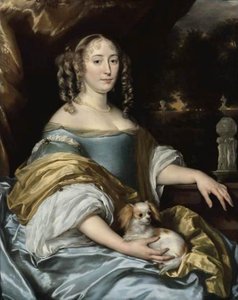
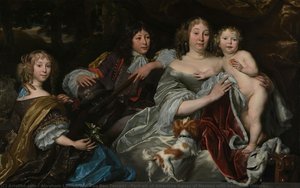
The Life and Legacy of Abraham Lambertsz. van den Tempel
In the vibrant tapestry of the Dutch Golden Age, few names evoke the intersection of intellectual rigor and painterly grace as effectively as Abraham Lambertsz. van den Tempel. Born in Leeuwarden, Netherlands, his early life was shaped by a profound connection to the arts and a lineage of craftsmanship. The son of a Mennonite preacher and a respected art teacher, Lambert Jacobsz, Abraham likely received his first lessons in the delicate nuances of the brush from his father. This foundational period, marked by the loss of his father in 1636, set him on a transformative journey through the great artistic hubs of the Netherlands, moving from the familiar surroundings of Leeuwarden to the bustling streets of Amsterdam, and eventually to the scholarly atmosphere of Leiden.
His development as an artist was characterized by a unique blend of mathematical precision and classical grandeur. While studying mathematics at Leiden University, he simultaneously honed his artistic technique under the guidance of Jacob Backer. This dual pursuit of science and art allowed him to approach the canvas with a structured understanding of composition and light. Interestingly, his very name became a part of his identity through his surroundings; while living in Leiden, he resided in a house featuring a relief of a temple on its keystone, leading him to adopt the name Tempel.
Mastery of the Baroque Style
Van den Tempel’s work is a testament to the theatrical and emotive power of the Baroque movement. He possessed a remarkable ability to breathe life into mythological and allegorical narratives, turning static canvases into dramatic performances. His technical mastery was particularly evident in his use of light and shadow, which he employed to sculpt figures with a three-dimensional presence that commanded the viewer's attention. This skill is perhaps most poignantly captured in works such as Minerva Crowns the Maid of Leiden, where the divine intervention of the Roman goddess is rendered with an intricate realism that highlights the textures of fabric and the subtle glints of light.
Beyond his mythological subjects, he was a celebrated portraitist, capable of capturing the social and intellectual essence of his era. His portraits were more than mere likenesses; they were meticulously crafted windows into the prestige and refinement of 17th-century Holland. Whether depicting the dignified gaze of a prominent citizen or the orchestrated elegance of a Family Portrait, his work consistently reflected the wealth, status, and familial bonds that defined the Dutch upper class.
Artistic Achievements and Historical Significance
The significance of Abraham Lambertsz. van den Tempel lies in his ability to merge civic pride with high art. His success with the Leiden city council led to prestigious commissions, including a series of large allegorical paintings celebrating the cloth industry of Leiden. These works served as both artistic triumphs and historical records of the region's economic vitality. Through his canvases, he immortalized the very essence of aristocratic prestige and the industrious spirit of the Dutch Golden Age.
His contributions to the art world can be summarized through several key pillars of his career:
- Technical Versatility: The ability to navigate between the rigorous demands of portraiture and the complex narratives of historical allegory.
- Intellectual Depth: A unique perspective shaped by his mathematical studies, contributing to the balanced and sophisticated compositions found in his masterpieces.
- Cultural Impact: His role in documenting the social hierarchy and civic identity of Leiden and the broader Dutch Republic through grand-scale painting.
Küsimused ja vastused
Mis on Abraham Lambertsz. Van Den Tempel sünnipaik ja sünnahöstua?
Abraham Lambertsz. Van Den Tempel sündis Leeuwarden linnas aastal 1622.
Millises linnas ja riigis on Abraham Lambertsz. Van Den Tempel sündinud?
Abraham Lambertsz. Van Den Tempel sündis Leeuwarden, Netherlands.
Kuidas on Abraham Lambertsz. Van Den Tempel karjäär perioodidess jaotatud?
Abraham Lambertsz. Van Den Tempel loominguline ajaloog on kättesaadav tema Kronika lehel, kus teosed esituvad loovimissarjade järgi, peatükk peatükilt.