A Life in Observation
Edouard de Jans began his life in Sint-Andries, the son of a farmer and a miller. His interest in art did not come from formal study but from a window, watching the displays in a local lithographer's shop. This early curiosity found a practical outlet when an aristocrat, working on the restoration of the Steentien castle, saw enough promise in the young man's drawings to suggest formal training. This led him to the Bogardenschool and later to the Bruges Academy of Fine Arts, where he studied under Eduard Wallays.
His path moved toward Antwerp, where he eventually entered the Master Class at the Royal Academy of Fine Arts. Under the guidance of Nicaise De Keyser, Polydore Beaufaux, and Charles Verlat, his hands learned the technicalities of oil on canvas, etching, and drypoint. In 1876, a scholarship from the Prix de Rome allowed him to move through France, Italy, Germany, and Austria. These travels brought new sights back to his studio in Antwerp.
The Weight of the Brush
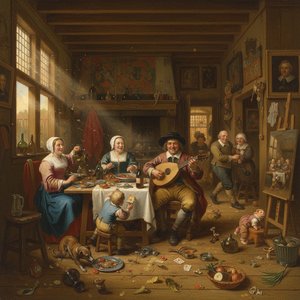
The work of Edouard de Jans often rests on the quiet details of human presence. He moved between the large scale of history paintings and the smaller, more intimate focus of portraiture and genre scenes. His hands captured the textures of everyday life, from the way a woman mends socks by a window to the movement of musicians in an Antwerp guest house. There is a specific gravity in his depictions of biblical stories, such as his 1878 work, De thuiskomst van de verloren zoon.
His repertoire included several distinct modes of expression:
- Portraiture: Capturing the features and character of individuals like Johan van Baren and Charles Verlat.
- Genre Painting: Scenes of daily labor and social interaction, such as Femme épluchant près d'un comptoir en bois.
- Historical and Biblical Subjects: Works that referenced the past, including his interpretation of Rubens' Perseus frees Andromeda of her chains.
- Printmaking: Etchings and drypoints that focused on singular moments, like a poet writing in a landscape.
A Legacy in Antwerp
By 1889, de Jans had returned to the Royal Academy of Fine Arts in Antwerp, not as a student, but as a professor, a position he held until his death in 1919. His life remained tied to the academic and artistic circles of the city. Even his family continued this connection, as his daughter, Luisa, also became a painter.
Today, his traces remain in collections such as the Museum Plantin-Moretus and the Royal Museum of Fine Arts in Antwerp. His work survives in various forms, from heavy oils to delicate prints, documenting a specific era of Flemish art through the lens of a man who learned to see by watching the world pass by his window.
Küsimused ja vastused
Millistes suunades Edouard de Jans töötas?
Edouard de Jans kunstistilid on leitav kunstniku Kõik suunad lehel, kus teosed on gruppitud stiili kaupa.
Kas Edouard de Jans teoste täielik nimekiri on olemas?
Kõiki Edouard de Jans teoseid see veebileht lehel saab vaadata artisti Kõik teosed lehelt.
Kuidas on Edouard de Jans karjäär perioodidess jaotatud?
Edouard de Jans karjääri avaneb perioodide kaupa kunstniku Kronika lehel: teoste ajajoon, mis on jaotatud karjääriperioodide peatükkidesse.