A Visionary of the Utopia Homelands
The story of Emily Kame Kngwarreye is one of profound connection, a life that blossomed into global recognition only when the sun was already high in its journey. Born around 1910 in the Alhalkere region of the Utopia Homelands, Kngwarreye lived a life deeply embedded in the Anmatyerr culture—a worldview where the boundaries between the physical landscape and the spiritual realm are beautifully blurred. Her early years were shaped by the rhythms of the Australian desert, working as a stockman and engaging in the traditional ways of her people. While she was a custodian of ancient knowledge long before she ever touched a brush to canvas, it was not until her sixties and seventies that she began to translate the whispers of the land into a visual language that would captositate the international art world.
Her heritage was one of both immense spiritual richness and significant historical struggle. As a member of the Anmatyerr language group, Kngwarreye carried the weight of her people's history, including the enduring scars of the Stolen Generations. This deep-seated connection to her Ancestral lands provided the foundation for her later work; she did not merely paint landscapes, but rather mapped the very soul of her Country. Her life was intertwined with other great artistic lineages, such as her relationship with Minnie Pwerl and her role as a parental custodian to the artist Barbara Weir, creating a tapestry of familial and cultural continuity that remains vital in contemporary Indigenous Australian art.
The Evolution of a Masterful Technique
Kngwarreye’s artistic evolution is a testament to her boundless creativity and her refusal to be confined by tradition. Her journey began in the delicate, meticulous medium of batik, a wax-resist dyeing technique that allowed her to explore color and pattern through fluid, organic shapes. This early experimentation with textiles laid the groundwork for her later, more explosive transition to canvas in 1988. Moving away from the controlled precision of batik, she embraced the raw energy of polymer paints, utilizing layering and vigorous brushwork to create works that felt alive with movement.
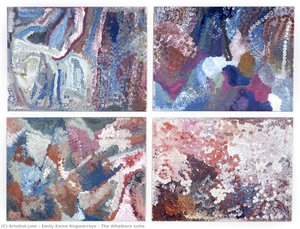
The brilliance of her style lies in its ability to oscillate between abstraction and representation. To the untrained eye, her canvases might appear as breathtakingly abstract compositions of color; yet, for those who understand the language of the Dreamtime, they are intricate maps of existence. She skillfully layered motifs that represented the plants, animals, and geological features of the desert ecosystems. Through her use of light and texture, she captured the essence of the pencil yam seeds, the shifting sands, and the seasonal transformations of the Utopia region. Her work became a rhythmic dance of dots, lines, and washes, embodying the pulse of the earth itself.
A Legacy Written in the Earth
The impact of Emily Kame Kngwarreye on the global stage cannot be overstated. She emerged as a central figure in the Aboriginal artistic revolution, helping to redefine contemporary Indigenous art from a localized tradition into a powerful movement of modern expressionism. Her work achieved such profound resonance that she was posthumously chosen to represent Australia at the 1997 Venice Biennale, an extraordinary honor that placed her Anmatyerr narratives on the most prestigious stage of international fine art.
Her achievements left behind a legacy characterized by several enduring contributions:
- Redefining Abstraction: She bridged the gap between ancient Dreamtime storytelling and modern Abstract Expressionism, proving that traditional motifs could speak to universal human emotions.
- Cultural Preservation: Through her vibrant depictions of the Utopia Homelands, she ensured that the ecological and spiritual significance of her Country would be recognized by generations to come.
- Artistic Inspiration: Her prolific output and fearless experimentation paved the way for subsequent generations of Indigenous artists to explore new media and larger-scale compositions.
Ultimately, Kngwarreye’s art remains a portal. To look upon her work is to step into a world where the earth is breathing, where every stroke of paint is a heartbeat, and where the ancient stories of the Anmatyerr people continue to vibrate with eternal life.
Küsimused ja vastused
Millistes suunadetes Emily Kame Kngwarreye töötas?
Suunad, milles Emily Kame Kngwarreye töötas, on nähtav kunstniku Kõik suunad lehel, kus teosed on liigitud suunade kaupa.
Kuidas leian Emily Kame Kngwarreye teosed konkreetse värvikombinatsiooniga?
Emily Kame Kngwarreye teoseid saab väripaleti järgi sirvida kunstniku Värvikombinationide järgi lehel.
Kuidas saan vaadata kõiki Emily Kame Kngwarreye loodud teoseid?
Kõiki Emily Kame Kngwarreye teoseid see veebileht lehel saab vaadata artisti Kõik teosed lehelt.