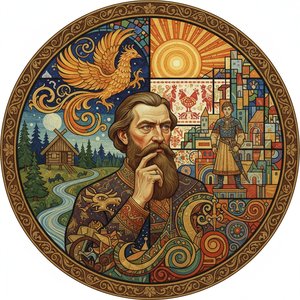
Ivan Yakovlevich Bilibin: A Life in Art
Early Life and Education
- Born: 1876 in Tarkhovka, a suburb of St. Petersburg, Russia.
- Ivan Bilibin demonstrated an early aptitude for art, nurtured by the vibrant cultural atmosphere of his surroundings.
- He initially studied law at the University of St. Petersburg but soon abandoned it to pursue his artistic passions.
- Bilibin received formal training at Anton Ažbe's School of Art in Munich (1898), where he was exposed to Art Nouveau and German satirical illustration, particularly the journal *Simplicissimus*.
- He further honed his skills under the tutelage of Ilya Repin at the Imperial Academy of Arts in St. Petersburg.
Artistic Development and Influences
- Early Influences: Bilibin’s artistic development was profoundly shaped by his ethnographic expeditions to northern Russia (Vologda, Olonetsk, Arkhangelsk governorates) between 1902-1904.
- These travels sparked a deep fascination with Russian folk art, wooden architecture, and the rich traditions of the peasantry. He documented his findings in *Narodnoye tvorchestvo russkogo severa* (Folk Arts of the Russian North) published in 1904.
- Japanese prints, with their emphasis on line, composition, and narrative storytelling, also exerted a significant influence on his style.
- He embraced a distinctive aesthetic that blended elements of traditional Russian iconography, folk art motifs, and the decorative qualities of Art Nouveau.
Key Works and Artistic Style
- Illustrations of Fairy Tales: Bilibin achieved widespread recognition for his enchanting illustrations of Russian fairy tales, beginning in 1899. Notable works include depictions of *Baba Yaga*, *Vasilisa the Beautiful*, and *Ivan Tsarevich catching the Firebird’s feather*.
- Stage Design: He became a sought-after stage designer, collaborating with Sergei Diaghilev's Ballets Russes. His designs for Nikolai Rimsky-Korsakov’s *The Golden Cockerel* (1909) are particularly celebrated.
- Distinctive Style: Bilibin’s style is characterized by its elegant lines, flattened perspective, symbolic use of color, and meticulous attention to detail. He often incorporated elements of medieval Russian manuscript illumination into his work.
- He also created posters and book illustrations for various publications, including *Dog Rose* and the Moscow Publishing House.
Political Engagement and Later Life
- Revolutionary Period: During the Russian Revolution of 1905, Bilibin created politically charged cartoons for the magazine *Župel*, which was later banned.
- Exile and Return: Following the October Revolution in 1917, disillusioned with the new regime, he left Russia. He lived in Cairo, Alexandria, and eventually settled in Paris (1925), where he worked as a decorator.
- Despite his initial departure, Bilibin harbored a longing for his homeland and returned to the Soviet Union in 1936 after decorating the Soviet Embassy.
- Tragic End: He died during the Siege of Leningrad in 1942, refusing to evacuate despite the dire conditions.
Legacy and Historical Significance
- Ivan Bilibin is considered one of Russia’s most important illustrators and stage designers.
- Revival of National Identity: His work played a crucial role in reviving interest in Russian folklore and national identity during a period of rapid social and political change.
- Influence on Modern Art: Bilibin’s distinctive style influenced subsequent generations of artists, particularly those interested in exploring the intersection of art, folklore, and national culture.
- His illustrations continue to captivate audiences worldwide with their beauty, imagination, and evocative portrayal of a bygone era.
Küsimused ja vastused
Kust saan leida statistikat Ivan Yakovlevich Bilibin teoste kohta?
Ivan Yakovlevich Bilibin kohta on olemas Statistika lehekülg, mis esitab see veebileht kunstniku teoste kohta statistika.
Kuidas leian kõik Ivan Yakovlevich Bilibin teosed teatud materjali järgi?
Ivan Yakovlevich Bilibin teoseid saab meediumi järgi sirvida tema Kõik tehnikad lehel.
Kuidas Ivan Yakovlevich Bilibin kunst ajas arenes?
Ivan Yakovlevich Bilibin Kronika on kerimispõhine ajajoon, mis esitab kunstniku teosed kronoloogilises järjekordas, jagatuna karjääriperioodide peatühidess.