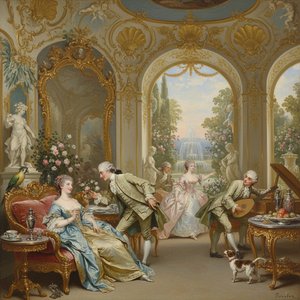
A Life Immersed in Rococo Splendor
Jean-Baptiste Marie Pierre, born in Aix-en-Provence in 1714, emerged as a pivotal figure within the elegant world of French Rococo painting. His artistic journey began with formal training at the prestigious Académie Royale de Peinture et de Sculpture in Paris, where he came under the tutelage of Charles-Joseph Natoire. This foundational education instilled in him a classical sensibility, yet Pierre quickly developed a distinctive style that transcended mere imitation. He wasn’t simply replicating the past; he was infusing it with a uniquely French grace and a burgeoning sense of dramatic narrative. From an early age, his talent shone through, culminating in a career marked by royal patronage and significant artistic contributions. The seeds of his future success were sown not just in technical skill but also in a keen understanding of the aesthetic currents shaping 18th-century France.The Blossoming of a Rococo Master
Pierre’s art is inextricably linked to the Rococo movement, an artistic style characterized by its lightness, elegance, and playful themes. However, he wasn't merely a follower; he was an innovator within this framework. While deeply influenced by Natoire’s emphasis on classical form, Pierre infused his work with a vibrant color palette and a refined sense of composition that set him apart. He drew inspiration not only from contemporary French art but also from the Italian Renaissance masters, evident in his masterful depictions of human anatomy and his ability to convey complex emotions through gesture and expression. This synthesis of influences allowed him to create works that were both technically accomplished and emotionally resonant. His early genre scenes, such as Old Man in a Kitchen, demonstrate a remarkable realism coupled with an intimate understanding of everyday life. As he matured, Pierre increasingly turned towards mythological subjects, transforming classical narratives into visually stunning spectacles.Mythology, Allegory, and Royal Favor
Throughout his career, Jean-Baptiste Marie Pierre created a diverse body of work encompassing mythological scenes, religious paintings, and portraits. The Seasons, an allegorical series celebrating the beauty and bounty of nature, exemplifies his ability to blend classical themes with a distinctly French sensibility. His depictions of mythology – notably Jupiter and Antiope and The Rape of Europa – are characterized by dynamic compositions and a masterful use of color to convey dramatic tension. The Death of Harmonia, a Baroque masterpiece, showcases his skill in portraying intense emotion and opulent detail. These works weren’t created in isolation; they were often commissioned by wealthy patrons, including the French monarchy. In 1770, Pierre reached the pinnacle of his career when he was appointed Premier peintre du roi (First Painter to the King) under Louis XV – a position that solidified his status as one of France’s most important artists and granted him access to the highest echelons of society.A Lasting Legacy in French Art
Jean-Baptiste Marie Pierre's influence extended beyond his own artistic output. He served as a mentor to a generation of aspiring artists, including Étienne-Louis Boullée, Louis-Jacques Durameau, and others, shaping the course of French art for years to come. His work embodies the elegance, refinement, and technical mastery of the Rococo era, even as it foreshadows some of the stylistic shifts that would characterize the subsequent Neoclassical period. Though sometimes overshadowed by more radical movements, Pierre’s legacy remains secure. He died in 1789, a year of immense upheaval in France, leaving behind a body of work that continues to captivate and inspire. His paintings are not merely historical artifacts; they are windows into a world of beauty, grace, and artistic innovation – a testament to the enduring power of Rococo art.Key Works & Artistic Characteristics
- Delicate Brushstroke: Pierre’s technique is characterized by a light and airy touch, creating a sense of movement and fluidity.
- Vibrant Color Palette: He employed a rich and harmonious range of colors, often emphasizing pastel shades to evoke a sense of elegance and refinement.
- Dramatic Composition: His compositions are carefully balanced and dynamic, drawing the viewer’s eye to key elements within the scene.
- Mythological Narratives: A significant portion of his work focuses on classical mythology, reimagined with a distinctly French sensibility.
- Emotional Depth: Pierre was adept at conveying complex emotions through facial expressions and body language, adding psychological depth to his paintings.
Küsimused ja vastused
Kas saan Jean Baptiste Marie Pierre teoseid otsida märksõnade alusel?
Jean Baptiste Marie Pierre lehel Märksõnade kaupa on kunstniku teosed gruppitud vastavalt nende märksõnadele.
Kust saan vaadata Jean Baptiste Marie Pierre teoseid meeleolu järgi sorteerituna?
Jean Baptiste Marie Pierre teoseid saab sirvida meeleheaku järgi tema Tunnetunoodete tuba lehel, kus teosed on grupeeritud vastavalt nende loovitud tunnetele.
Millises linnas ja riigis on Jean Baptiste Marie Pierre sündinud?
Jean Baptiste Marie Pierre sündis Aix-en-Provence, France.