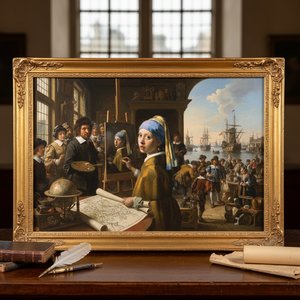
A Legacy of Light and Life: The Journey of Pieter Pietersz
In the heart of the Flemish Golden Age, amidst the bustling commerce and burgeoning creativity of Antwerp, a master was born who would forever capture the pulse of Northern European life. Pieter Pietersz (1540–1603) emerged from a lineage deeply rooted in the artistic soil of Belgium, the son of the renowned Pieter Aertsen. Growing up in an era where art and trade were inextricably linked, Pietersz did not merely inherit a name; he inherited a vision. While his father was celebrated for grander, often complex allegories, the younger Pietersz found his calling in the intimate and the immediate. His life was a masterful navigation of the shifting tides of the Dutch Renaissance, moving from the religious fervor of Haarlem to the mercantile sophistication of Amsterdam.
The trajectory of his career was shaped by both necessity and profound talent. As noted by the contemporary chronicler Karel van Mander, Pieters_z’s early professional path was influenced by the availability of commissions. While he possessed the technical prowess for large-scale religious narratives—as evidenced by his early works in Haarlem between 1569 and 1583—he strategically turned toward portraiture and genre painting. This transition allowed him to secure a steady patronage, transforming him from a mere painter into a respected figure of the social fabric. His marriage to Magdalena Pietersz, daughter of a Haarlem glass painter, further wove him into the very tapestry of the Netherlandish artistic community, creating a domestic life as colorful and interconnected as his canvases.
The Mastery of the Market and the Soul
To look upon a work by Pieter Pietersz is to step into the vibrant, noisy, and sensory-rich world of the 16th-century marketplace. He possessed an uncanny ability to translate the chaotic energy of urban life into structured, luminous compositions. His market scenes are not merely depictions of commerce; they are celebrations of abundance and human interaction. Through a meticulous application of color and light, he captured the glint of fresh produce, the texture of woven goods, and the subtle expressions of the common folk navigating the stalls.
Beyond the bustling streets, Pietersz’s mastery extended to the quiet dignity of portraiture. In these works, one finds a profound psychological depth. He moved beyond simple likeness, utilizing the techniques of the Dutch Renaissance to imbue his subjects with a sense of character and permanence. His ability to balance the fiery originality seen in his guild commissions with the delicate precision required for individual portraits established him as a versatile titan of his age. This duality—the ability to capture both the grand spectacle of a guild celebration and the quiet introspection of a single face—is what defines his enduring historical significance.
An Enduring Artistic Lineage
The impact of Pieter Pietersz extends far beyond the frames of his individual paintings. He was a cornerstone of an artistic dynasty that helped define the visual language of the Low Countries. His influence can be traced through several key facets of his life and legacy:
- Familial Influence: As the elder brother to Aert and Dirk Pietersz, and the grandfather to Dirck van Santvoort, he sat at the center of a family tree that nourished generations of Flemish and Dutch talent.
- The Antwerp-Amsterdam Connection: His movement between these two pivotal cities allowed him to bridge the gap between the traditional Flemish style and the emerging Dutch realism.
- Cultural Recognition: Known affectionately in historical records as "jonge lange pier," a nod to his father’s famous moniker, he carried the weight of his heritage while carving out a distinct identity as a wealthy merchant-artist.
By the time of his death in Amsterdam in 1603, Pieter Pietersz had achieved much more than financial success; he had become a chronicler of an era. His works remain vital touchstones for understanding the transition from the late Middle Ages to the dawn of the Dutch Golden Age, reminding us that even in the simplest market scene, there is a profound beauty waiting to be discovered by the observant eye.
Küsimused ja vastused
Kas Pieter Pietersz kohta on olemas kronoloogiline ülevaade?
Pieter Pietersz karjäär avaneb perioodide kaupa kunstniku Kronika lehel: teoste horisontaalne ajajoon, mis on jaotatud karjääriperioodide peatükkidesse.
Millist tundu Pieter Pietersz teosed väljendavad?
Kunstniku Meetliku tuju tuba lehel on Pieter Pietersz teosed koondatud vastavalt nende atmosferile.
Kas kunstniku Pieter Pietersz teoste 3D-virtuaaltuuri on saadaval?
Pieter Pietersz teoseid saab vaadata 3D-galeriis tema 3D muuseum lehel.