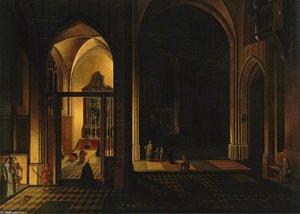
A Master of Light and Architecture: The Legacy of Pieter Neeffs the Elder
In the heart of the Flemish Baroque era, amidst the bustling, intellectually vibrant streets of Antwerp, emerged a painter whose brush possessed the unique ability to transform cold stone into breathing, atmospheric spaces. Pieter Neeffs the Elder, a name synonymous with the grandeur of architectural painting, did not merely depict buildings; he captured the very soul of sacred and secular interiors. While the exact details of his earliest years remain shrouded in the mists of the late sixteenth century, his presence in the Antwerp Guild of Saint Luke by 1610 marks him as a cornerstone of the city's artistic golden age. Born into a period of profound religious and political transformation, Neeffs developed a style that bridged the gap between meticulous structural accuracy and the emotive, dramatic lighting characteristic of the Baroque movement.
The artistry of Neeffs was deeply rooted in the traditions of his contemporaries, yet he carved out a niche that was entirely his own. He drew significant inspiration from the Dutch architectural masters, particularly Hendrik van Steenwijk the Elder and the Younger, whose precision in rendering perspective provided a foundation for his own explorations. However, where others might have focused solely on the geometry of a room, Neeffs sought the interplay of light and shadow. He became particularly celebrated for his nocturnal church interiors, compositions that utilized dual light sources to create a sense of profound mystery and reverence. In these works, the flickering glow of a candle or the soft moonlight filtering through a high clerestory window serves to animate the vast, silent vaults of cathedrals, inviting the viewer to step into a world of quiet contemplation.
The Collaborative Spirit and Artistic Innovation
One of the most fascinating aspects of Neeffs’ career was his ability to weave himself into the broader tapestry of the Antwerp art scene through collaboration. He was not an isolated creator but a central figure in a network of masters. His technical prowess in rendering complex architectural frameworks was so highly regarded that he often invited leading painters of his day to contribute the staffage—the small human figures and lively details—to his compositions. This collaborative method allowed for a synthesis of talents, where Neeffs provided the structural stage upon which other masters could perform their narrative dramas, resulting in works of unparalleled depth and complexity.
Beyond the canvas, Neeffs’ life was marked by a dedication to both family and civic duty. Alongside his brother, Gillis Neeffs, he established a productive studio that became a hub for artistic instruction, passing his techniques down to siblings such as Catharina and Jan Peeters I. This commitment to lineage ensured that the meticulous standards of Flemish architectural painting would endure through subsequent generations. Furthermore, his skill extended beyond the purely aesthetic; his ability to render precise detail earned him prestigious commissions from the authorities in Antwerp, including the creation of detailed maps following significant local conflicts. Such versatility highlights a man whose eye for detail was as much a tool for historical documentation as it was for artistic expression.
A Lasting Impression on the Baroque Canon
The historical significance of Pieter Neeffs the Elder lies in his role as a pioneer of a specialized genre. Before his emergence, the depiction of church interiors in Flanders had been relatively uncommon. Through his innovations, he helped establish the architectural interior as a legitimate and highly sought-after subject in its own right. His ability to manipulate light to evoke emotion—transforming a static room into a dynamic, atmospheric experience—prefigured many of the dramatic techniques that would define the later Baroque period.
Today, when we gaze upon his surviving works, such as his evocative depictions of the Antwerp Cathedral, we see more than just historical records of vanished or altered spaces. We witness a masterclass in perspective and luminosity. His legacy is found in every shadow that stretches across a painted nave and every beam of light that illuminates a silent altar. Through his meticulous devotion to the architecture of the soul, Pieter Neeffs the Elder remains an essential figure for anyone seeking to understand the profound intersection of light, space, and spirituality in seventeenth-century European art.
Küsimused ja vastused
Kas kunstniku Pieter The Elder Neeffs teoste 3D-virtuaaltuuri on saadaval?
Pieter The Elder Neeffs 3D muuseum on leht, mis esitab kunstniku teoseid virtuaalses kolmemõõdimeses galeriis.
Kui populaarsed on Pieter The Elder Neeffs teosed?
Pieter The Elder Neeffs lehekülg Statistika esitab statistika, mis on arvutatud see veebileht loetletud kunstniku teostest.
Kas saan uurida Pieter The Elder Neeffs värvikasutust kõigis teostes?
Pieter The Elder Neeffs teoste väriprofiil on nähtav kunstniku Palettide genoom lehel.