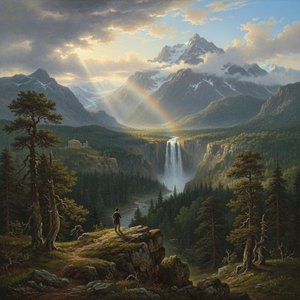
Xiang Shengmo: A Ming Dynasty Master of Serene Landscapes
Xiang Shengmo (項聖謨), born around 1597 and died in 1658, stands as a testament to the enduring beauty of Ming Dynasty landscape painting—a genre deeply rooted in Daoist philosophy and characterized by its pursuit of spiritual harmony. His artistic legacy resides primarily in his masterful depictions of mountains and water scenes, imbued with an understated elegance that reflects Wen Zhengming’s influence and embodies the core tenets of Shanshui (山水學) aesthetics.- Early Life & Family Background: Xiang Shengmo hailed from Xiushui (now Jiaxing), Zhejiang Province—a region renowned for its fertile lands and picturesque scenery. He descended from Xiang Yuanbian (項元汴), a celebrated collector of antiquities who fostered an appreciation for artistic excellence within his lineage. This familial connection undoubtedly shaped Xiang Shengmo’s formative years and instilled in him a profound understanding of cultural heritage.
- Training & Artistic Influences: Xiang Shengmo received formal training under Wen Zhengming (溫宗溟), arguably the most influential landscape painter of the Ming Dynasty. Wen Zhengming championed the Shanshui style—a contemplative approach prioritizing natural beauty and conveying spiritual contemplation—and Xiang Shengmo diligently absorbed these principles, establishing himself as a disciple committed to upholding artistic tradition.
Style & Technique: Embracing Wen Zhengming’s Legacy
Xiang Shengmo's artistic vision was firmly anchored in the Shanshui tradition championed by Wen Zhengming. He skillfully employed subtle brushstrokes and tonal variations to capture the ethereal quality of mountain landscapes—particularly snow-covered peaks—creating images that resonate with tranquility and evoke a profound connection to nature. His compositions favored asymmetrical arrangements, mirroring the organic rhythms of the natural world and prioritizing atmospheric perspective. The artist’s meticulous attention to detail—evident in depictions of pine trees and rocky outcrops—demonstrated his dedication to faithfully representing the grandeur and subtlety of Shanshui scenery.
- Palette & Brushwork: Xiang Shengmo favored a restrained palette dominated by muted hues—primarily browns, grays, and whites—reflecting the subdued colors of winter landscapes. His brushstrokes were characterized by fluidity and spontaneity, conveying a sense of immediacy while simultaneously capturing the essence of Shanshui’s contemplative spirit.
- Compositional Considerations: Xiang Shengmo's paintings often incorporated elements of Feng Shui (風水學)—the Chinese belief in harmonizing with natural forces—reflecting his understanding of the interconnectedness between humanity and environment. The placement of rocks, trees, and water features was carefully considered to create balanced compositions that evoked feelings of serenity and contemplation.
Notable Works & Achievements Among Xiang Shengmo’s surviving paintings are “Autumn Landscape” (1654) and “Pine Trees (handscroll)”—both celebrated for their masterful execution and evocative portrayal of Shanshui aesthetics. These works exemplify his ability to distill the spirit of Daoist philosophy into visual form, capturing not merely the appearance of mountains and water but also conveying a deeper sense of spiritual harmony. Xiang Shengmo’s paintings are held in prestigious collections worldwide, serving as enduring reminders of Ming Dynasty artistic excellence and demonstrating his contribution to Shanshui painting's canon.
Historical Significance & Legacy Xiang Shengmo’s work represents a pivotal moment in the history of Chinese landscape art—solidifying Wen Zhengming’s influence and establishing Shanshui style as a dominant aesthetic force during the Ming Dynasty. His paintings continue to inspire artists today, demonstrating the timeless appeal of contemplative observation and artistic fidelity to nature. Xiang Shengmo's legacy resides not only in his individual masterpieces but also in his embodiment of Daoist ideals—a testament to the enduring power of art to elevate consciousness and foster a profound appreciation for the beauty of the natural world.
Küsimused ja vastused
Kas saan uurida Xiang Shengmo värvikasutust kõigis teostes?
Xiang Shengmo teoste väriprofiil on nähtav kunstniku Palettide genoom lehel.
Kuidas leian teatud teemal Xiang Shengmo teoseid?
Et leida kunstniku Xiang Shengmo teoseid teatud teemal, kasutage kunstniku Märksõnade kaupa lehte, kus teosed on grupeeritud märksõnade järgi.
Millist tundu Xiang Shengmo teosed väljendavad?
Xiang Shengmo teoseid saab sirvida meeleheaku järgi tema Tunnetunoodete tuba lehel, kus teosed on grupeeritud vastavalt nende loovitud tunnetele.