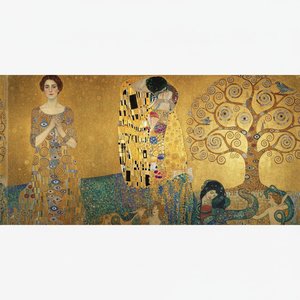
1907. Acrylic On Canvas, 430.0 x 300.0 cm.

§ 1Luettelotiedot

- 430.0 x 300.0 cm


§ 2Abstrakti
Keräilykohteen kuvaus
Executed in Art Nouveau style, *Philosophy* showcases Klimt’s signature blend of symbolism and realism. Its asymmetrical composition features intertwined nude figures representing stages of life, contrasted by a vast sky with a sphinx motif. The color palette utilizes earthy tones accented by gold leaf, enhancing the painting's opulent visual impact.
 Lue lisää
Taiteilijan elämäkerta
Gustav Klimt (1862-1918) oli Wienin taiteilija, joka loi upean Art Nouveau -tyylin kultaisella vuosikymmenellä. Tunnettu 'Suudelmasta' ja sensuaalisista naiskuvista.
§ 3Kommentointi
Gustav Klimt’s Philosophy (Final State): A Symphony of Symbolism and Controversy
Gustav Klimt's *Philosophy*, a painting that embodies the essence of symbolism and controversy, stands as a defiant emblem of Art Nouveau’s rebellious spirit. Created between 1899 and 1907 for the University of Vienna’s Great Hall ceiling project—a commission fraught with expectation and critique—this monumental artwork transcends mere visual representation to grapple with profound philosophical questions about existence itself.
- The Visionary Composition: Klimt eschewed academic conventions, opting instead for an asymmetrical arrangement that immediately captivated and unsettled viewers. The left side depicts a procession of nude figures representing humanity’s lifecycle—from infancy to old age—a deliberate challenge to idealized depictions of the human form prevalent in his time. Conversely, the right hemisphere is dominated by a vast expanse of sky punctuated by a colossal sphinx, symbolizing mystery and the unknowable dimensions of reality.
- Art Nouveau Technique: Klimt’s masterful execution showcases the hallmarks of Art Nouveau—a style characterized by flowing lines, organic forms, and opulent ornamentation. He employed tempera on canvas, meticulously layering gold leaf onto textured surfaces to create a shimmering visual experience that mirrored the richness of Byzantine mosaics. This technique wasn't merely decorative; it served as a conduit for conveying spiritual depth and elevating the artwork beyond the mundane.
- Symbolic Resonance: The painting’s core thematic concern revolves around philosophy—understood not as rational inquiry but as an embrace of paradox and contemplation. At its heart lies a woman figure, partially veiled in darkness, representing wisdom and knowledge. Klimt deliberately obscured her face, fostering an aura of enigma and prompting viewers to confront the complexities inherent in seeking understanding.
- Historical Context & Criticism: The initial reception of *Philosophy* was overwhelmingly negative within Austria’s artistic circles. Critics denounced it as sexually provocative and deemed unsuitable for academic spaces—a judgment fueled by anxieties surrounding societal morality. Despite this vehement opposition, Klimt secured international acclaim thanks to a prestigious award at the Paris World Exhibition in 1900.
- Legacy & Preservation: Tragically, *Philosophy* perished during the devastation of World War II, leaving only preparatory sketches and photographic documentation as tangible reminders of its grandeur. Nevertheless, it remains an enduring testament to Klimt’s artistic courage—a beacon of Symbolist innovation that continues to inspire admiration for its beauty and intellectual ambition. Today, reproductions of *Philosophy* can be found in prominent museums like Museo d’Arte Moderna Ca’ Pesaro and Schloss Immendorf, allowing audiences worldwide to experience the transformative power of Klimt's vision.
Kysymykset ja vastaukset
Kuka on luonut teoksen "Philosophy (final state)"?
"Philosophy (final state)" on Gustav Klimt:n luoma teos. Tällä sivulla olevat tiedot kuvaavat Gustav Klimt:n alkuperäistä työtä.
Miten teosta Gustav Klimt:n "Philosophy (final state)" voidaan käyttää sisustuksessa?
Gustav Klimt:n "Philosophy (final state)" on suositeltava Accent, mieluiten Living Room-tilassa. Käyttötarkoitus ja tila auttavat päättämään, mihin reproduktio sopii parhaiten.
Onko teos "Philosophy (final state)" tekijänoikeusvapaa?
Gustav Klimt:n "Philosophy (final state)" on vapaasti käytettävissä – tekijänoikeussuoja on päättynyt. Tämä tila määrittää, miten teoksen kuvaa saa käyttää uudelleen.


 Vaihda tulosteeseen


 Teoksille tai reproduktioille, joiden mikä tahansa sivu on suurempi kuin 105 cm (noin 41 tuumaa), kehys toimitetaan osina purettuna sarjana. Tämä menetelmä varmistaa turvallisen toimituksen ja ehkäisee vaurioita kuljetuksen aikana.