

1908. .

§ 1Luettelotiedot

§ 2Abstrakti
Taiteilijan elämäkerta
A German illustrator known for his elegant book plates. Discover the timeless beauty of Paul Thumann's art today.
1908. .
A German illustrator known for his elegant book plates. Discover the timeless beauty of Paul Thumann's art today.

1834 - 1908, Germany
Born on 5 October 1834 in Groß Schacksdorf-Simmersdorf, Paul Thumann was raised in the household of a teacher. His early inclinations did not immediately point toward the canvas. He initially sought a path in the technical sciences, enrolling at the engineering school in Glogau to pursue a career in that field. This practical direction, however, proved to be a temporary detour in a life that would eventually be defined by the visual arts.
The pull toward art eventually superseded his scientific interests. Between 1854 and 1856, Thumann sought formal instruction at the Prussian Academy of Arts in Berlin. This period of study provided the foundational discipline required for his future work as a painter and illustrator. He moved from the structured world of engineering toward the more fluid demands of graphic art and portraiture, setting the stage for a career that would span many decades and various mediums.
After honing his skills in the studios of Julius Hübner in Dresden, Thumann moved toward the academic rigor of the Weimar Saxon-Grand Ducal Art School. Under the guidance of Ferdinand Pauwels, his technical proficiency deepened, leading to his appointment as a professor in 1866. His career, however, was not confined to the quietude of the classroom. During the Franco-Prussian War, he stepped away from his academic duties to serve as a draftsman at the Prussian Third Army's headquarters, applying his precision to the demands of military documentation.
His reputation within the German academic circuit grew steadily. In 1875, he reached a significant professional milestone when he was appointed Professor at the Academy of Arts in Berlin. He held this prestigious position for over a decade, until 1887, shaping the next generation of artists through his instruction. His tenure in Berlin solidified his standing as a central figure in the institutional art world of the era.
Thumann’s life was marked by a restless movement across the European continent. His interests frequently drew him away from the academic circles of Berlin and Weimar toward the varied landscapes of Hungary and Transylvania. These excursions were often paired with more structured art-related tours through Italy and France, where he sought to refine his visual understanding. He also spent a period of time studying in England, a move that expanded his perspective beyond the Prussian tradition.
The pull of the Mediterranean proved particularly strong in his later years. Between 1887 and 1891, he made Italy his home, living there for several years. This period of residence allowed for a deeper immersion in the light and classical forms of the region. His reputation eventually crossed the Atlantic, reaching an audience far beyond the European sphere. In 1893, he exhibited his work Psyche at Nature's Mirror at the World's Columbian Exposition in Chicago. The piece caught the attention of the management of the White Rock Mineral Water, who subsequently purchased the reproduction rights to use the image as part of their logo.
Thumann’s output was defined by a versatility that bridged the gap between fine art and commercial illustration. He was a prolific illustrator, crafting plates for the literary works of Goethe, Tennyson, Chamisso, and Heine. His ability to translate text into visual form made him a frequent collaborator for publishers seeking elegance in their editions. This skill extended to his depictions of social and domestic life, seen in his various iterations of Die Gartenlaube produced in 1877, 1878, 1880, and 1882.
His reach extended beyond the printed page and into the realm of decorative arts. He produced several porcelain plaques, including a notable depiction of The Three Fates. In the realm of oil painting, his hand was seen in works such as The young suitor, which he signed and dated in 1871. His compositions often possessed a certain grace that appealed to both private collectors and commercial interests.
One of his most unexpected successes occurred through the medium of branding. His work Psyche at Nature's Mirror gained significant attention at the World's Columbian Exposition in Chicago in 1893. The image was so striking that the management of White Rock Mineral Water purchased the reproduction rights, adopting the work as a central element of their logo.
The final decade of Thumann's career was marked by a transition into significant institutional responsibilities. In 1892, he assumed the leadership of the Master Studio of Professor Julius Schrader, a position that solidified his influence within the academic circles of Berlin. His personal life during these years reflected a connection to the upper echelons of European society; he was married to a woman of the English nobility. This social standing was further extended through his family, as one of his daughters married the brother of the poet Algernon Swinburne.
As his career progressed, the elegance of his illustrative style began to face criticism for becoming increasingly facile. Despite this shift in critical reception, his presence in the German art scene remained steady until his passing. He died in Berlin on 19 February 1908.

AllPaintingsStore.com, “Paul Thumann, In the Bath (1908)”, https://allpaintingsstore.com/fi/art/in-the-bath-by-paul-thumann/ArtistReproduction/ (haettu 23 lokakuu 2026).
Käsinmaalattu öljyväri kankaalle haluamassasi koossa ja kehyksissä, taiteilijoidemme valmistamana tilauksesta. ( Vaihda tulosteeseen Siirry digitaaliseen kuvaan)
Se on määritelty tilauslomakkeessa reunamerkinnässä; kyseisen lomakkeen nykyinen sisältö kuuluu seuraavasti.
In the Bath
Replikaatin koko
Lisää yksityiskohtia, hienostuneisuutta ja enemmän aikaa tuotantoon
-
Teoksille tai reproduktioille, joiden mikä tahansa sivu on suurempi kuin 105 cm (noin 41 tuumaa), kehys toimitetaan osina purettuna sarjana. Tämä menetelmä varmistaa turvallisen toimituksen ja ehkäisee vaurioita kuljetuksen aikana.
Vaatii ammattimaista kokoamista – kyseessä ei ole tee-se-itse-tuote.
Sarja on koottava ja kangas kiristettävä kokeneen kehystysammattilaisen toimesta käyttäen puuliimaa (ei sisälly pakkaukseen), kangaspinnetteitä ja puristimia, jotta kehyksen kulmat pysyvät suorina liiman kuivuessa. Virheellinen kokoaminen tai epätasainen kankaan kiristys voi vaurioittaa teosta pysyvästi, eikä tällaiset vauriot ala takuun piiriin.
Kaikki massiivipuupalat sisältyvät, tarkasti mittojen mukaan leikattuina.
Kootaan mukana tulevilla ruuveilla sekä kulmaliitoksia varten tarvittavalla puuliimalla, jota ei toimiteta, joten se on hankittava kehystäjältä.
Vaatii ammattilaisvälineitä, jotka eivät sisälly pakkaukseen: kankaan venytyspihdit (kiristin) ja puristimet, joilla pidetään kehyksen puut suorassa liiman kuivuessa.
Tärkeää:
Kulmaliitoksissa tarvitaan puuliimaa, kehyksien osat on pidettävä puristimilla, kunnes liima on täysin kuivunut, ja koottuun kehykseen jännitettävän kankaan kiristämiseen tarvitaan kangaspenssipihti. Mikään näistä ei sisälly pakkaukseen. Suosittelemme varmistamaan kokeneen kehystäjän saatavuuden ennen tämän kokoisen kehyksen tilaamista.
-
Kiiltävä lakka (syventää värejä, suojaa valolta ja kosteudelta)
Esimerkkejä muokattavista asioista: Vaihda kasvot asiakkaan omaan valokuvaan; Lisää lemmikki (esim. vaihda kissa koiraan); Lisää taustalle piilotettu viesti; Muuta taustan maisemaa tai elementtejä.
Maailmanlaajuinen toimitus () 3–4 viikossa tavallisen 5 viikon sijaan. (20 marraskuu). Laadusta ei tingitä.
Maailmanlaajuinen toimitus () 5 viikon kuluessa. (27 marraskuu).
Sisältyy jokaiseen tilaukseen

Elevate your bathroom with icons from Van Eyck to Warhol. Find curated museum-quality art on AllPaintingsStore.com. Explore the full collection online.
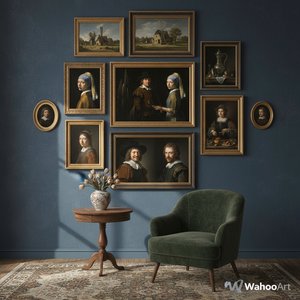
Uppoudu hollantilaisen barokin maailmaan! Tutustu Rembrandtin, Vermeerin ja muiden mestarien ikonisiin teoksiin. Taidetta, historiaa ja inspiraatiota kotiisi – löydä upeat reproduktiot AllPaintingsStore.comista.

Transform your bathroom with icons from Warhol to Renoir. Explore museum-quality masterpieces on AllPaintingsStore.com.

Explore a curated journey through iconic bathing scenes from myth to Impressionism. Discover the history of art's most sacred waters now.
 Lue lisää


 Teoksille tai reproduktioille, joiden mikä tahansa sivu on suurempi kuin 105 cm (noin 41 tuumaa), kehys toimitetaan osina purettuna sarjana. Tämä menetelmä varmistaa turvallisen toimituksen ja ehkäisee vaurioita kuljetuksen aikana.


