Rahat takaisin -takuu · 100 päivää Ilmainen toimitus ympäri maailman
449 587teokset 30 613taiteilijat 4 660museot 32kielet
Valuutta
    Kieli
      Ateljee · Perustettu 2015 · Pariisi, Ranska
      AllPaintingsStore
      allpaintingsstore.com
      Catalogue entry

      From outside

      Acrylic On Canvas.

      Fig. 1. Marcel Duchamp, From outside. Shown as the reproduction you are specifying: , .

      § 1Catalogue data

      § 2Abstract

      Keräilykohteen kuvaus

      Taiteilijan elämäkerta

      Marcel Duchamp: Filosofinen vallankumouksen tuoja, jonka Dadaismi ja kubismi muuttivat taidehistoriaa. Tutustu ikonisiin teoksiin kuten Kestävyyden Kuutio ja Siirtymä neitoon morsiameksi.

      § 3Commentary

      From Outside: A Dadaist Challenge to Perception

      Marcel Duchamp’s *From Outside* stands as an arresting testament to the radical spirit of Dadaism, a movement born from the disillusionment and trauma of World War I. This seemingly simple painting—a depiction of a doorway framed by brick arches—holds within it layers of conceptual complexity that continue to fascinate art historians and collectors alike. The artist’s deliberate choice of materials – weathered wood, nails – speaks volumes about his rejection of traditional artistic conventions and his desire to provoke viewers into questioning their assumptions about what constitutes ‘art.’

      Style and Technique: Embracing Chance and Minimalism

      Duchamp's approach defies easy categorization. He employs a minimalist style characterized by stark geometric forms and muted tones, prioritizing conceptual impact over visual ornamentation. The brushstrokes are deliberately absent, reflecting Duchamp’s belief that the artist’s role is not to represent reality but to disrupt it. This technique aligns perfectly with Dadaist principles of chance and spontaneity, mirroring the chaotic atmosphere of the era and rejecting the polished aesthetic of preceding movements like Impressionism. The painting's surface texture contributes to its overall mood—a sense of aged solidity juxtaposed with an unsettling emptiness.

      Historical Context: Reaction Against War’s Ideals

      Duchamp created *From Outside* in 1917, amidst the fervor of the Great War. Dada emerged as a vehement critique of militarism, nationalism, and bourgeois morality—values that seemed utterly absurd to artists grappling with the horrors unfolding across Europe. Artists like Duchamp sought to dismantle established artistic hierarchies and challenge viewers’ intellectual complacency. They embraced absurdity, irrationality, and provocation as tools for dismantling accepted norms. The doorway itself can be interpreted symbolically – representing passage into an unknown realm, a confrontation with the unsettling realities of the time, and ultimately, a refusal to passively accept societal dictates.

      Symbolism: The Doorway as Metaphor

      Beyond its formal qualities, *From Outside* operates on a deeper symbolic level. The doorway represents not merely physical access but also psychological exploration—a gateway into confronting uncomfortable truths and questioning preconceived notions. The nails securing the wooden frame serve as reminders of permanence and constraint, contrasting with the fluidity of perception and experience. Duchamp’s intention was to force viewers to reconsider their relationship with art and its role in shaping understanding of the world around them.

      Emotional Impact: A Quiet Disquiet

      Despite its understated appearance, *From Outside* possesses a palpable emotional resonance. The painting evokes a feeling of melancholy contemplation—a quiet acknowledgement of decay and loss alongside an invitation to consider alternative perspectives. Duchamp’s masterful manipulation of visual elements achieves this effect without resorting to explicit sentimentality. It's a piece that lingers in the mind long after viewing, prompting reflection on themes of isolation, vulnerability, and the enduring power of artistic provocation.

      Kysymykset ja vastaukset

      Mitä aihetta ja tunnelmaa Marcel Duchamp:n "From outside" yhdistää?

      Marcel Duchamp:n "From outside" esittää aiheita doorway, brick archway, wooden doors, nails, architecture, geometric form, avant-garde Calm tunnelmassa. Aihe ja ilmapiiri kuvaavat teosta yhdessä.

      Onko Marcel Duchamp:n "From outside" pysty-, vaaka- vai neliökompositio?

      Marcel Duchamp:n "From outside" on Portrait-muotoinen sommitelma. Suhteet kannattaa tarkistaa ennen tulostekoon valitsemista.

      Onko teos "From outside" tekijänoikeusvapaa?

      Marcel Duchamp:n "From outside" on on edelleen tekijänoikeuden alainen. Tämä tila määrittää, miten teoksen kuvaa saa käyttää uudelleen.
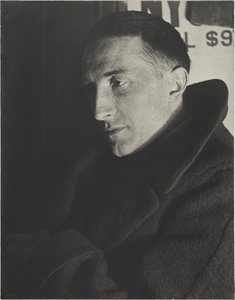
      § 4The artist

      Marcel Duchamp

      Marcel Duchamp

      1887 - 1968, Ranska

      Quick facts about Marcel Duchamp

      • Artistic Movement Or Style:
        • Kubismi
        • Dadaismi
      • Artists Or Movements Influenced By This Artist: ['Kubismi']
      • Date Of Birth: 28 heinäkuuta 1887
      • Date Of Death: 2 oktoberia 1968
      • Full Name: Marcel Duchamp
      • Nationality: Ranskalainen-Amerikkalainen
      • Notable Artworks:
        • Fontana
        • L.H.O.O.Q.
        • Suuri lasi
      • Place Of Birth: Blainville, Ranska

      Taiteilijan elämäkerta

      Marcel Duchamp: A Revolutionary Spirit

      Marcel Duchamp, born Henri-Robert-Marcel Duchamp in 1887 in Blainville-Crevon, Normandy, was more than an artist; he was a philosophical provocateur who fundamentally altered the course of modern art. His early life, though seemingly conventional – nurtured within a family that appreciated artistic expression with both brothers pursuing successful careers as artists – hinted at the iconoclasm to come. Duchamp initially pursued formal training, mastering traditional techniques and experimenting with post-impressionist styles. However, this academic foundation served not as an end in itself, but as a springboard for questioning the very nature of art, its purpose, and its definition. He wasn’t content merely to depict the world; he sought to challenge how we perceive it, and what constitutes artistic value. This restless intellectual curiosity would become the defining characteristic of his prolific career.

      Early Artistic Explorations: Cubism and Impressionism

      Duchamp's initial foray into art began with a fascination for Impressionism, absorbing influences from artists like Monet and Sisley. He diligently honed his painting skills, capturing fleeting moments of light and color with meticulous detail – a technique that would later inform his approach to more conceptual endeavors. Yet, he quickly recognized the limitations of representational art, perceiving it as an attempt to impose order onto a chaotic reality. This realization propelled him toward Cubism, spearheaded by Picasso and Braque, where he embraced fragmented forms and multiple perspectives. *Portrait of Chess Players* (1911) exemplifies this stylistic shift, demonstrating Duchamp’s willingness to experiment with innovative visual strategies. The influence of Cézanne's geometric simplification further solidified his commitment to exploring new artistic possibilities.

      The Dadaist Rebellion: Challenging Artistic Conventions

      The horrors of World War I profoundly impacted Duchamp’s worldview, fueling a deep disillusionment with societal values and artistic traditions. He abandoned academic pursuits altogether, joining the ranks of Dadaists – artists who vehemently rejected logic, reason, and bourgeois morality. This movement sought to dismantle established norms and expose the absurdity of cultural pretensions. Within Dadaism, Duchamp unleashed his subversive genius, rejecting beauty as an aesthetic criterion and prioritizing conceptual provocation. His aim wasn’t to create aesthetically pleasing objects; it was to disrupt viewers' perceptions and incite critical reflection. The infamous *Fountain* (1917), a porcelain urinal signed “R. Mutt,” epitomized this radical stance—a deliberate affront to artistic conventions that sparked considerable controversy and cemented Duchamp’s place in art history.

      The Birth of Conceptual Art: Beyond Representation

      Duchamp's groundbreaking contribution to the art world was arguably his pioneering role in establishing Conceptual Art. He dismantled the traditional distinction between artwork and object, arguing that the artist’s idea—the concept behind the work—was paramount. This perspective fundamentally shifted artistic priorities away from visual appearance toward intellectual inquiry and philosophical exploration. Works like *The Large Glass* (1915–1923), a monumental assemblage incorporating glass panels, mirrors, and enamel paint, exemplify this preoccupation with complex symbolism and intricate craftsmanship. The meticulous construction of the Glass underscored Duchamp’s belief in the transformative power of artistic process—a deliberate rejection of spontaneous creativity in favor of carefully considered conceptual frameworks.

      Legacy and Enduring Influence

      Marcel Duchamp's impact on subsequent generations of artists is undeniable. He irrevocably altered our understanding of art, advocating for a shift from visual representation to intellectual contemplation. His unwavering conviction that art should reside in the mind—not merely in the eye—continues to inspire artists today.
      • Cubism: Early exploration of fractured forms and spatial representation.
      • Dadaism: Rejection of logic, reason, and traditional artistic values in response to World War I.
      • Conceptual Art: Emphasis on the idea behind the artwork rather than its aesthetic qualities.
      He remains a central figure in discussions about art’s role in society, his legacy resonating powerfully within contemporary artistic discourse. Duchamp's unwavering commitment to questioning established norms solidified his position as one of the most influential artists of the 20th century—a true visionary who reshaped the landscape of modern art forever.

      § 5Comparanda

      § 6Questions

      Pikaista tietoa

      • Location: MoMA, New York
      • Artistic style: Irrational; Challenging conventions
      • Notable elements or techniques: Brick archway; Wooden doors; Nails
      • Year: 1917
      • Influences: Cubism
      • Artist: Marcel Duchamp

      § 7Cite this entry

      AllPaintingsStore.com, “Marcel Duchamp, From outside”, https://allpaintingsstore.com/fi/art/marcel-duchamp-from-outside-8EWLEV-en/ArtistReproduction/ (accessed 2 lokakuu 2026).

      § 8The reproduction

      Käsinmaalattu öljyvärinen jäljennös

      Käsinmaalattu öljyväri kankaalle haluamassasi koossa ja kehyksissä, taiteilijoidemme valmistamana tilauksesta. ( Vaihda tulosteeseen Siirry digitaaliseen kuvaan)

      It is specified on the order sheet in the margin; the present state of that sheet reads as follows.

      From outside

      Reproduktiotekniikka

      Replikaatin koko

      -

      Kokenut huipputaiteilija

      Lisää yksityiskohtia, hienostuneisuutta ja enemmän aikaa tuotantoon

      -

      Reproduktion kehystysvaihtoehdot

      -

      -

      Teoksille tai reproduktioille, joiden mikä tahansa sivu on suurempi kuin 105 cm (noin 41 tuumaa), kehys toimitetaan osina purettuna sarjana. Tämä menetelmä varmistaa turvallisen toimituksen ja ehkäisee vaurioita kuljetuksen aikana.

      Vaatii ammattimaista kokoamista – kyseessä ei ole tee-se-itse-tuote.
      Sarja on koottava ja kangas kiristettävä kokeneen kehystysammattilaisen toimesta käyttäen puuliimaa (ei sisälly pakkaukseen), kangaspinnetteitä ja puristimia, jotta kehyksen kulmat pysyvät suorina liiman kuivuessa. Virheellinen kokoaminen tai epätasainen kankaan kiristys voi vaurioittaa teosta pysyvästi, eikä tällaiset vauriot ala takuun piiriin.

      • Kaikki massiivipuupalat sisältyvät, tarkasti mittojen mukaan leikattuina.

      • Kootaan mukana tulevilla ruuveilla sekä kulmaliitoksia varten tarvittavalla puuliimalla, jota ei toimiteta, joten se on hankittava kehystäjältä.

      • Vaatii ammattilaisvälineitä, jotka eivät sisälly pakkaukseen: kankaan venytyspihdit (kiristin) ja puristimet, joilla pidetään kehyksen puut suorassa liiman kuivuessa.

      Tärkeää:
      Kulmaliitoksissa tarvitaan puuliimaa, kehyksien osat on pidettävä puristimilla, kunnes liima on täysin kuivunut, ja koottuun kehykseen jännitettävän kankaan kiristämiseen tarvitaan kangaspenssipihti. Mikään näistä ei sisälly pakkaukseen. Suosittelemme varmistamaan kokeneen kehystäjän saatavuuden ennen tämän kokoisen kehyksen tilaamista.

      Nimilaatta

      -

      -

      Suojalakkaus

      Kiiltävä lakka (syventää värejä, suojaa valolta ja kosteudelta)

      -

      Mukauta taideteokseni

      Esimerkkejä muokattavista asioista: Vaihda kasvot asiakkaan omaan valokuvaan; Lisää lemmikki (esim. vaihda kissa koiraan); Lisää taustalle piilotettu viesti; Muuta taustan maisemaa tai elementtejä.

      -

      Pikatoimitus

      Maailmanlaajuinen toimitus () 3–4 viikossa tavallisen 5 viikon sijaan. (30 lokakuu). Laadusta ei tingitä.

      -

      Pikatoimitus

      Maailmanlaajuinen toimitus () 5 viikon kuluessa. (6 marraskuu).

      Sisältyy hintaan

      Kokonaishinta

      € 229

      Included with every order

      • Ilmainen pikatoimitus ympäri maailman
      • Korkealaatuinen pellavakangas
      • Kattava kuljetusvakuutus
      • Tulliveron palautustakuu
      • Takuu täydellisestä värien vastaavuudesta
      • 100 päivän palautusoikeus (vain valmistusvirheet)
      • 100% rahat takaisin -takuu
      • Määräalennus tarjolla
      Order sheet