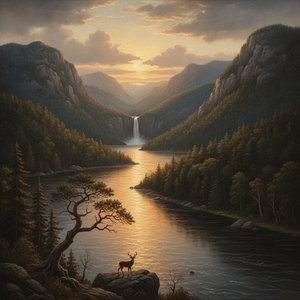
1825. Oil On Canvas. High Museum of Art.

§ 1Luettelotiedot


§ 2Abstrakti
Keräilykohteen kuvaus
Thomas Cole's "The Tempest" captures a dramatic American landscape scene, embodying the Hudson River School’s romanticism and exploration of nature's power. A masterpiece of 1826.
 Lue lisää
Taiteilijan elämäkerta
Thomas Cole (1801-1848) oli yhdysvaltalainen maalaaja, Hudson River Schoolin perustaja ja Amerikan luonnon mystisen kauneuden tunnetuin kuvaaja. Hänen teoksensa ovat täynnä henkistä syvyyttä ja allegorioita.
§ 3Kommentointi
The Tempest by Thomas Cole: A Vision of American Romanticism
Thomas Cole’s “The Tempest,” painted in 1825, isn't merely a landscape; it’s a profound meditation on the relationship between humanity and nature, a cornerstone of the Hudson River School movement, and a hauntingly beautiful embodiment of early American Romanticism. More than two centuries after its creation, this oil-on-panel masterpiece continues to resonate with viewers, inviting contemplation on themes of power, vulnerability, and the sublime—the awe-inspiring grandeur that simultaneously terrifies and elevates the human spirit.
The painting depicts a dramatic, almost apocalyptic scene set within the Catskill Mountains. A brooding sky, choked with swirling clouds and illuminated by flashes of lightning, dominates the composition. Below, a small clearing reveals two figures—a man and a woman—standing on a rocky outcrop, gazing out at an unseen horizon. The landscape itself is rendered with meticulous detail: ancient trees twisted by wind and weather, a turbulent river rushing through a narrow gorge, and distant peaks shrouded in mist. Cole’s masterful use of chiaroscuro – the dramatic contrast between light and dark – intensifies the scene's emotional impact, creating a palpable sense of tension and foreboding.
A Synthesis of European Tradition and American Identity
Cole, born in Bolton le Moors, England, in 1801, brought with him a deep appreciation for European artistic traditions, particularly those of the Romantic movement. However, he quickly developed a distinctly American sensibility, rejecting the prevalent historical and mythological subjects favored by his European counterparts. Instead, Cole turned his gaze to the untamed wilderness of his adopted homeland, seeking to capture its raw beauty and spiritual significance. “The Tempest” exemplifies this shift—it’s not a depiction of a biblical scene or a classical allegory, but rather an intensely personal response to the grandeur of the American landscape.
The painting's composition is deliberately ambiguous, inviting multiple interpretations. The figures in the foreground are dwarfed by the immensity of nature, suggesting humanity’s vulnerability and insignificance in the face of the sublime. Yet, their gaze—directed towards something beyond the viewer’s sight—hints at a deeper connection to the natural world, a yearning for transcendence. Cole skillfully employs symbolism throughout the work: the storm represents chaos and uncertainty, while the distant peaks symbolize aspiration and hope. The horse and birds scattered across the scene further emphasize the dynamism and energy of the natural world.
Symbolism and the Concept of the Sublime
Central to understanding “The Tempest” is Cole’s concept of the sublime—a term popularized by Edmund Burke in his 1757 treatise *A Philosophical Enquiry into the Origin of Our Ideas of Beauty*. The sublime, as Cole understood it, wasn't simply about beauty; it was about an overwhelming experience that evoked both terror and delight. It was a feeling triggered by encountering something vast, powerful, and beyond human comprehension—something that simultaneously threatened to overwhelm us and inspire awe.
The storm in “The Tempest” is a prime example of this concept. The sheer scale of the clouds, the ferocity of the wind, and the potential for destruction all contribute to a sense of overwhelming power. Yet, within this chaos, there’s also a strange beauty—a raw, untamed energy that captivates the viewer's imagination. Cole masterfully captures this duality, creating an image that is both terrifying and exhilarating.
A Legacy in Reproduction
Today, “The Tempest” remains one of Thomas Cole’s most celebrated works, housed at the High Museum of Art in Atlanta. High-quality reproductions allow art lovers to experience the painting's power and beauty firsthand, bringing its evocative imagery into their homes or offices. The meticulous detail, dramatic lighting, and profound symbolism continue to inspire admiration and contemplation. Reproductions are available through AllPaintingsStore.com, offering a tangible connection to this pivotal moment in American art history.
Beyond its aesthetic appeal, “The Tempest” serves as a reminder of the enduring power of nature—and our own place within it. It’s an invitation to pause, reflect, and appreciate the sublime beauty that surrounds us, even amidst the storms of life.
Kysymykset ja vastaukset
Onko Thomas Cole:n "The Tempest" pysty-, vaaka- vai neliökompositio?
Thomas Cole:n "The Tempest" on Landscape-muotoinen sommitelma. Suhteet kannattaa tarkistaa ennen tulostekoon valitsemista.
Onko Thomas Cole teos "The Tempest" tekijänoikeudeltaan vapaa (public domain), ja miksi?
Thomas Cole:n "The Tempest" on vapaasti käytettävissä – tekijänoikeussuoja on päättynyt. Tekijänoikeuden voimassaolo lasketaan taiteilijan kuolinvuodesta, joka oli 1848.
Mihin taidesuuntaukseen ja mihin aikakauteen Thomas Cole:n "The Tempest" kuuluu?
Thomas Cole:n "The Tempest" kuuluu Hudson River School-suuntaukseen ja sijoittuu tekijänsä luku aikakaudelle.


 Vaihda tulosteeseen


 Teoksille tai reproduktioille, joiden mikä tahansa sivu on suurempi kuin 105 cm (noin 41 tuumaa), kehys toimitetaan osina purettuna sarjana. Tämä menetelmä varmistaa turvallisen toimituksen ja ehkäisee vaurioita kuljetuksen aikana.