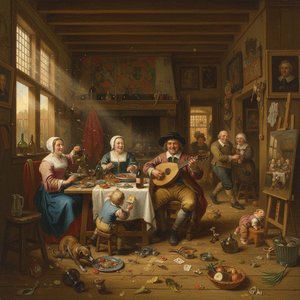
A Life Shaped by Light and Tradition
In the quiet corners of Leeuwarden, where the air of Friesland carries the weight of history, a young man began to observe the world with a precision that would define his life's work. Christoffel Bisschop did not merely see objects; he felt the way light rested upon them. His early years were guided by the hands of masters like Hendrik Schaaff and Jacob Schoemaker Doyer, men who taught him that a painter must first be an observer of truth. These lessons in detail and composition formed the bedrock of his talent, grounding him in the Dutch tradition even as his curiosity began to pull him toward broader horizons.
The path of his development led him from the familiar landscapes of the Netherlands to the bustling streets of Paris. It was here, under the guidance of Charles Gleyre, that his brush found a new language. The atmosphere of the French capital introduced him to different ways of handling color and light, an experience that would later earn him the nickname the painter of radiant effect. He returned to his roots not as a stranger, but as an artist enriched by the subtle shifts in tone and the soft glow of midday sun filtering through a window.
The Quiet Intimacy of the Interior
Bisschop found his greatest inspiration in the stillness of domestic life. He possessed a singular ability to transform a simple room into a stage for human emotion. His canvases often featured women lost in thought, perhaps reading a Bible or gazing out at a garden, their faces illuminated by a careful, luminous touch. In works such as The Interrupted Prayer, he captured the sudden break in a moment of devotion, while A Sunny Corner invited the viewer to sit beside a young woman working near an open window. These were not merely depictions of rooms; they were studies of peace and the passage of time.
His fascination with regional identity found its most profound expression in the town of Hindeloopen. He sought out the specific textures of this place, documenting the traditional costumes and customs that felt like echoes from a receding past. Through his meticulous rendering of these scenes, he preserved the visual memory of a society caught between eras. His technique relied on careful tonal gradations and a precise brushwork that brought the weight of fabric and the grain of wooden furniture to life.
A Legacy of Artistry and Connection
The artist's life was deeply intertwined with the lives of those around him, most notably his wife, Kate Bisschop-Swift. Their partnership was one of shared passion and mutual growth; she had been his student before they wed in Kensington, and together they navigated the artistic circles of The Hague. They lived in a villa named Frisia in Scheveningen, a home that became a center for their creative pursuits. This connection to other artists extended to his role as a teacher, where he nurtured the beginnings of talents like Bernard Blommers and Karel Klinkenberg.
His contributions to the Dutch art community were marked by active participation in organizations such as the Pulchri Studio and the Nederlands Kunstenaars Genootschap. Even as his fame grew through exhibitions in France and England, he remained anchored to the cultural life of his homeland. His work remains held within the Fries Museum, where the remnants of his workshop serve as a physical link to the man who found such profound beauty in the everyday.
Kysymykset ja vastaukset
Mistä Christoffel Bisschop on kotoisin?
Christoffel Bisschop on syntynyt Netherlands.
Voinko vierailla Christoffel Bisschop teosten virtuaalisessa museossa?
Virtuaalikäynti on mahdollista: Christoffel Bisschop -taiteilijan 3D-museo -sivu esittelee taiteilijan teoksia kolmiulotteisessa galleriassa.
Mistä löydän Christoffel Bisschop teokset ryhmiteltynä tekniikan mukaan?
Christoffel Bisschop:n teoksia voi selata tekniikan mukaan artistin Kaikki tekniikat -sivulla.