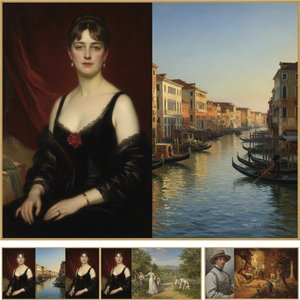
The Soul of the Highlands: The Artistry of John Blake MacDonald
In the sweeping vistas of the Scottish Highlands, where mist clings to rugged peaks and history whispers through ancient glens, lies the true essence of John Blake MacDonald. Born in Edinburgh in 1829, MacDonald emerged as a pivotal figure in nineteenth-century Scottish art, a painter whose brush captured not merely the topography of his homeland, but its very soul. His artistic journey was shaped by the profound Victorian fascination with folklore and the picturesque ideal, a period when the romanticized past held a powerful grip on the collective imagination. Through his work, the legends of the Jacobite era were breathed into life, transforming historical memory into enduring visual poetry.
MacDonald’s formal training provided him with the technical rigor necessary to execute such ambitious visions. After receiving an education at Eton College, he pursued advanced studies at the Glasgow School of Art, where he honed his mastery of drawing and composition. This academic foundation allowed him to bridge the gap between meticulous realism and the emotive power of the Romantic tradition. Influenced by the atmospheric brilliance of masters like Turner and Constable, MacDonald learned to prioritize emotional resonance over strict topographical accuracy, seeking instead to capture the ephemeral quality of light as it dances across the Isle of Skye and the dramatic shadows of the northern mountains.
Narrative Grandeur and Historical Resonance
While his landscapes are celebrated for their breathtaking beauty, MacDonald’s true distinction lies in his ability to weave historical narrative into the fabric of the natural world. He was a master of genre painting, specializing in scenes that reconstructed the pivotal, often tragic, moments of the Stuart dynasty’s struggle for sovereignty. His canvases serve as windows into the Jacobite heart, portraying the tension, heroism, and sorrow of a lost cause. In works such as “The Piper” and “The Gathering of the Clans,” he captures the communal spirit and the looming shadows of conflict that defined the era.
Perhaps his most poignant achievement is found in his depictions of historical tragedy, where the landscape itself becomes a participant in the human drama. In his masterpiece, “Glencoe, 1692,” MacDonald presents a haunting tableau of loss. The painting depicts a woman standing amidst fallen soldiers in the snow, her gestures conveying a profound sense of grief and spiritual searching. Here, the rugged terrain is not merely a backdrop but a silent witness to the carnage of war. This ability to imbue historical events with deep human empathy is what elevates his work from mere illustration to high art.
Technique, Symbolism, and Lasting Legacy
The technical brilliance of MacDonald’s oeuvre is found in his sophisticated use of light and texture. He was a skilled practitioner of glazing techniques, meticulously layering translucent washes of color over underlying pigments to achieve a luminous, ethereal glow. This method allowed him to convey the heavy moisture of the Scottish air and the subtle shifts in atmospheric depth. His brushwork, while precise, possessed a textural richness that captured the ruggedness of the heather-clad hills and the cold, stark reality of winter landscapes.
Beyond the visual, MacDonald’s work is steeped in symbolism, reflecting the rich tapestry of Scottish mythology and cultural heritage. Every element within his compositions—from the placement of a clan banner to the specific light hitting a mountain pass—serves to reinforce themes of identity, loss, and romantic longing. As a member of the Royal Scottish Academy, his contributions helped solidify the importance of historical genre painting within the Scottish canon. Today, the legacy of John Blake MacDonald lives on through his ability to evoke the enduring spirit of the Highlands, ensuring that the legends of the past remain vibrantly alive in the modern consciousness.
Kysymykset ja vastaukset
Miten voin seurata John Blake Macdonald's teoksia vuosi vuodelta?
John Blake Macdonald:n teoksista on saatavilla aikajana: taiteilijan Teosten aikajana -sivulla teokset on järjestetty luomisjärjestykseen.
Miten John Blake Macdonaldn taide kehittyi ajan myötä?
John Blake Macdonald-taiteilijan Ura kronikka on vieritettävä aikajana, joka esittää taiteilijan teokset kronologisessa järjestyksessä jaettuna uravaiheita vastaaviin lukuihin.
Mistä voin löytää tilastoja John Blake Macdonald teoksista?
Tiedot John Blake Macdonald:n teoksista löytyvät artistin Tilastot -sivulta.