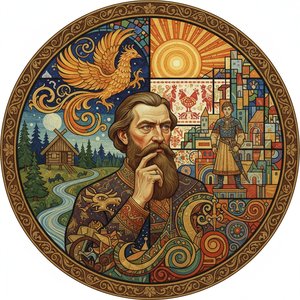
The Sculptor Echoing Russian Folklore
Sergey Timofeevitch Konenkov stands as a singular, monumental figure in the landscape of Russian sculpture, a creator whose hands breathed life into the ancient shadows of Slavic mythology. Often whispered about in art circles as “the Russian Rodin,” his work possesses a profound, visceral connection to the expressive vision of Auguste Rodin, yet it remains fiercely rooted in the soil of his homeland. Born in 1874 in the village of Karakovichi, Konenkov’s early life was steeped in the rich, oral traditions of the Russian peasantry. This formative upbringing, filled with the legends of forest spirits and ancient heroes, would eventually permeate every fiber of his oeuvre, transforming cold stone and wood into vessels of cultural memory.
His journey toward mastery was not without its tribulations. During his formal training at the Imperial Academy of Arts in St. Petersburg between 1892 and 1899, Konenkov found himself at odds with the rigid academicism of the era. He possessed a restless spirit that prioritized raw emotional expression over the sterile precision demanded by his instructors. This tension between tradition and innovation led to initial rejections from the Academy's elite, yet it was precisely this refusal to conform that would define his greatness. Supported by the visionary patronage of Savva Mamontov, Konenkov began to forge a path that looked beyond the classroom and toward the broader European avant-garde.
A Parisian Encounter and the Birth of Style
The turning point in Konenkov’s artistic evolution arrived in 1900, when he relocated to Paris. Immersed in the vibrant atmosphere of Impressionism and witnessing the revolutionary sculptural breakthroughs of Auguste Rodin, Konenkov found the vocabulary he had been seeking. The Parisian milieu taught him how to manipulate light, shadow, and texture to evoke psychological depth and human vulnerability. However, rather than abandoning his roots for French modernism, he performed a brilliant synthesis: he took the stylistic innovations of the West and applied them to the primordial themes of the East.
Upon his return to Russia in 1906, Konenkov emerged as a cornerstone of the Russian Art Nouveau movement. His work became a breathtaking blend of classical sculptural techniques and organic, flowing forms. He possessed a unique ability to use expressive gestures to depict narratives drawn from the deep well of Slavic folklore. Whether working in wood or bronze, his sculptures seemed to pulse with an internal life force, capturing the very essence of creatures like the Leshy or the mythic grace of Leda and the Swan. His style was characterized by:
- An emphasis on emotional resonance over anatomical perfection.
- The use of organic textures that mimicked the natural world.
- A profound integration of mythological symbolism into modern forms.
- A mastery of materiality, particularly in his evocative wood carvings.
Legacy and Historical Significance
As the decades progressed, Konenkov’s reputation grew from that of a controversial rebel to a national treasure. His ability to navigate the shifting political landscapes of the Russian and Soviet eras allowed him to maintain a level of creative continuity that few of his contemporaries could claim. He became a bridge between the old world of imperial tradition and the new era of Soviet monumentalism, earning prestigious honors such as the Golden Star of the Hero of Socialist Labour.
The historical significance of Sergey Konenkov lies in his role as a guardian of cultural identity. In an age of rapid industrialization and political upheaval, his sculptures served as enduring monuments to the spiritual heritage of the Slavic people. His works do not merely represent myths; they resurrect them, inviting modern viewers to reconnect with the primal, enchanted world of their ancestors. Today, his legacy continues to resonate through his monumental contributions to the art of sculpture, ensuring that the echoes of Russian folklore remain vibrantly alive in the halls of art history.
Kysymykset ja vastaukset
Missä ja minä vuonna Sergey Timofeevitch Konenkov on syntynyt?
Sergey Timofeevitch Konenkov syntyi Petrozavodskssä vuonna 1874.
Kuinka suosittuja Sergey Timofeevitch Konenkovn teokset ovat?
Sergey Timofeevitch Konenkov-artistille on olemassa Tilastot-sivu, joka esittää tilastoja artistin teoksista tämä sivusto-sivustolla.
Miten Sergey Timofeevitch Konenkovin ura on jaettu eri aikakausiin?
Sergey Timofeevitch Konenkov:n tuotanto esitellään kronologisesti taiteilijan Ura kronikka -sivulla, jossa teokset etenevät luomisjärjestyksessä luku luvulta.