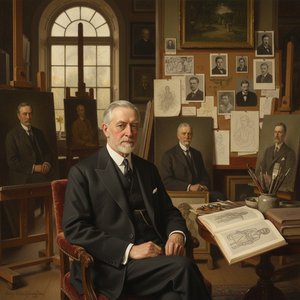
A Mariner's Eye on the Humber: The Life of William Daniel Penny
Born in 1834 amidst the salt-sprayed landscapes of Caistor, Lincolnshire, William Daniel Penny emerged as a profound voice in British marine art during the height of the Victorian era. This was an age defined by the relentless pulse of industrial expansion and a romantic fascination with the untamed sea. Penny’s artistic journey found its true north in the rugged coastal stretches of Yorkshire, particularly around Grimsby. It was here, amidst the rhythmic toil of fishing fleets and the shifting tides of the Humber Estuary, that he established himself not merely as a painter, and later as the proprietor of ‘The Artist’s Rest,’ but as a dedicated chronicler of maritime life. His early years in this maritime hub provided him with an intimate, firsthand understanding of the sea's dual nature—both its serene beauty and its terrifying volatility.
While much of his formal training remains shrouded in the mists of history, anecdotal accounts suggest that Penny was a master of self-study, refining his craft through keen observation and the mentorship of contemporary peers. His development as an artist was deeply intertwined with the geography of the Humber. The estuary became his primary muse, providing a constant stream of subjects ranging from humble fishing smacks to larger, more imposing vessels. He possessed a rare ability to look beyond the mere physical structure of a ship, seeking instead to capture the very soul of the maritime environment through meticulous detail and an advanced use of atmospheric perspective.
Luminism and the Mastery of Light
The true brilliance of Penny’s work lies in his embrace of Luminism, a stylistic movement that prioritized the subtle gradations of light to evoke deep emotional resonance. Influenced by the works of masters such as Frederic Church and Asher Durand, Penny moved away from stark photographic realism toward a more poetic interpretation of the natural world. He utilized diffused light and tonal shifts to convey the heavy humidity of a coastal morning or the dramatic tension of an approaching storm. This dedication to capturing the essence of atmosphere allowed his canvases to breathe with a palpable sense of life.
In his most celebrated compositions, one can witness this mastery of light and texture. His technique often involved:
- Atmospheric Depth: Using soft, hazy horizons to create a sense of vast, unending ocean.
- Tonal Gradations: Employing the subtle interplay of shadow and light to suggest the movement of clouds and the swell of waves.
- Realistic Texture: Capturing the weathered wood of hulls and the frothing whitecaps of turbulent seas with incredible precision.
A Lasting Maritime Legacy
The significance of William Daniel Penny’s oeuvre extends far beyond simple maritime documentation; his works serve as a visual archive of a vanishing way of life. Through masterpieces such as SS 'Prospero', which depicts the struggle of a trawler against turbulent waters, and Top Sail Schooner on the Humber, which offers a moment of profound tranquility, he captured the heartbeat of the British fishing industry. His ability to oscillate between the dramatic and the serene allowed him to document the full spectrum of the human experience at sea.
Today, his contributions are preserved in esteemed institutions like the Hull Maritime Museum, ensuring that his vision of the Victorian maritime landscape remains accessible to future generations. Penny’s legacy is one of profound connection—a bridge between the observer and the infinite horizon, reminding us of the enduring, powerful bond between humanity and the sea. His paintings remain not just studies of ships and water, but evocative meditations on the beauty, danger, and majesty of the maritime world.
Kysymykset ja vastaukset
Mistä voin selata William Daniel Penny's teoksia tunnelman mukaan järjestettynä?
William Daniel Penny-taiteilijan Tunnelmallinen huone kokoaa taideteokset tunnelman mukaan.
Mihin tyylisuuntauksiin William Daniel Penny kuului?
William Daniel Penny:n teoksia voi selata tyylisuuntien mukaan artistin Kaikki taidesuuntaukset -sivulla.
Mistä voin nähdä William Daniel Penny teosten väriprofiilin?
William Daniel Penny:n teosten värien käyttö tämä sivusto-sivustolla on tarkasteltavissa artistin Paletin sielunmaisema -sivulla.