


 Aperçu en situation
 Envoyer
 Partager
 Détails de l'œuvre
 Guide
Guide

 Télécharger l'image
 Articles similaires
 Radiographie
 Diaporama
 Q&A
Q&A Statistiques
File Cutters

- 31.0 x 47.0 cm


 Lire la suite
Giclées et impressions d'art
Impressions giclées ou sur toile de qualité musée, avec une production rapide et des finitions au choix. ( Commander la reproduction peinte à la main Passer au format numérique)




































Choisissez parmi nos formats prédéfinis qui respectent les proportions originales de l’œuvre.

Saisissez la largeur et la hauteur souhaitées pour qu'elles s'adaptent à votre cadre ou à votre mur. Une impression peut être recadrée, mais jamais agrandie au-delà de l'image originale ; ainsi, un format de forme différente entraînera la perte d'une partie de l'image. Nous vous envoyons une maquette numérique pour approbation avant toute impression. L'image présentée sur cette page ne montre pas le recadrage réel — seule la maquette le permet.
Livraison dans le monde entier () en 2 semaines au lieu des 4/5 semaines habituelles. (1 novembre)

Livraison express gratuite dans le monde entier

Toile de lin de qualité supérieure

Assurance transport complète

Garantie de remboursement des droits de douane

Garantie de fidélité des couleurs

Politique de retour de 100 jours (uniquement en cas de défaut)

Garantie de remboursement à 100%

Offre de tarifs dégressifs
 L'option verre n'est disponible que pour les dimensions inférieures à 110 cm.

File Cutters
Giclées et impressions d'art
Format de la reproduction
-


Prix total
€ 57
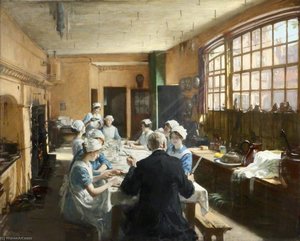
Industrial Setting and Women's Roles
The scene depicts a group of women seated at tables with sewing machines, engaged in the production of clothing items such as dresses. The atmosphere suggests an industrial setting where teamwork and collaboration are essential. This painting highlights the significant role women played in the workforce during this period, often working in factories and contributing to the war effort. Key aspects of the painting include the attention to detail in the depiction of the sewing machines and the factory environment. The women appear focused and engaged in their tasks, demonstrating the importance of their work. For more information on industrial-themed paintings, visit Otto Friedrich Wilhelm Lietz: Industry in the Visual Arts at the Grohmann Museum.Artist and Style
Edward Frederick Skinner was a notable artist known for his contributions to the representation of industrial scenes. His style often featured detailed depictions of machinery and factory settings, as seen in "File Cutters" and other works like Coiling and Setting Springs and Making Bessemer Steel. These paintings provide a glimpse into the industrial era, showcasing the evolution of manufacturing processes.- Visit Painting by 'Edward Frederick Skinner': File Cutters to explore more about this artwork.
- Learn about the American frontier and its impact on industrial development.
The "File Cutters" by Edward Frederick Skinner is a significant artwork that highlights the importance of women's roles in the industrial era. Its detailed depiction of factory life and machinery makes it a fascinating piece for art enthusiasts and historians alike.
Questions et réponses
Quel âge avait Edward Frederick Skinner lors de la création de « File Cutters » en 1917 ?
Lorsque « File Cutters » a été créé en 1917, Edward Frederick Skinner — né(e) en 1865 — était âgé(e) de 52 ans.
« File Cutters » est-il représentatif de l'œuvre habituelle de Edward Frederick Skinner ?
«File Cutters» dépeint industrial labor, women workers”, “factory life”, “victorian era”, “detailed art”, “social commentary”, “1917 history”, tandis que les thèmes récurrents de Edward Frederick Skinner sont industrial realism influence, victorian social critique", labor & class themes, war effort support, skinner's factory focus, documenting modern work, american industrial scene. La comparaison des deux montre comment l'œuvre s'inscrit dans la lignée des sujets habituels de l'artiste.
Quelle est l'intensité des couleurs de «File Cutters» de Edward Frederick Skinner ?
L'intensité des couleurs de « File Cutters » est Monochromatic. L'intensité décrit la force avec laquelle les couleurs apparaissent.
Œuvres similaires




Articles connexes

L'Âme Industrielle : 10 Chefs-d'œuvre Révélant la Beauté du Monde Moderne | AllPaintingsStore
Plongez dans l'âme industrielle de 10 chefs-d'œuvre emblématiques ! Découvrez les histoires fascinantes de Van Gogh, Monet et d'autres artistes ayant capturé la beauté brute du monde moderne. Reproductions de qualité musée sur AllPaintingsStore.com – Explorez la collection en ligne.

Maîtriser la solitude : les 25 chefs-d'œuvre emblématiques d'Edward Hopper
Explorez les 25 chefs-d'œuvre d'Edward Hopper et son réalisme unique. Découvrez toute la collection sur AllPaintingsStore.com.

The Enduring Muse: Women as Subject & Symbol in Art History
Explore the rich history of women in art – from iconic muses to groundbreaking artists. Discover feminist movements, global perspectives & reclaim female narratives with AllPaintingsStore.
Portrayals of Power & Perception: A Historical Survey of Women in Art
Explore the rich history of women in art – from iconic muses to groundbreaking artists. Discover feminist movements & reclaim female narratives with AllPaintingsStore. Expert insights for discerning collectors.

L'Esthétique Industrielle dans l'Art Moderne : De la Rupture à la Résonance Émotionnelle
Explorez l'esthétique industrielle dans l'art moderne : des origines philosophiques au brutalisme, en passant par les chartes du design. Découvrez comment la production a influencé les formes artistiques et collectionnez des œuvres emblématiques.