


 Aperçu en situation
 Envoyer
 Partager
 Détails de l'œuvre
 Guide
Guide

 Télécharger l'image
 Articles similaires
 Radiographie
 Diaporama
 Statistiques
untitled (792)

 Lire la suite
Giclées et impressions d'art
Impressions giclées ou sur toile de qualité musée, avec une production rapide et des finitions au choix. ( Commander la reproduction peinte à la main Passer au format numérique)




P118B €10

P118H €10

P118W €10

P438Z €10

P508JH €12

P508YH €12

P805H €10

P805Z €10

P919BZ €10

P919G €10

P919XJ €10

P959ZH €10

P968JZ €12

W106C €8

W218G €10

W218JH €8

W218Y €10

W307PJ €10

W316G €10

W316PJ €8

W316Y €10

W398PJ €8

W4111J €10

W500HY €15

W500JH €15

W692G €12

W849H €8

W940BG €15

W953PJ €8




Choisissez parmi nos formats prédéfinis qui respectent les proportions originales de l’œuvre.

Saisissez la largeur et la hauteur souhaitées pour qu'elles s'adaptent à votre cadre ou à votre mur. Une impression peut être recadrée, mais jamais agrandie au-delà de l'image originale ; ainsi, un format de forme différente entraînera la perte d'une partie de l'image. Nous vous envoyons une maquette numérique pour approbation avant toute impression. L'image présentée sur cette page ne montre pas le recadrage réel — seule la maquette le permet.
Livraison dans le monde entier () en 2 semaines au lieu des 4/5 semaines habituelles. (26 octobre)

Livraison express gratuite dans le monde entier

Toile de lin de qualité supérieure

Assurance transport complète

Garantie de remboursement des droits de douane

Garantie de fidélité des couleurs

Politique de retour de 100 jours (uniquement en cas de défaut)

Garantie de remboursement à 100%

Offre de tarifs dégressifs
 L'option verre n'est disponible que pour les dimensions inférieures à 110 cm.

untitled (792)
Giclées et impressions d'art
Format de la reproduction
-


Prix total
€ 56
A Cry from Within: Decoding Egon Schiele’s Untitled (792)
Egon Schiele's untitled (792) is not merely a painting; it’s a visceral outpouring of emotion, a raw and unflinching exploration of the human condition rendered in swirling lines and unsettling color. The work depicts a solitary female figure, dramatically posed with arms raised – an ambiguous gesture that can be interpreted as supplication, ecstasy, or even despair. Her body, painted in a striking shade of yellow, dominates the canvas, its form both vulnerable and defiant. This isn’t a celebration of the nude in the classical sense; rather, it's a psychological portrait, a window into an interior landscape fraught with tension and longing. The presence of two figures in the background, seemingly detached observers or perhaps participants in her emotional turmoil, adds to the painting’s enigmatic quality.
The Expressionist Tempest: Style and Technique
Schiele was a pivotal figure in Austrian Expressionism, a movement that sought to convey subjective emotion and experience rather than objective reality. untitled (792) exemplifies this approach through its distorted forms, jarring color palette, and energetic brushwork. The artist eschews traditional notions of beauty and anatomical accuracy, prioritizing instead the conveyance of inner turmoil. His lines are often jagged and angular, creating a sense of unease and instability. The yellow hue enveloping the figure is particularly significant; it can be seen as representing illness, decay, or perhaps even a feverish intensity of feeling – all themes frequently explored in Schiele’s oeuvre. He wasn’t interested in replicating what he *saw*, but rather translating what he *felt* onto the canvas. This painting isn’t about precise representation; it’s about emotional resonance.
A Life Etched in Art: Historical Context and Personal Turmoil
To understand Schiele’s work, one must consider the context of his tragically short life (1890-1918). Born into a world grappling with societal upheaval and personal loss – including the early death of his father to syphilis and a complex upbringing under the control of an uncle – Schiele channeled his experiences into art. His work often reflects themes of sexuality, mortality, and alienation. He was deeply influenced by Gustav Klimt, who served as a mentor, but quickly surpassed his teacher in terms of radical experimentation and emotional intensity. Schiele’s willingness to confront taboo subjects and depict the human body with such unflinching honesty led to controversy during his lifetime; he even faced obscenity charges for his work. Yet, this very boldness is what continues to captivate audiences today.
The Language of Gesture: Symbolism and Emotional Impact
The raised arms in untitled (792) are a powerful symbol open to multiple interpretations. They could represent a reaching out for salvation, a desperate plea for connection, or even an expression of liberation. The figure’s nakedness isn’t simply about physical exposure; it symbolizes vulnerability and emotional rawness. The painting doesn’t offer easy answers or comforting resolutions. Instead, it invites the viewer to confront their own anxieties and desires. It is a work that lingers in the mind long after viewing, prompting introspection and challenging conventional notions of beauty and representation. The overall effect is profoundly moving – a testament to Schiele's ability to translate the complexities of the human psyche onto canvas.
- Artist: Egon Schiele
- Birth Year: 1890
- Death Year: 1918
- Birth City: Vienna
- Birth Country: Croatia
Schiele’s oeuvre is marked by a preoccupation with themes of vulnerability, mortality and sexuality. His style—characterized by distorted forms and expressive lines—became synonymous with Expressionism.
- Notable Influences: Gustav Klimt
- Movement: Austrian Expressionism
Despite facing controversy during his lifetime, Schiele’s uncompromising artistic vision continues to inspire admiration and fascination.
- Key Themes: Sexuality, Mortality, Alienation
- Symbolic Gesture: Raised Arms – Supplication, Ecstasy, Despair
Questions et réponses
Quelle pièce est recommandée pour «untitled (792)» de Egon Schiele, compte tenu de ses couleurs ?
Grâce à sa palette de couleurs Tons neutres, l'œuvre « untitled (792) » s'intègre parfaitement dans une Salon.
Quelle est la notoriété de « untitled (792) » au sein du mouvement Expressionisme ?
« untitled (792) » est répertorié comme étant Reconnue parmi les œuvres du Expressionisme dans le catalogue.
Quelle palette de couleurs utilise "untitled (792)" ?
La palette de «untitled (792)» de Egon Schiele est décrite comme étant Tons neutres. Il s'agit d'une description concise des couleurs de l'œuvre.
Œuvres similaires


Biographie de l'artiste
Egon Schiele : Vie et Héritage
Jeunesse et Influences
- Né le 12 juin 1890 à Tulln an der Donau, en Basse Autriche, Egon Schiele a connu une enfance marquée à la fois par une inclination artistique et des difficultés personnelles.
- Son père, Adolf Schiele, était maître de gare, instaurant chez le jeune Egon une fascination pour les trains – un motif qui apparaîtra subtilement plus tard dans son œuvre.
- Le décès prématuré de son père à cause de la syphilis lorsqu'il avait 14 ans l'a profondément affecté, entraînant sa tutelle par son oncle maternel, Leopold Czihaczek.
- Czihaczek lui a apporté un soutien mais a également exercé une influence contrôlante, contribuant ainsi au paysage émotionnel complexe reflété dans l’art de Schiele.
Parcours Artistique et Développement
- La formation artistique de Schiele a commencé à la Kunstgewerbeschule (École des Arts et Métiers) de Vienne, mais il est rapidement passé à l’Akademie der bildenden Künste (Académie des Beaux-Arts).
- Il s'est rapidement désillusionné face à l’approche conservatrice de l’Académie, qu’il trouvait étouffante pour sa vision expressive. Il a finalement quitté la formation formelle.
- Ses influences précoces comprenaient Gustav Klimt, figure de proue de la Sécession viennoise, dont le style décoratif et son exploration du symbolisme résonnaient chez Schiele. Cependant, Schiele a rapidement développé un style distinctif.
- Ses premières œuvres présentaient souvent des portraits et autoportraits dérangeants, caractérisés par des figures déformées et une intensité émotionnelle.
Caractéristiques et Thèmes Clés
- L’art de Schiele est réputé pour son honnêteté brute et sa profondeur psychologique. Il a exploré sans crainte les thèmes de la sexualité, de la mort, de l'anxiété et de l'isolement.
- Son style distinctif se caractérise par des figures allongées, des poses contorsionnées et des lignes expressives qui transmettent un sentiment de vulnérabilité et de tourment émotionnel.
- Les autoportraits constituent une part importante de son œuvre, offrant des aperçus intimes dans son monde intérieur.
- Il a également créé de nombreux portraits d'autres personnes, les représentant souvent avec un réalisme sans complaisance et une perspicacité psychologique.
- La peinture de paysages a joué un rôle dans son travail, démontrant sa maîtrise de la forme et de la couleur, bien qu’elle soit moins centrale que ses œuvres figuratives.
Réalisations Majeures et Reconnaissance
- Malgré les censures et les défis juridiques (y compris une brève incarcération pour avoir été accusé de corruption infantile avec son art), Schiele a gagné la reconnaissance dans les cercles avant-gardistes de Vienne.
- Il a cofondé le Neues Wiener Kunstgruppe (Groupe d'Art Viennois Nouveau) en 1909, présentant son œuvre aux côtés d'autres artistes progressistes.
- Œuvres importantes comprennent Autoportrait avec physalis, Couple s’embrassant et Paysage de campagne (Kreuzberg près de Krumau).
- Au moment de sa mort prématurée, Schiele s'était établi comme une figure de proue de l'expressionnisme autrichien.
Signification Historique et Héritage
- Egon Schiele est décédé en 1918 pendant la pandémie d’influenza espagnole à l’âge de 28 ans, mettant fin prématurément à une carrière prometteuse.
- Son œuvre a profondément influencé les générations suivantes d'artistes, en particulier celles intéressées par l'exploration des thèmes psychologiques et le défi des normes artistiques conventionnelles.
- L’approche audacieuse de Schiele en matière de forme et de sujet reste pertinente pour les publics aujourd'hui, faisant de lui l'un des figures les plus importantes et les plus influentes de l'art du début du XXe siècle.
- Ses peintures sont aujourd'hui conservées dans les principales collections muséales du monde entier, et des reproductions de son œuvre sont largement disponibles, assurant ainsi la pérennité de son héritage artistique.
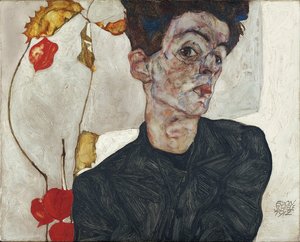
Egon Schiele
1890 - 1918 , Croatie
L'essentiel de l'artiste
- Artistes Influents: ['Gustav Klimt']
- Date De Décès: 1918
- Date De Naissance: 12 juin 1890
- Influences Artistiques: ['Expressionnisme autrichien']
- Lieu De Naissance: Vienne, Croatie
- Mouvement Artistique: Expressionnisme
- Nationalité: Autrichien(ne)
- Nom Complet: Egon Schiele
- Oeuvres Notables:
- Portrait avec physalis
- Couple s'embrassant
- Paysage de champ (Kreuzberg)
Articles connexes

Egon Schiele : Expressionnisme, Angoisse et la Condition Moderne – Une Exploration Approfondie
Explorez l'univers poignant d'Egon Schiele : expressionnisme, angoisse et condition humaine. Analyse approfondie de son œuvre, son contexte viennois et son héritage artistique. Découvrez un artiste majeur avec AllPaintingsStore.
Egon Schiele : Les 25 Œuvres Maîtresses d'un Artiste Expressionniste
Plongez dans l'univers poignant d'Egon Schiele avec les 25 œuvres incontournables de ce maître expressionniste. Découvrez son style unique, ses nus audacieux et la profondeur émotionnelle de ses portraits. Reproductions de qualité muséale sur AllPaintingsStore.com
Top 10 des Tableaux Célèbres Dominés par le Jaune Chrome : Art & Décor
Plongez dans le monde vibrant du jaune chrome à travers 10 tableaux célèbres ! Découvrez l'histoire de Van Gogh, Monet et d'autres maîtres impressionnistes. Trouvez l'inspiration déco et achetez des reproductions d'art de qualité muséale sur AllPaintingsStore.com.

Expressionnisme : Les 10 Chefs-d'œuvre qui ont Marqué l'Histoire de l'Art
Plongez au cœur de l'Expressionnisme avec les 10 œuvres majeures qui ont marqué ce mouvement puissant. Découvrez Munch, Kirchner, Kandinsky et plus encore. Reproductions d'art de qualité muséale sur – Explorez la collection !
Expressionnisme : 10 Chefs-d'œuvre Révolutionnaires pour une Décoration d'Art
Plongez au cœur de l'expressionnisme avec 10 chefs-d’œuvre emblématiques : Munch, Kirchner, Kandinsky… Découvrez les histoires et émotions derrière ces peintures révolutionnaires. Reproductions d'art de qualité muséale sur AllPaintingsStore.com !


